No items found.

Blog
Get Smart: Choosing the Best Customer Intelligence Platform

Bob Dimicco


Customer intelligence platform options have exploded in recent years, and picking the wrong one is an expensive mistake.
Here's a quick answer for data nerds who want the short version:
Platform TypeBest ForKey StrengthRevealAIQualitative research at scaleVerifiable AI interviews, trust-firstOutreachSales engagement & deal intelligence33B+ weekly signals, 81% deal accuracyDovetailResearch repositories & feedback2.3x ROI, 30 hrs saved/week per userSAS CI 360Enterprise marketing personalizationReal-time AI decisioning across channelsAmperityCustomer data unificationIdentity resolution, zero-copy lakehouseQualtricsLarge-scale sentiment & surveysEnterprise-grade market researchMeltwaterMarket & media monitoring270,000+ global news sources
The market for these tools has reached $3.1 billion in 2024 and is growing at 27% annually. That pace reflects a real problem: most organizations still can't answer basic questions about why their customers behave the way they do.
Quantitative data tells you what happened. Qualitative intelligence tells you why — and that's where most platforms fall short.
The deeper issue is data fragmentation. Customer signals live across CRMs, surveys, call recordings, feedback tools, and third-party data providers. Without a way to unify and verify those signals, insights become unreliable. Only 29% of sales professionals rate their data as "very accurate" — a staggering gap for teams making high-stakes decisions.
For market researchers and product teams, there's an added layer of risk: generic AI tools hallucinate, strip out context, and can't attribute findings back to real human sources. That's not a minor inconvenience — it erodes client trust and research credibility.
This roundup focuses specifically on research-grade customer intelligence — platforms built for data nerds who need speed and verifiability, not one at the expense of the other.
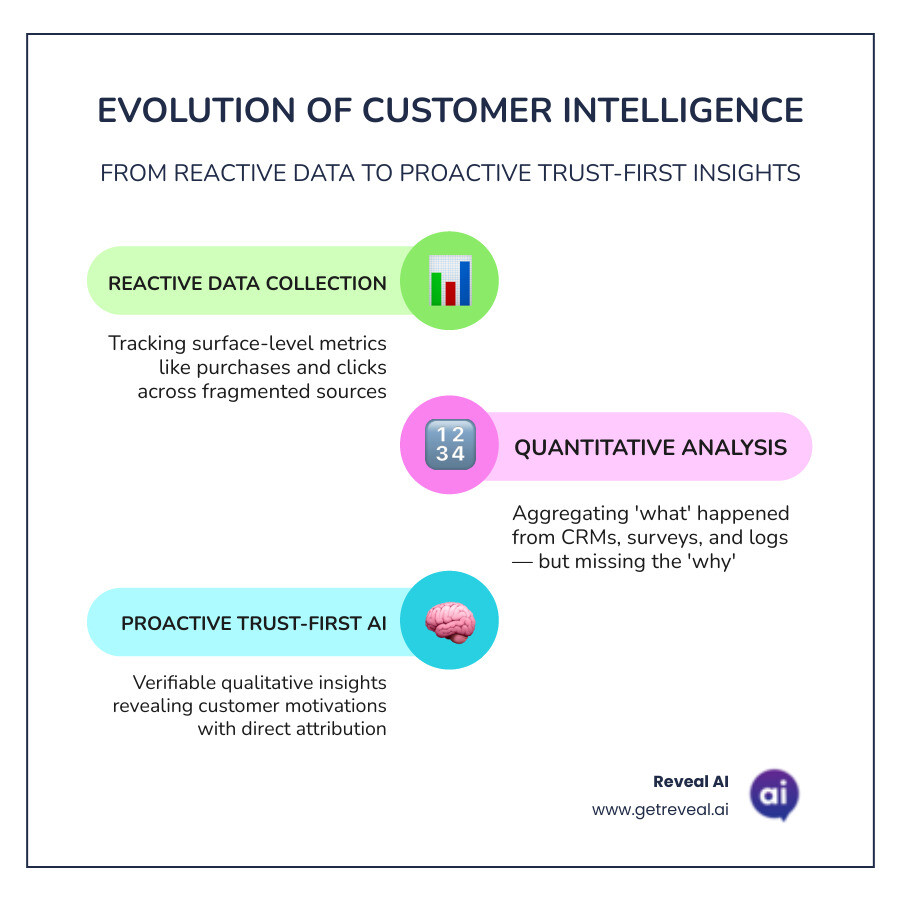

For those of us who live in the weeds of data, a Customer intelligence platform (CIP) isn't just another database. It is a "System of Insight." While a CRM tracks what a customer bought and a CDP aggregates their clicks, a true intelligence platform explains the motivations driving those actions.
According to Grand View Research, the global market for these platforms reached $3.1 billion in 2024. This growth is fueled by a shift from reactive data lookup to proactive account and audience intelligence. For those in Market Research, the challenge isn't getting more data—it’s getting data you can actually trust to build a strategy on.
A modern CIP must go beyond simple data aggregation. To be useful for research and product teams, it needs to handle the "messy" side of human feedback.
When we look at Use Case - Customer Research, we see that the most effective platforms don't just summarize; they provide a direct line to the customer's voice.
The Indispensable Role of Qualitative AI in a Comprehensive Customer Intelligence StrategyYou can't build a 360-degree view of a customer with numbers alone. If your "intelligence" is 100% quantitative, you're looking at a skeleton without the muscle. Qualitative AI breathes life into data by capturing the "why." It transforms a "4/10 satisfaction rating" into a specific, actionable narrative about a friction point in the user journey.
Data nerds hate "black box" insights. We want to see the work. This is why qualitative intelligence is becoming the cornerstone of the modern stack. It allows us to:
Salesforce's State of Sales data shows that reps spend less than 30% of their week actually selling, often lost in the "research" phase. A research-grade CIP automates this, providing deep context so teams can move straight to execution.
In the quest for speed, many teams have turned to generic AI tools. But for market researchers and analysts, "fast" is useless if it's "wrong." Building a trust-first stack means prioritizing platforms that offer verifiable qualitative signal coverage.
Forrester Research notes that companies acting on buying signals within the first week see conversion rates 2-3x higher. However, those signals must be accurate. Whether you are conducting Brand Awareness Research or testing a new product feature, the ROI of your intelligence platform is directly tied to the quality of the underlying data.
Generic AI is like a well-read intern who occasionally makes things up to sound smart. In a research environment, that’s a liability. We advocate for a "Walled Garden" approach to data integrity. This means the AI only analyzes the specific data you provide—your customer interviews, your survey results—and doesn't pull in outside noise or "hallucinate" trends that aren't there.
The Power of Customer-Centric Branding is built on these trusted insights. To maintain research rigor, look for platforms that meet these criteria:
A Customer intelligence platform shouldn't be a silo. It needs to play nice with the tools you already use. Whether you're pulling data from a data lakehouse like Snowflake via zero-copy sharing or pushing insights into a CRM like Salesforce, integration is key.
Our Product is designed to complement your existing infrastructure, not replace it. By using robust APIs, you can funnel qualitative insights directly into your dashboards, enriching your quantitative metrics with real human context.
How do you justify the cost of a CIP to your CFO? You point to the "Time-to-Insight" metric.
We believe the future of research isn't just about "more AI"—it's about better AI. Reveal AI is the leading AI-powered qualitative research platform designed specifically for the needs of data nerds, market researchers, and product teams.
We don't do generic. We provide a research-grade environment where you can conduct short, conversational AI interviews at scale. Our platform doesn't use voice input—avoiding the friction of recorded calls—but instead uses text-based, intelligent probing to get to the heart of customer motivations.
Why Reveal AI is different:
If you're ready to stop guessing and start knowing, you can find More info about Reveal AI services on our product page.
The transition from reactive data to proactive customer intelligence is no longer a luxury; for modern research and product teams, it is critical for success. While quantitative tools provide the "what," a research-grade Customer intelligence platform provides the "why" through verifiable qualitative insights.
When choosing a platform, "Trust first" should be your guiding principle. Avoid generic AI that sacrifices accuracy for novelty. Instead, look for solutions that offer deep integration, direct attribution, and a focus on data integrity. By unifying your research stack with high-quality qualitative AI, you turn scattered feedback into a powerful engine for business growth.
Key Takeaways:

.png)