

No items found.
Core Methods and the Process of Qualitative Data Analysis
To master qualitative data analysis, one must understand the various lenses through which unstructured data can be viewed. While traditional methods were developed in academic settings, modern market research requires these methods to be faster and more structured. Reveal AI’s AI-powered qualitative research platform enhances these core methodologies, delivering the rigor of academic research at the speed of business.
Comparative Overview: Qualitative vs. Quantitative Analysis
| Feature | Qualitative Analysis | Quantitative Analysis | RevealAI’s Hybrid Approach |
|---|---|---|---|
| Goal | To understand "Why" and "How" | To quantify "How many" | Deep "Why" at "How many" scale |
| Data Type | Text-based (Unstructured) | Numbers, stats (Structured) | Structured qualitative text |
| Sample Size | Small, deep-dive | Large, representative | Large-scale conversational AI |
| Flexibility | High—iterative process | Low—fixed variables | High—dynamic AI probing |
| Outcome | Thematic patterns & insights | Statistical significance | Verifiable, attributed themes |
Key Methodologies
- Thematic Analysis: This is perhaps the most flexible and popular method. It involves identifying recurring patterns or "themes" across a dataset. For example, if we are analyzing research feedback, we look for common pain points or desires.
- Grounded Theory: Unlike other methods that start with a hypothesis, grounded theory allows the theory to emerge directly from the data. It’s an iterative process of constant comparison, making it perfect for exploring new markets where you don't yet know what you don't know.
- Content Analysis: This approach provides a structured way to categorize and quantify qualitative information. Researchers use it to group content into words or phrases to identify emerging patterns.
- Discourse Analysis: This method goes beyond the surface of the words to examine written language in its social context. It helps researchers understand how language shapes power dynamics and cultural nuances.
- Narrative Analysis: Here, the focus is on the "story." Researchers analyze the sequence of events and the way people recount their experiences to understand their personal or brand identity.
Five Essential Steps in Qualitative Data Analysis
The transition from raw text to breakthrough insight follows a systematic path. When using an AI research platform like RevealAI, these steps are streamlined without sacrificing depth.
- Data Gathering via Conversational AI: We replace static, boring surveys with short, conversational AI interviews. This text-based approach allows for probing questions at scale, ensuring we capture the "why" from hundreds or thousands of participants simultaneously.
- Organization in a Walled Garden: Security is paramount. We organize and store all data within a walled garden data integrity model. This means your data is never used to train public models and remains isolated and secure.
- Axial Coding and Pattern Recognition: Using research-grade AI, we perform axial coding—making connections between categories and sub-categories. This identifies the relationships between different sentiments and product features.
- Insight Reporting with Attribution: A major risk of generic AI is "hallucination." We solve this by ensuring every insight is backed by direct quote attribution. This provides verifiable trust for stakeholders.
- Actionable Recommendations: Finally, we translate these patterns into strategy. Whether it's for brand awareness research or product development, the final step is telling the story of the data.
More info about AI-powered market research
Ensuring Rigor and Validity in Research
In qualitative research, we don't use "p-values," but we do have strict standards for truth. Ensuring rigor means moving beyond "gut feelings" to defensible science.
- Data Triangulation: This involves using multiple data sources or methods to corroborate findings. Within our platform, you might combine AI interview data with existing internal research insights to see if the stories align.
- Member Checking & Human Verification: To ensure accuracy, researchers can perform "member checking"—sharing findings with a subset of participants to see if the interpretation rings true. RevealAI supports this through human source verification.
- Reflexivity and Audit Trails: Researchers must practice reflexivity, acknowledging their own biases. Maintaining an audit trail of how codes evolved ensures the analysis is transparent and repeatable.
- Data Saturation Monitoring: We look for the point of data saturation, where new interviews no longer yield new insights. This tells us our sample size is sufficient.
- Ethical Considerations: Protecting participant privacy is not optional. We implement strict privacy guardrails to ensure all research meets global ethical standards.
- Peer Debriefing: Discussing analysis with colleagues helps uncover blind spots. Peer debriefing sessions act as a quality control measure for research integrity.
Visualizing and Reporting Qualitative Insights
A spreadsheet of 5,000 quotes is not an insight; it’s a headache. Effective reporting turns data into a narrative that stakeholders can actually use.
- Mind Maps and Thematic Networks: Visual tools like mind maps help us step back from the details to see the bigger picture. RevealAI generates these networks automatically to show how different themes interconnect.
- Salient Quotes: Nothing carries more weight in a boardroom than the actual voice of the customer. We use salient quotes to provide "meat" to the skeletal data of a report.
- Audience-Tailored Reporting: We know that a Product Manager wants different details than a CMO. Our reporting is modular—if your audience prefers numbers, we provide frequency charts; if they prefer interpretation, we provide deep-dive memos.
The Future of AI-Powered Research
The industry is at a crossroads. For decades, researchers chose between manual coding (accurate but slow) and legacy software like NVivo, ATLAS.ti, or MAXQDA (helpful for organization, but still labor-intensive).
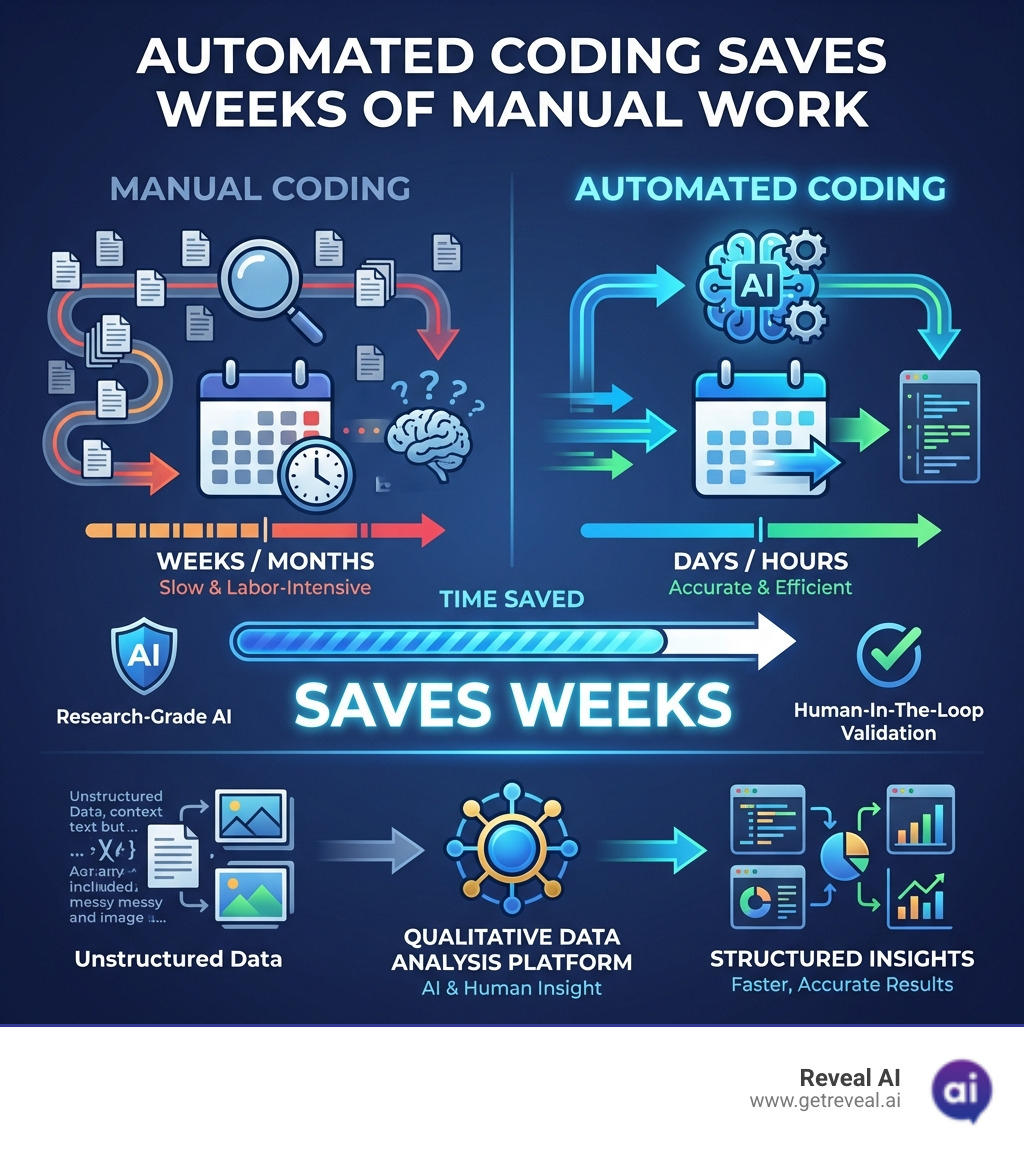
Manual qualitative data analysis can take weeks or even months. Experiments show that automated coding in specialized platforms is now just as accurate as manual coding, but it saves weeks of work. However, there is a massive difference between "Generic AI" (like ChatGPT) and "Research-Grade AI."
Manual vs. Automated Coding
Generic AI tools often suffer from "hallucinations"—making up quotes or missing the subtle nuance of a specific industry. RevealAI’s research-grade AI is built with guardrails specifically for market and product teams. We utilize augmented intelligence, which keeps the human researcher in the loop to ensure that the AI's speed is balanced with human intuition and context.
Overcoming Challenges with Research-Grade AI
The biggest barrier to adopting AI in Data analysis qualitative is trust. If you can’t prove where an insight came from, you can’t bet your product roadmap on it.
- Eliminating Bias: By using transparent, auditable AI, we reduce the "researcher bias" that often happens when a single person manually codes data based on their own preconceptions.
- Verifiable Trust: Every theme identified by RevealAI is linked back to the original text. You can click on a theme and see the exact quotes that created it. This "Walled Garden" approach ensures data security and absolute transparency.
- No "Black Box": Unlike models that scrape the public web, our platform operates on your specific project data. This prevents the "garbage in, garbage out" problem associated with generic models.
Conversational AI for qualitative research
Industry Applications and Mixed-Methods Integration
Qualitative data is most valuable when it solves real-world problems. For market research firms and product teams, this usually falls into three categories:
- Product Concept Testing: Before building, you need to know if the concept resonates. We provide rapid, structured feedback that tells you not just if they like it, but why.
- Market Research at Scale: Traditionally, you had to choose between a survey of 1,000 people (quant) or interviews with 10 people (qual). We allow you to do qualitative research at a quantitative scale.
- UX Research: Product teams use our platform to identify friction points in the user experience that metrics like "time on page" can't explain.
By combining these insights with quantitative data (like brand preference or market share), researchers can conduct true mixed-methods studies. For example, you might see a shift in brand preference (quant) and use RevealAI to instantly find the "why" (qual) hidden in the open-ended research responses.
AI for product concept testing
Best Practices for Modern Data Analysis Qualitative
To stay ahead in the market research industry, we recommend the following best practices:
- Trust First, Not Novelty First: Don't use AI just because it's new. Use it because it provides a verifiable, structured path to the truth.
- Implement Guardrails: Always ensure your tools have built-in protections against hallucinations and data leaks.
- Human-in-the-Loop: AI should handle the heavy lifting of organization and initial coding, but a human should always provide the final layer of business context and strategic interpretation.
- Avoid Generic Tools: Avoid using non-research-grade tools for client-facing work. The lack of attribution and potential for bias can damage your firm's reputation.
More info about market research services
Conclusion: Key Takeaways for Market and Product Researchers
Data analysis qualitative is no longer a slow, manual bottleneck. By embracing an AI-powered qualitative research platform, market researchers and product teams can finally achieve the "holy grail" of research: deep, human insights at the speed of modern business.
Key takeaways for your next project:
- Scalability: You can now analyze thousands of open-ended responses with the same rigor as a dozen one-on-one interviews.
- Verifiability: Never settle for an AI insight you can't trace back to a real human quote. Direct attribution is the foundation of trust.
- Integrity: Use a "Walled Garden" approach to keep your proprietary research data secure and untainted by the public web.
- Actionability: The goal of analysis isn't just to understand—it's to decide. Use thematic mapping and impact analysis to drive your next product or market move.
Adopting a "Trust First" philosophy ensures that as the research landscape evolves, your insights remain defensible, nuanced, and valuable. For more resources on modernizing your workflow, see our Buyers Guide and explore how RevealAI can future-proof your qualitative research.