
No items found.
Why Automated Qualitative Data Analysis Is Changing How Researchers Work
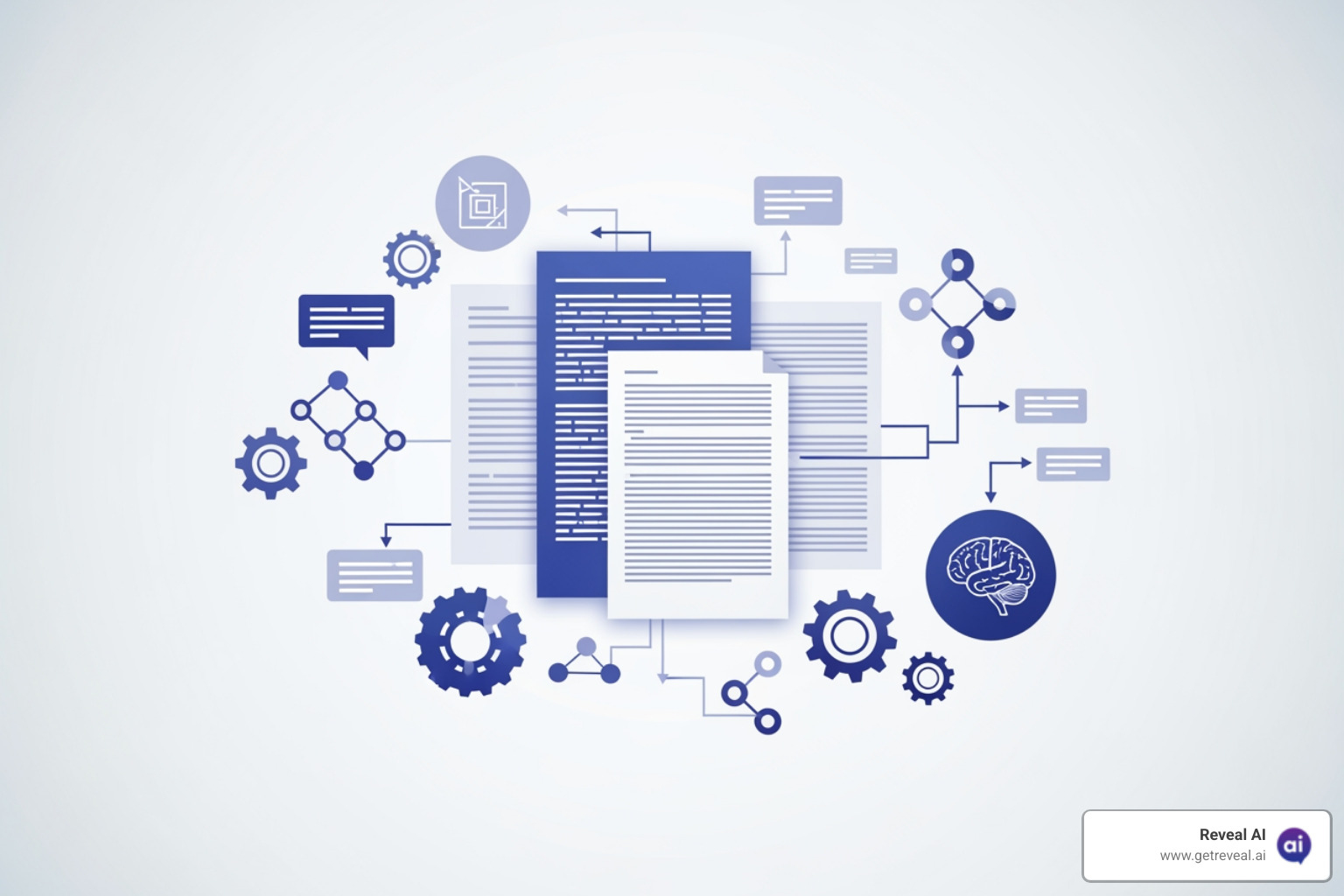
Automated qualitative data analysis uses AI to read, code, and find themes in unstructured text data — like interview transcripts, open-ended survey responses, and focus group notes — without requiring researchers to do it line by line, manually.
Here's what it means in practice:
| What it replaces | What AI does instead |
|---|---|
| Manually reading hundreds of transcripts | Reads and codes all data automatically |
| Building code frames by hand | Identifies themes and patterns across responses |
| Weeks of analysis work | Delivers structured insights in hours or days |
| One researcher's interpretation | Consistent, repeatable coding at scale |
The core promise is simple: less time on mechanical work, more time on judgment and strategy.
If you've ever stared at a folder of interview transcripts and a blank spreadsheet, you know the feeling. Manual qualitative analysis is slow, inconsistent at scale, and brutally time-consuming. Research that should drive fast decisions ends up stuck in a backlog.
The problem isn't the data. It's the process.
AI can now handle the heavy lifting — reading, tagging, clustering, and summarizing qualitative data at a speed no human team can match. Tools like NVivo, ATLAS.ti, MAXQDA, and AI-native platforms have all moved in this direction. But speed alone isn't enough. For market researchers and product teams, the real question is: can you trust what the AI produces?
That's the tension at the center of this guide.
The Imperative for Trust in AI-Powered Qualitative Research
In market and product research, we often hear the quote by William Bruce Cameron (1963): "Not everything that can be counted, counts, and not everything that counts can be counted." This is the fundamental reason we turn to qualitative data. While numbers tell us what is happening, qualitative data tells us why. It captures the emotions, motivations, and nuanced experiences that a Likert scale simply cannot.
However, as datasets grow from 10 interviews to 1,000 open-ended survey responses, the "why" becomes a mountain of text that is nearly impossible to climb manually. This is where automated qualitative data analysis steps in. But for us at Reveal AI, speed is secondary to integrity. If an AI summarizes a thousand voices but hallucinates the key takeaway, the research is worse than useless—it’s misleading.
Beyond Manual Methods: The Limitations of Spreadsheets and Generic AI Tools
Traditional qualitative analysis is often described as a "microscope" view—deeply detailed but narrow. Quantitative analysis is the "telescope"—broad but distant. Manual coding requires a researcher to read and reread data multiple times to identify "meaning units." These units are then condensed into codes and grouped into themes.
This manual process faces three massive hurdles:
- The "Drift" Problem: In large projects, a researcher’s coding criteria often shift between Monday morning and Friday afternoon. This "codebook drift" makes consistency nearly impossible.
- The Scalability Wall: Manual analysis can take weeks or even months for large datasets. In a fast-moving market, insights that take six weeks to produce are often "stale" by the time they reach stakeholders.
- The Bias Trap: Humans are prone to cognitive bias, often highlighting the quotes that support their existing hypotheses while ignoring outliers.
To solve this, many teams have turned to generic AI tools (like ChatGPT or basic LLM wrappers). While these are fast, they often lack the "research-grade" rigor required for professional work. Generic AI can hallucinate themes that don't exist or fail to provide a "paper trail" back to the original respondent. For a researcher, a summary without attribution is just a story; it isn't evidence.
The Mechanics of Research-Grade AI: Coding, Themes, and Verifiable Insights
How does automated qualitative data analysis actually work under the hood? It generally follows three levels of sophistication:
- Level 1: Discrete Tasks. This includes tools like Otter.ai, which automate transcription. NVivo Transcription, for example, offers up 90% accuracy from quality audio. This saves time but still leaves the "thinking" to the human.
- Level 2: Human-in-the-loop. Tools like Fuel Cycle or Ascribe Coder act as assistants, suggesting codes or managing codebooks while the researcher maintains final approval.
- Level 3: Full Automation with Oversight. Platforms like Thematic or Displayr use machine learning to identify meaningful statements and create taxonomies on the fly.
In practice, AI-powered coding uses Natural Language Processing (NLP) to understand context. For example, if a customer says, "I really hate the customer service," the AI doesn't just look for the word "hate"; it recognizes the sentiment and labels it under a broader theme like "Poor Support Experience."
Different methodologies benefit differently from this automation:
- Thematic Analysis: AI excels at identifying recurring patterns across thousands of responses.
- Content Analysis: This popular approach involves grouping content into words or concepts. AI can do this in seconds, calculating word frequencies and visualizing them through word clouds.
- Discourse Analysis: While more complex, as it examines language in its social context, AI can help flag power dynamics or specific linguistic structures.
Why AI-Powered Qualitative Research is Critical for Modern Insights Teams
The shift toward leveraging AI in market research is no longer a luxury; it is critical for success. Modern teams are expected to handle "multimodal" data—text, voice, video, and social media—simultaneously.
Statistics show that while manual analysis takes weeks, AI platforms can process and categorize data within hours or days. This allows for "Qual-at-Scale," a method that removes the traditional trade-off between depth and sample size. You can now conduct 500 "interviews" via conversational AI and analyze them with the same rigor you would apply to five in-person sessions.
Furthermore, AI bridges the gap between qualitative and quantitative methods. By calculating the impact of a theme on metrics like NPS, researchers can prove exactly how much a specific "pain point" is costing the business.
Implementing a Trust-First Approach to Qualitative Insights
When we talk about the evolution of market research, the conversation often centers on "black box" automation. But for a professional analyst, a black box is a liability. If you cannot explain how the AI reached a conclusion, you cannot defend that conclusion to a stakeholder or a client.
Ensuring Verifiable Trust in Automated Qualitative Data Analysis
Reliability and validity are the twin pillars of research. In manual methods, we often use "intercoder agreement" (where two humans code the same data to see if they agree) to ensure quality. In the AI era, we use "human-in-the-loop" verification.
Cécile and Andrea Chiarelli have noted that responsible AI use requires humans to review, refine, and guide AI results. This ensures that the final insights are nuanced and actionable, especially for complex or sensitive topics.
When choosing a tool, researchers should look for:
- Transparency: Can you see the "evidence" (the original quote) for every theme the AI identifies?
- Researcher Control: Can you merge codes, rename themes, or override the AI's suggestions?
- Data Integrity: Is the AI training on your sensitive data, or is it operating in a secure environment?
Reveal AI's Research-Grade AI: A Walled Garden for Data Integrity
At Reveal AI, we believe in "Trust First, Not Novelty First." While many platforms use generic web-trained models that are prone to hallucinations, our AI-powered qualitative research platform operates within a "Walled Garden" model. This means the insights are derived only from the data you provide—your actual customer conversations—not from random corners of the internet.
This approach solves the most common challenges of qualitative data analysis:
- Zero Hallucinations: Because the AI is restricted to the provided dataset, it cannot "invent" trends.
- Direct Attribution: Every insight comes with a direct quote. You can click on a theme and see exactly who said what, providing the "verifiable trust" that stakeholders demand.
- GDPR and Security: Compliance isn't an afterthought. Tools like MAXQDA AI Assist and Reveal AI prioritize GDPR compliance, ensuring that sensitive research data is encrypted and handled according to global standards.
Unlike some legacy tools that require months of training, or lightweight tools that offer shallow summaries, we focus on providing a "research-grade" experience that is as easy to use as a chat interface but as rigorous as a university lab.
Actionable Insights, Not Just Data: The Path Forward with Reveal AI
Implementing automated qualitative data analysis isn't just about buying software; it's about changing your workflow. Here is a step-by-step process for a modern research team:
- Gather via Conversational AI: Instead of static forms, use conversational interviews to probe for deeper "whys."
- Organize in a Central Repository: Platforms like Dovetail or EnjoyHQ help store these conversations, but an integrated platform like Reveal AI handles the collection and analysis in one place.
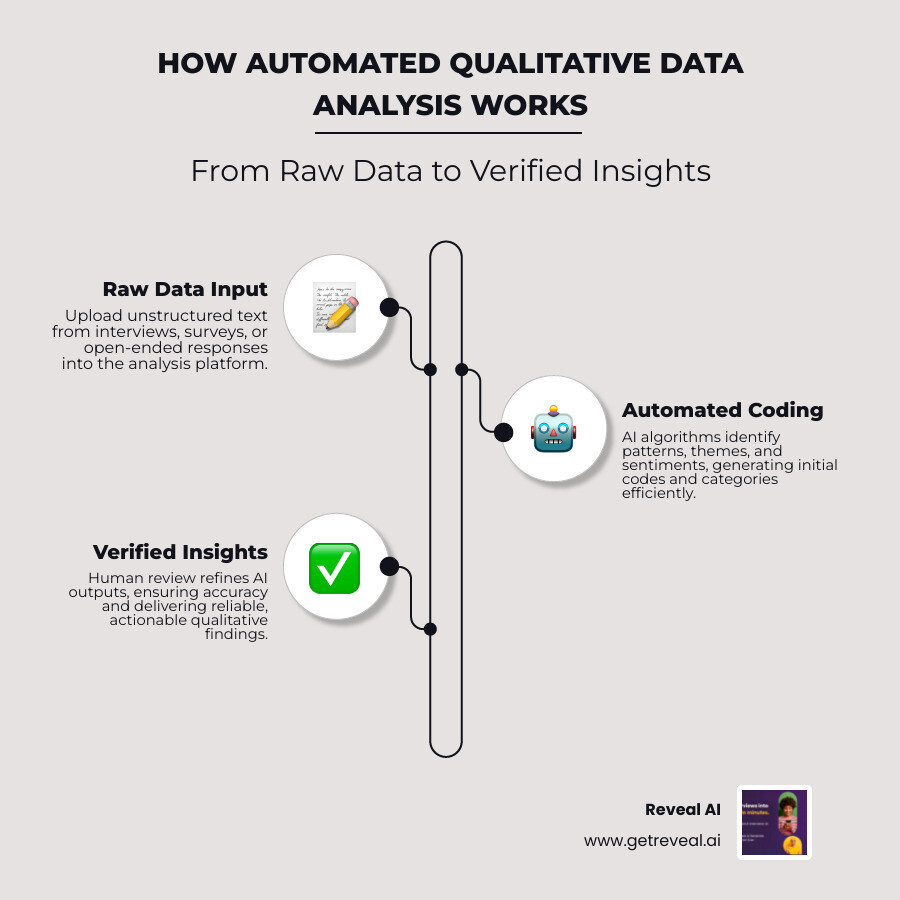
- AI-Powered Coding: Let the AI do the first pass. It will identify themes, sentiments, and patterns across the dataset.
- Human Synthesis: Review the AI's clusters. Use your expertise to add business context—something AI still cannot do.
- Visualize and Report: Use Sankey diagrams, word clouds, or network views to show how themes connect.

As we look toward the future, trends like "agentic research agents" are emerging. These are AI assistants that don't just code data but can actually chat with your documents and answer complex questions like, "What are the three main reasons our European users are frustrated with the checkout process?"
By combining market research expertise with AI's processing power, we can finally move away from the "painful" manual labor of the past. No more endless spreadsheets. No more "codebook drift." Just clear, verifiable insights that drive business decisions.
Conclusion: The Future of Qualitative Insights
The transition from manual to automated qualitative data analysis represents the most significant shift in the research industry in decades. We are moving from a world where qualitative research was a "slow and expensive" luxury to one where it is a "fast and scalable" necessity.
However, the "human" in the research remains indispensable. AI is the engine that processes the miles of data, but the researcher is the navigator who decides where the ship should go. By adopting a "trust-first" platform like Reveal AI, you ensure that your speed doesn't come at the cost of accuracy.
Whether you are conducting brand awareness research or optimizing a product for a global market, the goal remains the same: to listen to the human voice and turn it into a decision. With research-grade AI, we can finally do that at the scale the modern world demands.
Ready to see how conversational AI can transform your qualitative research? Explore the Reveal AI Product and start turning customer voices into your competitive advantage.