No items found.

Blog
Unlock Customer Insights: The Ultimate Guide to Voice of Customer Platforms

Bob Dimicco

Voice of customer platforms are digital systems that help researchers and product teams collect, analyze, and act on customer feedback at scale. These platforms transform raw input from surveys, interviews, reviews, and other sources into structured insights that drive product decisions and business strategy.
Quick Overview: What VoC Platforms Do
Building without customer insight means flying blind. Research shows 8 of 10 executives believe their company loses sales by failing to engage customers, yet many research teams still struggle with slow, manual analysis that delays decisions.
The stakes are high: 7 in 10 Americans will spend 13% more with companies providing excellent service. Capturing this advantage requires analyzing thousands of responses quickly while maintaining the nuance that builds stakeholder trust.
This creates a fundamental tension for research teams. Traditional qualitative methods are rich but slow, while generic AI tools promise speed but risk hallucinations and poor attribution. Researchers face pressure to deliver faster insights without sacrificing the rigor their work demands.
Modern voice of customer platforms address this challenge by combining systematic data collection with advanced analysis capabilities. The best platforms don't just aggregate feedback—they help researchers uncover patterns, validate hypotheses, and present findings with the source attribution that maintains client trust.
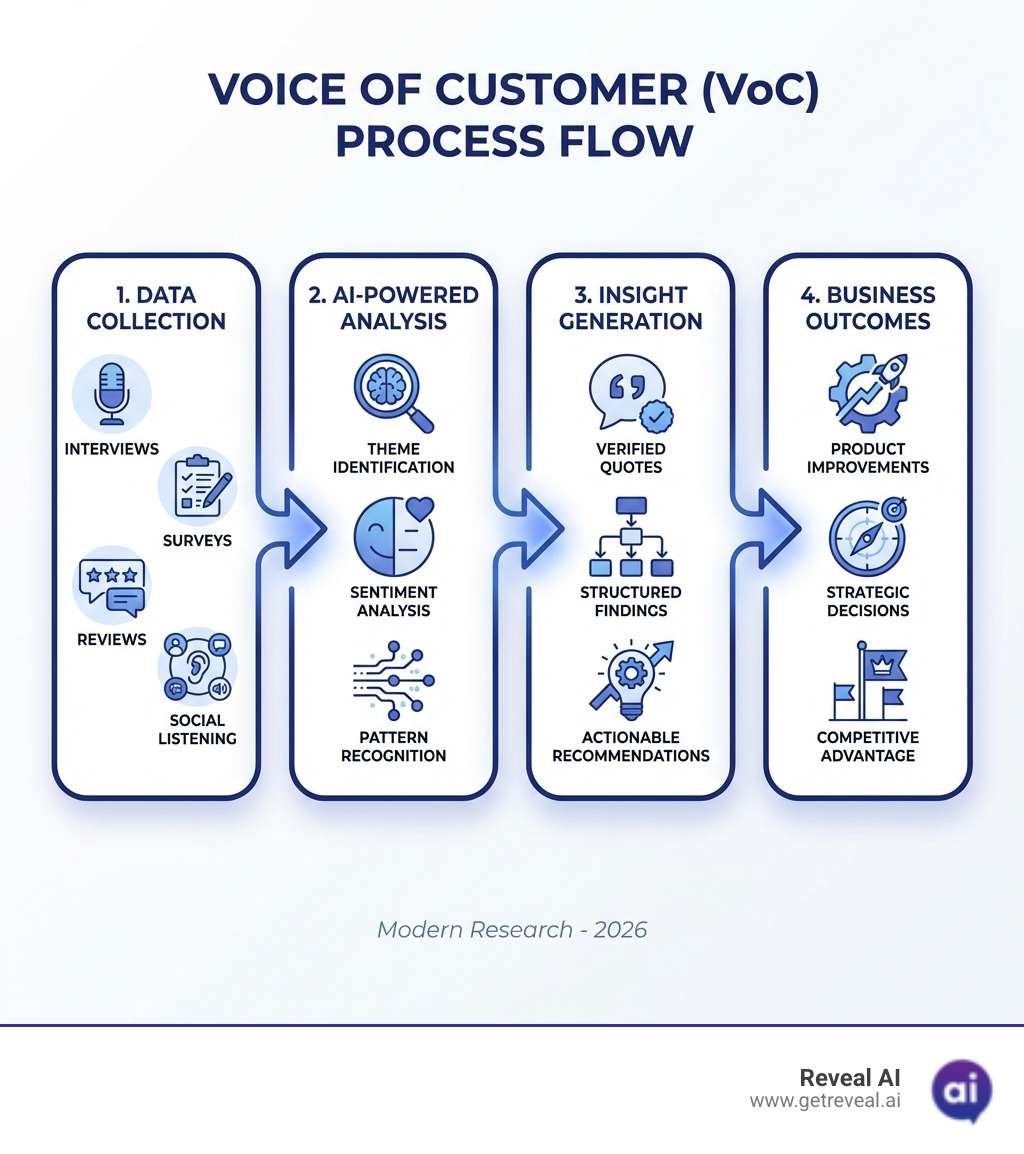
Modern voice of customer platforms streamline the feedback journey from data capture to strategic insights. They offer powerful analysis, visualization, and reporting crucial for research and product teams in the United States and Europe.

To truly open up customer insights, a platform must offer an integrated approach. This includes robust data collection, advanced analysis powered by research-grade AI, clear insight visualization, and comprehensive reporting that empowers confident decision-making.
An effective voice of customer program starts with gathering authentic feedback from multiple sources. Feedback is categorized into two main types:
The volume and variety of these sources demand a sophisticated voice of customer platform to unify this data. Unifying data from multiple channels is vital for understanding changing customer needs and preventing churn. A comprehensive approach is essential for building a comprehensive view, a topic further explored in the evolution of market research.
Once collected, a voice of customer platform turns raw data into actionable insights. This is where advanced analytics and research-grade AI excel, especially for qualitative data.

Traditionally, manual qualitative analysis was slow and subjective, leading to data overload, organizational silos, and inaction. Modern voice of customer platforms leverage powerful technologies to overcome these limitations:
However, not all AI is created equal. Generic AI tools can introduce significant risks like hallucinations, lack of attribution, and loss of nuance, which erodes client trust.
This is where research-grade AI becomes paramount. Our "Trust first, not novelty first" philosophy addresses this. Our AI research platform has built-in guardrails for verifiability and rigor. We use a 'Walled Garden' data model, safeguarding your data's purity by not using external web data. We ensure trustworthy insights through direct quote attribution and human source verification, backing every finding with the authentic customer voice.
By leveraging AI in market research responsibly, we transform how qualitative data is processed, allowing researchers to dig deeper and faster into customer needs without compromising accuracy or trust.
The true value of a voice of customer platform is its ability to drive informed business decisions. For research and product teams, this means translating insights into tangible improvements that impact customer satisfaction and business growth.
The goal is a "closed-loop feedback system" where customer input leads to meaningful change. Here’s how VoC insights from research-grade AI facilitate action:
An effective voice of customer platform provides a roadmap for continuous improvement, empowering teams to move from reactive problem-solving to proactive innovation. For a deeper dive into how customer insights can drive strategic initiatives, explore our use case on customer research.
Selecting the right voice of customer platform is a critical decision for research and product teams. The best choice aligns with your specific research objectives, team structure, and desired depth of insight.
First, define your objectives. Do you need to:
Your goals will shape your criteria. Also consider integration needs, scalability, data security, and how you will measure ROI.
The VoC platform market is diverse. Understanding the different types is crucial to finding the right fit for your research goals.
CriteriaSurvey-Focused PlatformsAnalytics-Focused PlatformsAI-Powered Qualitative Research Platforms (e.g., RevealAI)Primary UseQuantitative surveys, NPS/CSATAggregating structured/unstructured data for trendsIn-depth qualitative insights, concept validation, root cause analysisData TypeStructured (multiple choice, ratings)Mixed (surveys, reviews, social, support tickets)Unstructured, conversational, open-ended responsesInsight DepthSurface-level metrics, basic themesThematic identification, sentiment trendsNuanced understanding, verified direct quotes, emotional driversKey OutputScores, charts, basic word cloudsDashboards, trend graphs, categorized feedbackStructured qualitative insights, verifiable quotes, actionable recommendationsQualitative GapLimited depth, manual analysis of open-endsAggregates, but often lacks deep, verifiable qualitative nuanceFills the gap by automating deep qualitative analysis with attribution
Survey-focused platforms excel at collecting structured data like NPS but offer rudimentary analysis for open-ended questions, requiring substantial manual effort from research teams.
Analytics-focused platforms integrate multiple data sources to monitor trends. They can process unstructured text but often prioritize aggregation over the granular, verifiable insights needed for deep qualitative research.
This highlights a qualitative gap: many platforms show what customers say but struggle to explain why with the depth and verifiability that research demands.
This is where RevealAI's AI-powered qualitative research platform excels. We turn unstructured, conversational data into rich, verifiable insights. Our AI research platform analyzes qualitative feedback with speed and trust, delivering the "why" behind the "what." Every insight is backed by direct customer quotes, allowing market research firms, UX teams, and product researchers to gain a deeper, more confident understanding of their customers.
When selecting a VoC platform, a meticulous evaluation is essential to ensure it meets your needs and maintains research integrity.
By focusing on these criteria, research and product teams can confidently choose a voice of customer platform that delivers verifiable, actionable insights. This approach allows you to conduct market research without doubt, powered by AI you can trust.
In today's market, understanding your customer is a prerequisite for survival. Voice of customer platforms are indispensable for research and product teams driving customer-centric innovation.
These platforms collect diverse feedback, from surveys to open-ended feedback. We've highlighted how research-grade AI moves beyond superficial trends to uncover deep, nuanced insights. Most importantly, we emphasized verifiability and direct attribution—the cornerstone of trust in research, which is embedded in our AI research platform.
The critical shift is towards trusted, research-grade AI. Generic AI offers speed but can sacrifice accuracy and verifiability. Our "Trust first, not novelty first" philosophy guides our platform, which features built-in guardrails, a 'Walled Garden' data model, and direct quote attribution. This ensures your insights are fast, comprehensive, and credible.
Building a future-proof voice of customer strategy means embracing continuous improvement. It involves consistently listening to customers, analyzing their feedback with trustworthy tools, and acting on those insights to refine products and drive sustainable growth.
The success of any business hinges on its ability to truly hear and respond to its customers. For market research and product teams, this means having a voice of customer platform that delivers speed without sacrificing depth, and innovation without compromising trust.
Find how RevealAI’s AI-powered qualitative research platform can transform your insights by exploring our product.
Testing