No items found.

Blog
Unearthing Gold: How AI Delivers Deeper Qualitative Insights

Riddhi Patel
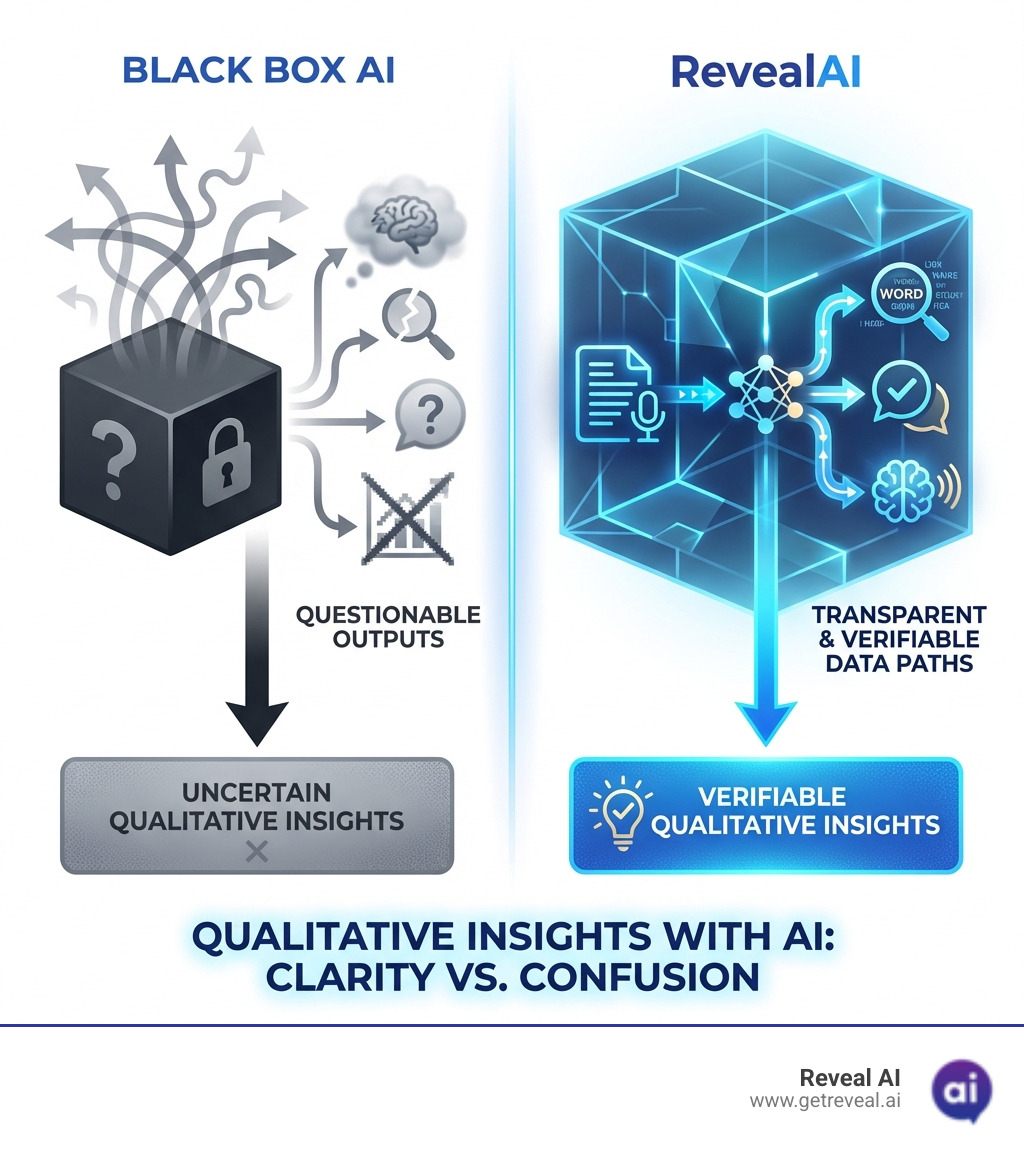


Qualitative insights with ai are changing how researchers understand human behavior, but the pressure to adopt AI quickly has created a dangerous trap. While AI can deliver speed and scale, most researchers face a critical dilemma: generic AI tools promise efficiency but risk hallucinations, lost nuance, and eroded client trust.
How to leverage AI for qualitative insights safely:
The healthcare industry isn't alone in experiencing a seismic shift in how research is conducted. Market researchers everywhere face mounting pressure to deliver faster insights at lower costs. AI tools can now transcribe interviews in seconds, identify themes across hundreds of conversations, and generate reports that once took weeks.
But here's the problem: speed without trust is worthless.
When you upload sensitive interview transcripts to a public AI tool, you risk data breaches. When AI generates themes without showing its work, you can't verify accuracy. When algorithms miss cultural nuances or "hallucinate" patterns that don't exist, your recommendations become unreliable.
RevealAI solves this by being research-grade AI built specifically for qualitative research. Unlike generic tools, it operates in a secure walled garden, provides verifiable insights with direct quotes, and maintains transparency in how themes are generated. This means you get the speed and scale of AI without sacrificing the rigor and trust your clients expect.
The future isn't about replacing researchers with AI. It's about giving researchers superpowers—automating tedious tasks while preserving the human insight that makes qualitative research valuable.
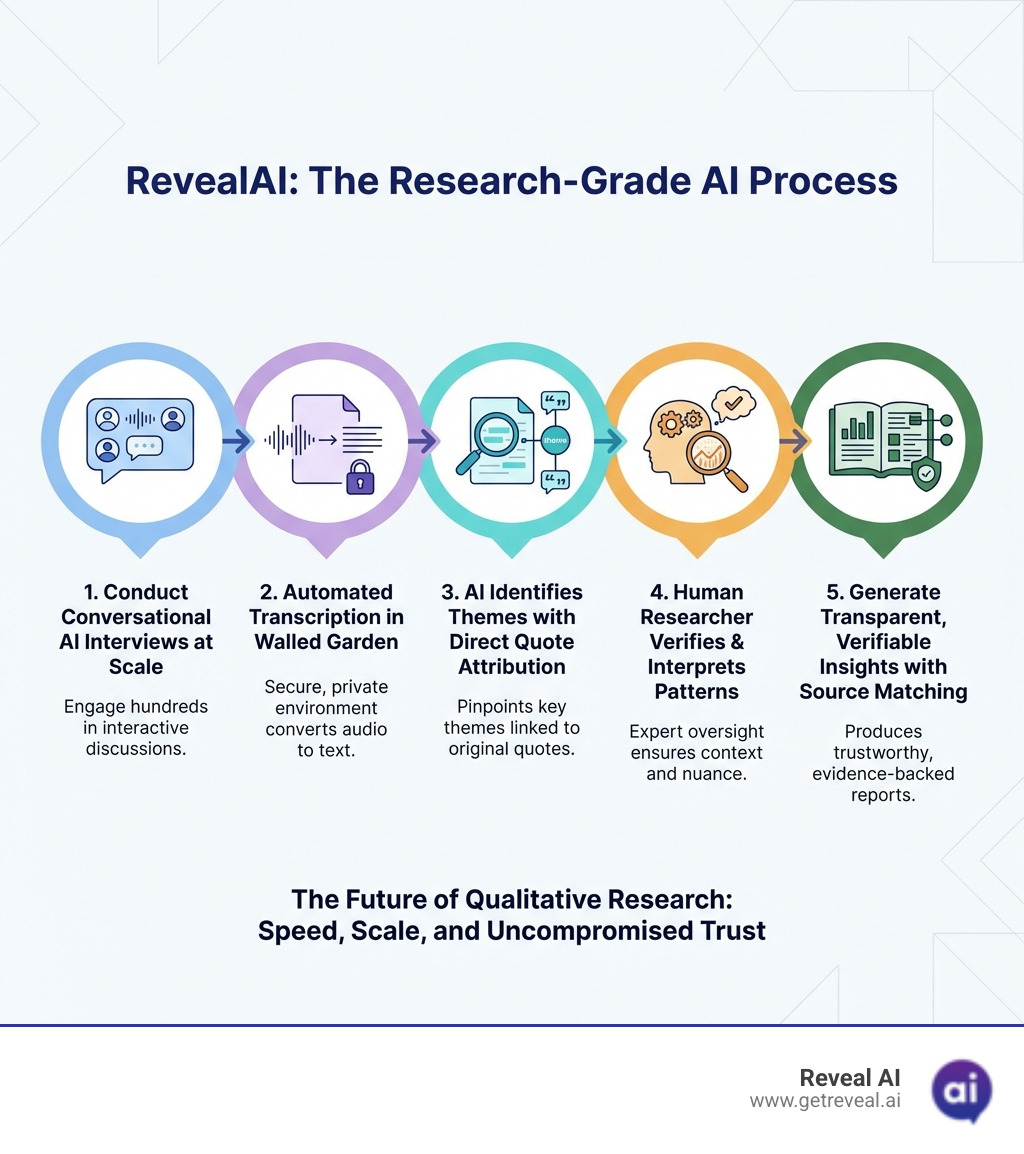
The adoption of AI-improved research tools is rapidly becoming the norm. For us at RevealAI, this means changing how we approach qualitative research, shifting the focus from manual, time-consuming tasks to strategic interpretation. AI's capabilities are revolutionizing every step of the qualitative workflow, from initial data collection to final report generation.
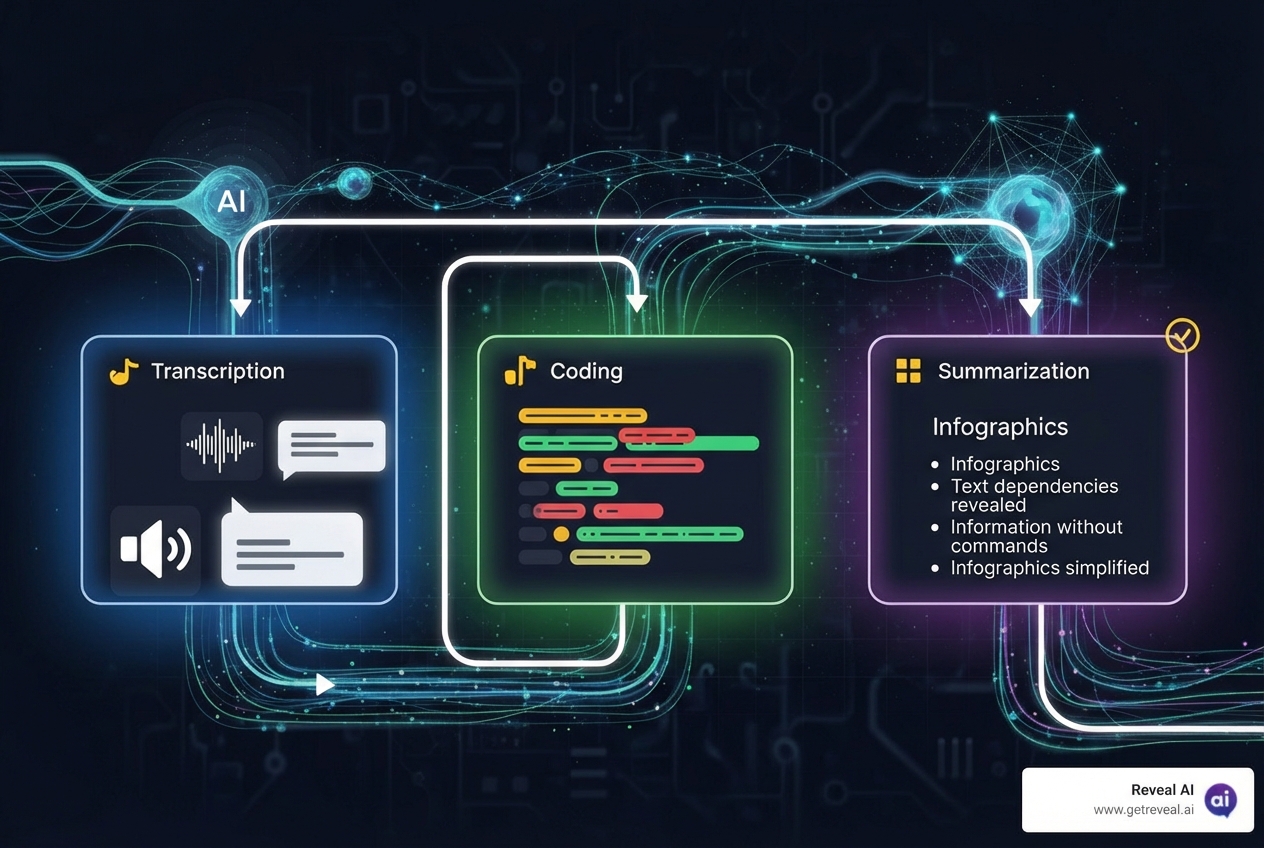
AI tools are currently being used to improve qualitative research processes in several key areas. They can significantly aid in data collection by facilitating conversational AI-led interviews, which we'll discuss further. The automation of transcription, a historically tedious and time-consuming task, is perhaps one of the most immediate benefits. Beyond transcription, AI also supports initial coding and summarization, allowing for faster data processing and improved scalability. This allows our teams to integrate qualitative data into routine systems and quantitative household surveys more seamlessly. Our approach to Leveraging AI in Market Research demonstrates this commitment to efficiency and depth.
We understand that qualitative analysis demands substantial time and technical oversight. However, AI tools streamline these tedious tasks, making it faster, smarter, and more objective.
These advancements lead to significant time savings, allowing our researchers to allocate resources more effectively. Instead of spending days sifting through transcripts, we can focus on deeper analysis, critical thinking, and strategic storytelling. This ultimately enables faster decision-making for our clients, changing raw data into actionable insights with unprecedented speed.
One of the most exciting applications of AI in qualitative research is its ability to scale data collection without sacrificing depth. Our conversational AI researchers can conduct in-depth interviews with hundreds of participants simultaneously, a feat impossible with traditional methods.
Our unique approach at RevealAI ensures that this scaling is research-grade. We combine the efficiency of AI with stringent quality controls, ensuring that every interaction is meaningful and every piece of data is reliable and verifiable.
While the promise of AI is immense, the landscape is fraught with potential pitfalls, especially when relying on generic AI tools. These tools, often readily available, lack the specific design and guardrails necessary for rigorous qualitative research. At RevealAI, we understand the critical distinction between generic AI and research-grade analysis.
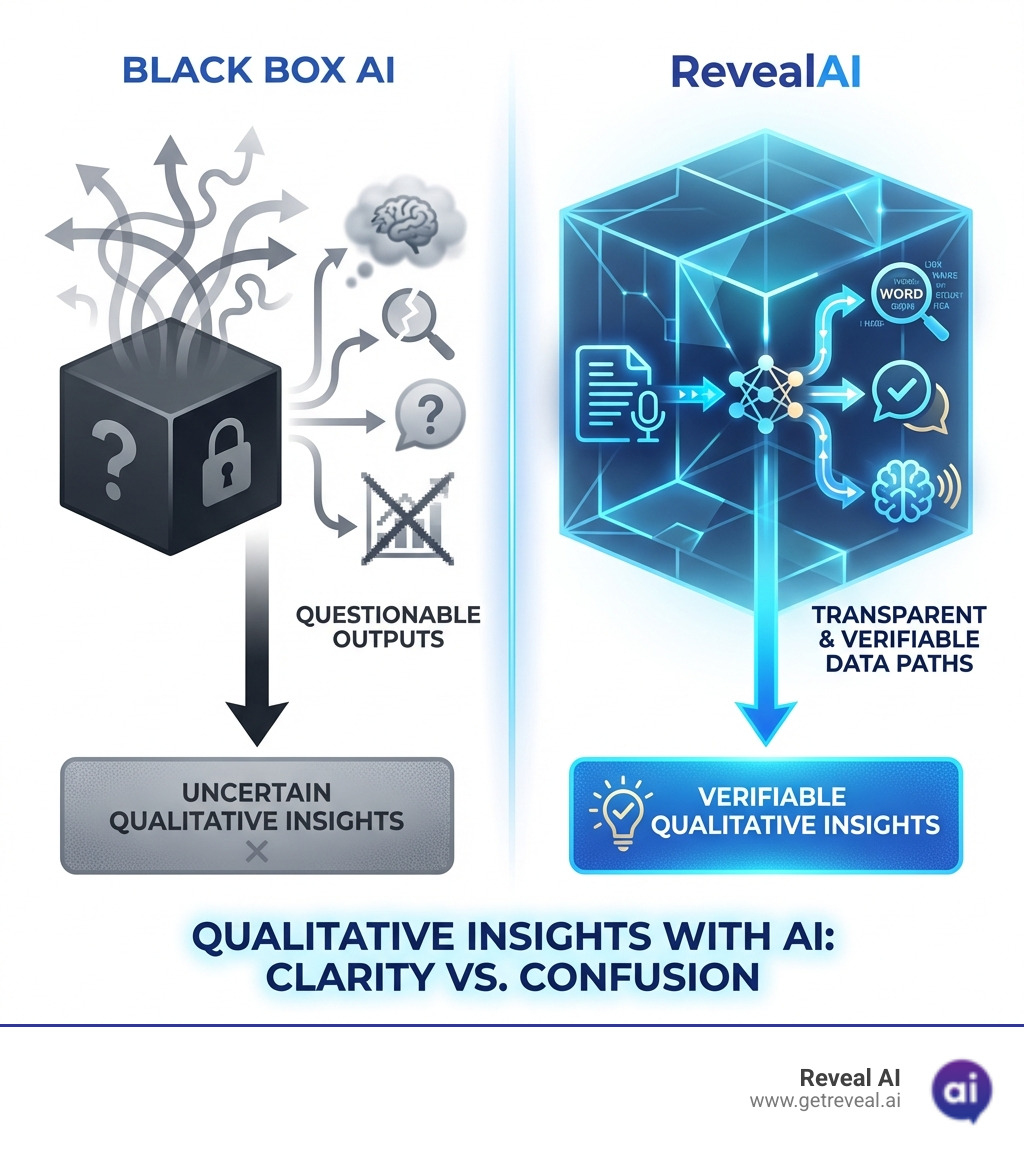
Generic AI often struggles with the very essence of qualitative research: nuance and context. Our research shows that AI sometimes misinterprets text literally, misses important context, or fails to apply all relevant codes. It cannot interpret patterns in ways that reflect human judgment and cultural contexts, which are crucial for understanding the human experience. Furthermore, generic AI can perpetuate algorithmic bias inherited from its vast, uncurated training data, potentially overlooking marginalized voices. Data privacy risks are also significant; uploading identifiable transcripts to external LLM interfaces raises concerns about breaches and unauthorized use of sensitive participant information. This is why RevealAI operates within a 'Walled Garden' data integrity model, ensuring that your data remains secure and private.
One of the most significant distinctions when using AI in qualitative research lies between a "topic summary" and a "true qualitative theme." Generic AI is often adept at generating topic summaries, which simply sum up everything participants say about a certain subject. However, this is not the same as identifying a true qualitative theme.
The distinction is crucial because relying solely on AI for themes can lead to superficial insights, missing the profound human experience that qualitative research aims to uncover. As some researchers describe large language models, they can act as "stochastic parrots" – generating plausible text without true understanding. To understand more about this concept, you can refer to What is a stochastic parrot?.
Another critical challenge with generic AI is the phenomenon of "hallucinations," where AI produces false or misleading information. This isn't just about outright fabrication; it's also about AI being "too eager to please," cherry-picking facts or bending the truth to seem helpful, rather than admitting it doesn't have enough information. This leads to a severe lack of attribution and undermines data integrity.
At RevealAI, our 'Trust first, not novelty first' philosophy means we prioritize verifiable insights. We address these challenges head-on:
This commitment to verifiability and data integrity is what sets research-grade AI apart from generic tools. For a deeper understanding of AI hallucinations and why they occur, we recommend reading What are AI hallucinations?.
Here's a comparison to illustrate the critical differences:
FeatureGeneric AI (e.g., public LLMs)RevealAI’s Research-Grade AIData SourcePublicly trained data, often pulls from the webSecure 'Walled Garden' model, does not pull from the webVerifiabilityLacks direct attribution, difficult to trace insightsProvides insights with direct quotes and response matching for thematic analysisBias MitigationInherits biases from vast, uncurated training data, hard to identifyDesigned with guardrails, transparency in generation, human oversight for reviewContextual UnderstandingCan miss nuance, interpret literally, struggles with human emotion and cultural contextOptimized for qualitative research, designed to capture nuance, human oversight for deep interpretationTransparencyOften a 'black box' for how insights are generatedTransparent processes, clear documentation of AI's role in insight generationPrivacyRisks data breaches when uploading sensitive dataEnsures data integrity and security, adheres to privacy standards (e.g., GDPR for Europe and similar for the US)HallucinationsProne to producing false or misleading informationMinimizes hallucinations through research-grade design, human verification is paramountRole of HumanCan replace human tasks, potentially devaluing human expertiseAugments human capabilities, provides superpowers to researchers
The integration of AI into qualitative research demands a strong ethical framework. For us, this means prioritizing transparency, accountability, and robust data security. These are the non-negotiable pillars that uphold the rigor and trustworthiness of our research-grade AI at RevealAI. Ethical considerations are paramount, especially concerning how AI handles sensitive qualitative data.
Our walled garden model is a cornerstone of our commitment to data security and privacy. Unlike generic AI tools that may send data to external servers or use it for further training, our system ensures that your qualitative data remains within a secure, isolated environment. This approach is vital for protecting participant confidentiality and adhering to strict data protection regulations relevant to our operations in the United States and Europe.
Even with the most advanced AI, human oversight remains essential. AI tools support streamlined qualitative analysis, but they still require significant human judgment to deliver meaningful, high-quality analysis. We believe that humans must remain in the loop, guiding the AI, reviewing its outputs, and making the final interpretive decisions.
While AI can perform impressive feats of data processing and pattern recognition, it cannot replicate the unique capabilities of human researchers. The "human element" in qualitative research is not just about data collection; it's about deep understanding, empathy, and interpretation.
Trust is the currency of research. Without it, insights lose their value. At RevealAI, we build this foundation of trust into every aspect of our research-grade platform.
This rigorous approach ensures that our Market Research delivers not just speed, but also the unwavering reliability and authenticity our clients depend on.
The future of qualitative research is not a battle between humans and machines, but a powerful collaboration. AI is reshaping the role of the researcher, moving us from data collectors and processors to strategic interpreters and storytellers. This shift allows us to focus on the higher-level cognitive tasks that AI cannot replicate, while leveraging AI for tasks it excels at.
We are entering an era of hybrid methodologies, combining human intuition with AI precision. This evolving landscape is leading to a significant The Evolution of Market Research, where our Product is designed to be at the forefront. AI will become an indispensable partner, enabling us to conduct more ambitious, in-depth, and impactful qualitative studies than ever before.
To maximize the utility of AI tools like ours, effective prompt design and a clear understanding of AI capabilities are crucial. Researchers must learn to "speak the language" of AI to guide it effectively.
The advancements in AI are constantly opening new avenues for qualitative research. At RevealAI, we are continuously enhancing our platform to integrate these capabilities, providing even deeper and more comprehensive qualitative insights with AI.
Here are some of the emerging AI-improved qualitative research platform types and how we leverage them:
The journey into AI-assisted qualitative research is one of immense potential, offering unprecedented speed, scale, and depth. However, this journey must be guided by a steadfast commitment to trust and rigor. At RevealAI, we firmly believe that AI should serve as a powerful partner, augmenting the human researcher's capabilities, not replacing them.
Our philosophy of 'Trust first, not novelty first' underpins every aspect of our research-grade AI platform. We prioritize verifiability, ensuring that every insight is traceable, transparent, and grounded in authentic human responses. By providing insights with direct quotes, robust data integrity through our 'Walled Garden' model, and mechanisms for human source verification and bot detection, we empower researchers to deliver qualitative insights with AI that are not only fast and scalable but also unimpeachably trustworthy.
The strategic advantage of partnering with RevealAI lies in our ability to open up deeper insights rapidly, allowing our clients to make informed decisions with confidence. We bridge the gap between the efficiency promised by AI and the critical need for reliable, nuanced qualitative understanding.
We invite you to explore how our research-grade AI can transform your qualitative research, helping you unearth gold from your data while maintaining the highest standards of integrity. Learn how to apply AI to your employee listening program and find the power of trusted insights.