Blog
AI Customer Feedback is the Secret to Happy Users

Bob Dimicco

AI customer feedback analysis is the use of artificial intelligence to automatically collect, process, and interpret large volumes of customer input — from surveys and reviews to support tickets and social media — so teams can act on insights in hours, not weeks.
Here's what it does at a glance:
If you're a CX or research leader today, you already know the problem. Survey response rates are low. Open-ended answers pile up unread. By the time your team finishes manual analysis, the moment to act has passed.
The numbers make it hard to ignore. 98% of consumers read online reviews before making a purchase. A product with at least five reviews is 270% more likely to be bought than one with none. Customer feedback isn't just nice to have — it's directly tied to revenue.
But most teams are still stuck in a reactive cycle: collect data, wait weeks for analysis, then act on insights that are already stale.
AI changes that equation entirely. Instead of sampling a fraction of your feedback and hoping it's representative, AI reads everything — every ticket, every review, every open-ended survey response — and turns it into clear, prioritized signals your team can act on today.
The shift isn't just about speed. It's about moving from reactive damage control to proactive customer experience management.
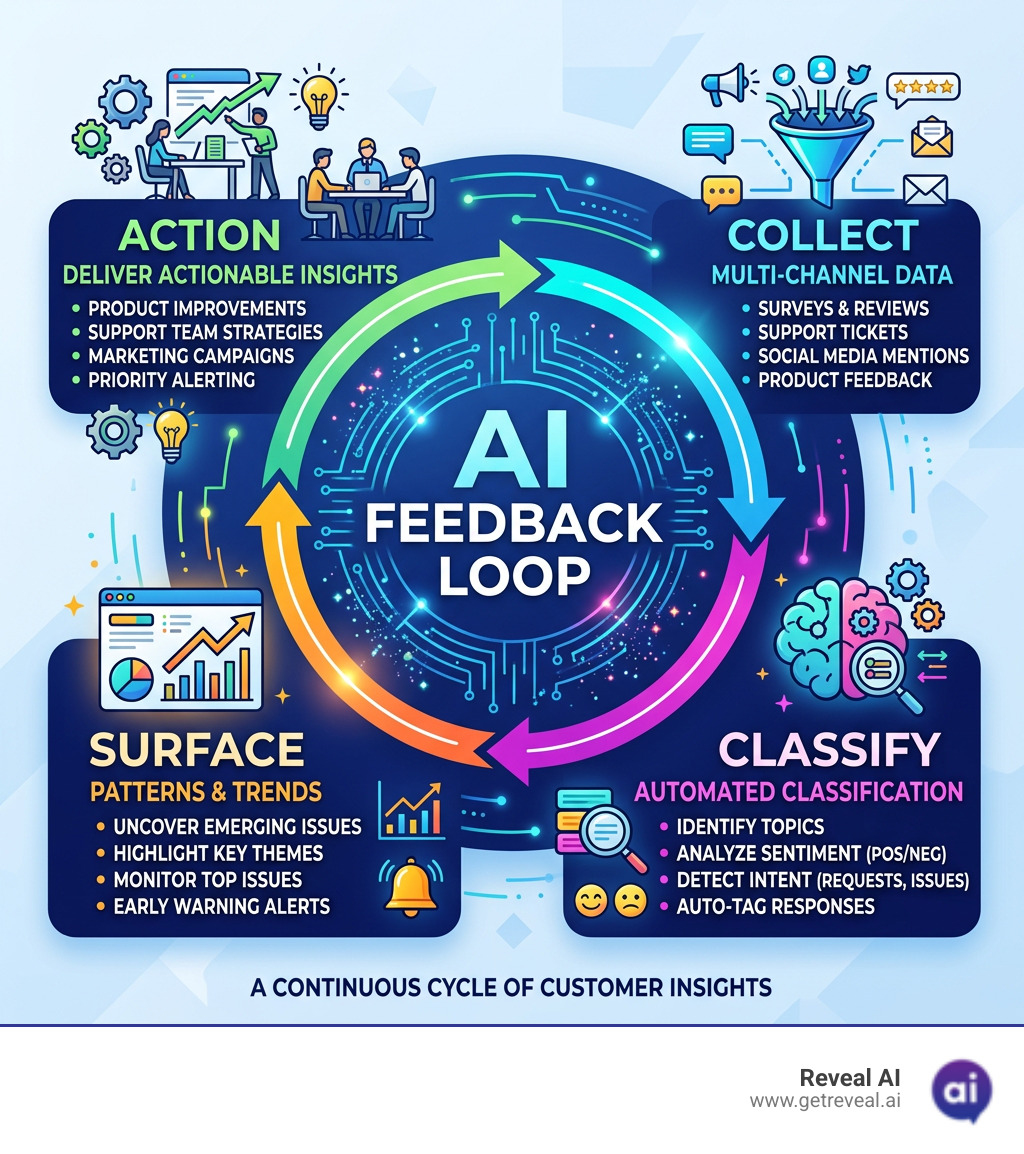
At its simplest, ai customer feedback analysis is like having a thousand expert researchers reading every single comment, review, and support ticket your company receives, 24/7, without ever getting tired or bored.
In the "old days" (which for some is still last Tuesday), we had to manually tag spreadsheets. We’d look for keywords like "broken" or "expensive" and hope we didn't miss the nuance. AI works differently. It uses a combination of technologies to understand the meaning behind the words, not just the words themselves.

The process typically follows a specific flow. First, the AI gathers data from various silos—Zendesk tickets, Trustpilot reviews, or social media mentions. Then, it uses Natural Language Processing (NLP) to break down the sentences. This is where text classification capabilities come into play, allowing the system to categorize feedback into buckets like "Usability," "Pricing," or "Bug Report" automatically.
But it goes deeper than just sorting. AI performs sentiment analysis to determine if a customer is happy, frustrated, or neutral. It uses topic extraction to find the specific features being discussed and intent detection to figure out what the customer wants next—be it a refund, a new feature, or just a bit of help. By using these tools, we can achieve Market Research Without Doubt, Powered by AI, ensuring that the "why" behind customer behavior is never a mystery.
The "magic" under the hood is driven by Large Language Models (LLMs). Unlike the basic keyword bots of the past, modern LLMs are trained on billions of pages of text, giving them a human-like grasp of language. However, generic models can sometimes "hallucinate" or provide vague answers. That’s why leading platforms use LLM fine-tuning to train models specifically on product feedback patterns.
We also employ proprietary algorithms and hallucination detection to ensure the insights are grounded in real data. If a customer didn't say it, the AI shouldn't report it. These systems also handle data enrichment, where feedback is linked to user metadata (like their subscription tier or location) to provide a 360-degree view of the customer journey.
Unstructured data is the "messy" stuff: long-form emails, rambling survey comments, or transcriptions from sales calls. AI begins by "cleaning" this data—removing duplicates and gibberish.
Once cleaned, the AI performs thematic clustering. This is a part of Automated Qualitative Analysis where the system groups similar complaints or praises into "themes." For example, instead of seeing 500 individual complaints about "the checkout button," you see one major theme: "Checkout Friction."
This allows for root cause analysis. If your Net Promoter Score (NPS) drops, you don't have to guess why. The AI can point to a specific SKU or a recent software update that triggered the decline. You can even drill down to SKU-level insights, seeing exactly which product in your catalog is causing the most headaches for your support team.
In today's market, you aren't just competing on price; you're competing on the experience. Modern growth is fueled by social proof and rapid iteration. When you realize that a product with at least five reviews has a 270% greater chance of being purchased than a product with no reviews, you understand that every piece of feedback is a marketing asset.
Manual analysis simply cannot keep up with the scale of modern business. If you receive 5,000 pieces of feedback a month, a human team might take weeks to categorize them. By then, the frustrated customers have already left. AI provides the consistency and unbiased insight needed to build a Use Case: Customer Research strategy that actually moves the needle. It turns your feedback loop into a proactive product roadmap.
Retention is where AI truly shines. It acts as an early warning system. Before a customer cancels their subscription, they usually leave a trail of "micro-signals"—a frustrated support ticket here, a three-star review there.
According to the Zendesk AI-Powered CX Trends Report, 80% of consumers expect support representatives to assist them with everything they need immediately. When you use AI to monitor these interactions, you can spot a 30% spike in negative sentiment around a specific topic before it impacts your churn rate.
By "closing the loop"—responding to the customer's specific issue and fixing the underlying problem—you demonstrate that you are listening. This level of Use Case: Audience Intelligence turns "at-risk" users into loyal advocates. For example, some brands have seen a 9.44% increase in CSAT and a 50% reduction in support tickets just by using AI to route and analyze sentiment.
How do we know it's working? We look at the numbers. The ROI of ai customer feedback tools comes from three main areas:
When Leveraging AI in Market Research, we use technical metrics like precision (how accurate the AI is), recall (how much of the data it captured), and F1 scores (the balance between the two) to ensure the system is performing at its peak. But for most businesses, the ultimate metric is the bottom line: higher retention and lower acquisition costs.
Implementing AI isn't just about "turning it on." It requires a strategic approach. We recommend starting with clear objectives. What are you trying to solve? Is it high churn? Low survey response rates? A confusing product launch?
FeatureManual AnalysisAI-Powered AnalysisSpeedWeeks or MonthsReal-time / SecondsScalabilityLimited by headcountVirtually infiniteObjectivitySubject to human biasData-driven and consistentDepthSurface-level keywordsDeep thematic clusteringActionabilityReactiveProactive and predictive
A core best practice is data centralization. You cannot get a full picture if your reviews are in one tool, your surveys in another, and your support tickets in a third. You need a "single source of truth." This is Why Multi-Level AI Clustering is a Game-Changer for Market Research; it allows the AI to see how a complaint on Twitter might be related to a bug report in your help desk.
We also believe in the human-in-the-loop model. AI is great at spotting patterns, but humans are great at understanding strategy. Use AI to do the heavy lifting, then have your experts review the high-level themes to decide which product changes to prioritize. Finally, keep an eye on model drift. As language and slang evolve, your AI needs to be updated to stay accurate.
To truly understand your user, you need an omnichannel view. This means integrating:
By creating a unified taxonomy, the AI can label a "slow app" complaint the same way, whether it came from a frustrated tweet or a formal support ticket. This prevents teams from working in silos and ensures everyone is looking at the same priorities.
It's not all sunshine and rainbows; there are hurdles. Data privacy is the big one. Any AI system you use must be GDPR and CCPA compliant, and ideally SOC2 certified. You should never use your customers' private data to train external, public models.
There are also the pros and cons of Generative AI to consider. While GenAI can summarize thousands of comments in seconds, it can also introduce bias if the training data isn't diverse. We overcome this by using specialized, "clean" datasets and rigorous validation processes. Finally, watch out for integration silos. If your AI insights don't flow directly into your project management tools (like Jira or Slack), they won't lead to action.
The future of ai customer feedback is becoming more "human" than ever. We are moving beyond simple text analysis into emotion detection. Future systems will be able to tell the difference between a customer who is "mildly annoyed" and one who is "about to quit," based on the tone and urgency of their language.
We are also seeing a shift toward predictive consumption. Instead of telling you what happened yesterday, AI will predict what your customers will want tomorrow. This is part of The Evolution of Market Research. Other emerging trends include:
Traditional NPS (Net Promoter Score) is a "lagging indicator." It tells you that someone is unhappy, but it often doesn't tell you why. AI feedback analysis takes the "why" from open-ended comments and combines it with the "what" from support tickets and reviews. It’s the difference between seeing a temperature of 102°F and having a full blood test that explains exactly what the infection is.
Modern AI is surprisingly good at this. Because LLMs are trained on vast amounts of conversational data (including the snarky corners of the internet), they can often detect sarcasm. Furthermore, by using domain-specific training, AI can learn that "this app is fire" is a compliment in a consumer setting, whereas "my phone is on fire" is a critical safety issue in a hardware setting.
The biggest challenges are usually data quality and organizational buy-in. If your data is "noisy" (full of spam or duplicates), the AI’s insights will be skewed. Organizationally, teams need to trust the AI's output. We recommend starting small—pick one channel, prove the ROI, and then scale to the rest of the business.
At the end of the day, ai customer feedback isn't about replacing humans; it's about empowering them. It’s about making sure that every customer who takes the time to give you their opinion is actually heard.
At Reveal AI, we’ve seen how this transformation changes businesses. By using conversational AI surveys that probe deeper in real-time, we help companies capture 2.5x more high-value words and achieve 41% higher response rates. Our projects run 40% faster because the AI handles the transcription and the heavy-duty analysis, leaving you free to do what you do best: making your users happy.
Ready to stop guessing and start knowing? It's time to bring the power of AI to your Market Research and listen to what your customers are truly saying.