No items found.

Blog
How AI Knows Your Customers Better Than Their Own Mothers

Bob Dimicco
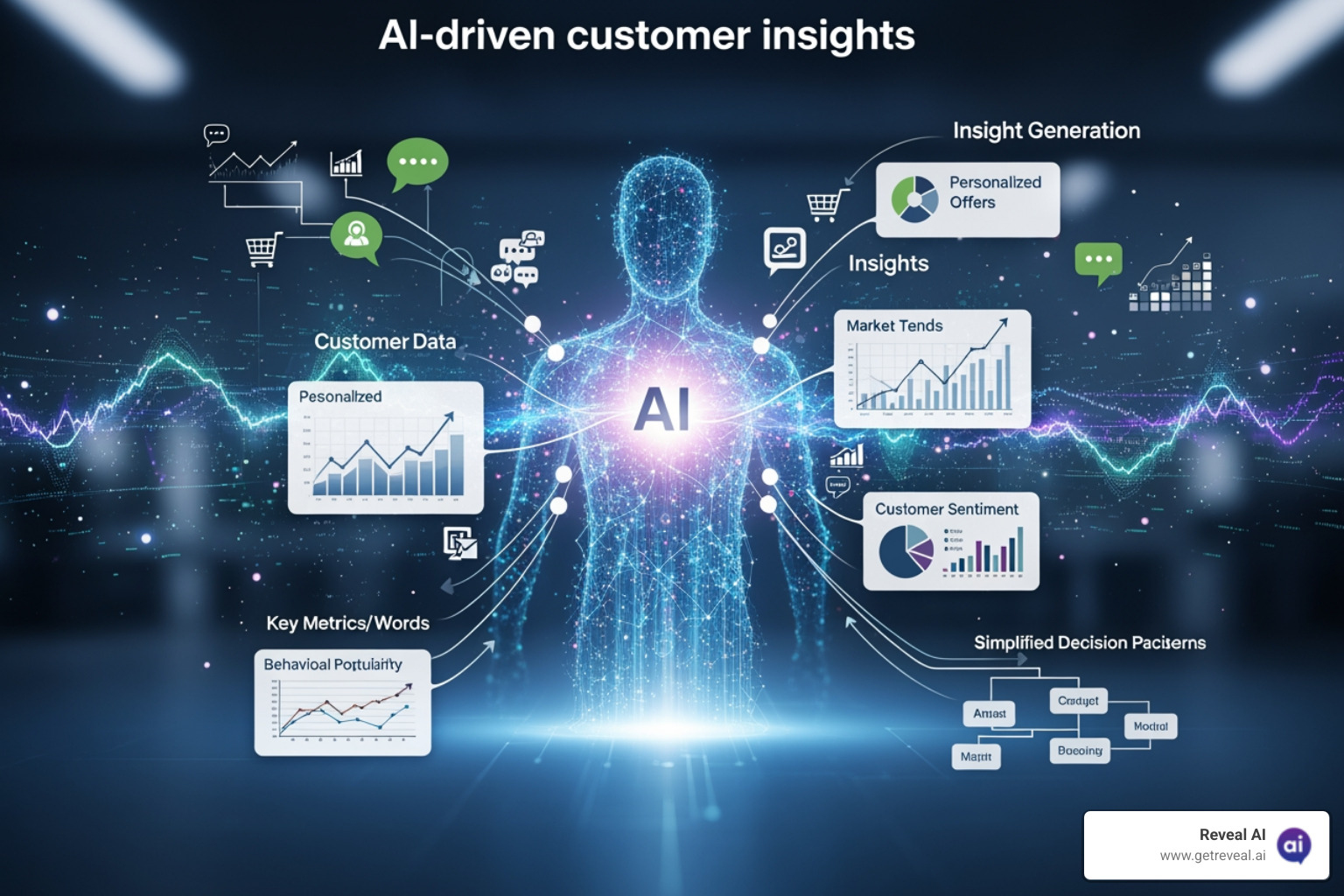

AI-driven customer insights are the result of using artificial intelligence to analyze customer data — including behavior, preferences, feedback, and sentiment — faster and more accurately than any human team can manage alone.
Here is a quick breakdown of what they are and why they matter:
Think about the sheer volume of customer signals flying around every day — interviews, survey responses, reviews, support notes. Organizations now generate four times more unstructured data than structured data. Manual coding and analysis simply cannot keep up.
For market researchers and product teams, this creates a painful gap. The business wants answers now. But producing deep, trustworthy qualitative insights — the kind that hold up in a client presentation — takes time, rigor, and careful interpretation.
That gap is exactly what AI is built to close.
But not all AI is equal. Speed without trust is just fast guesswork. The most forward-thinking research teams are not just adopting AI for efficiency — they are demanding AI that is research-grade: transparent, attributable, and verifiable.
That is the philosophy behind Reveal AI. Trust first, not novelty first.
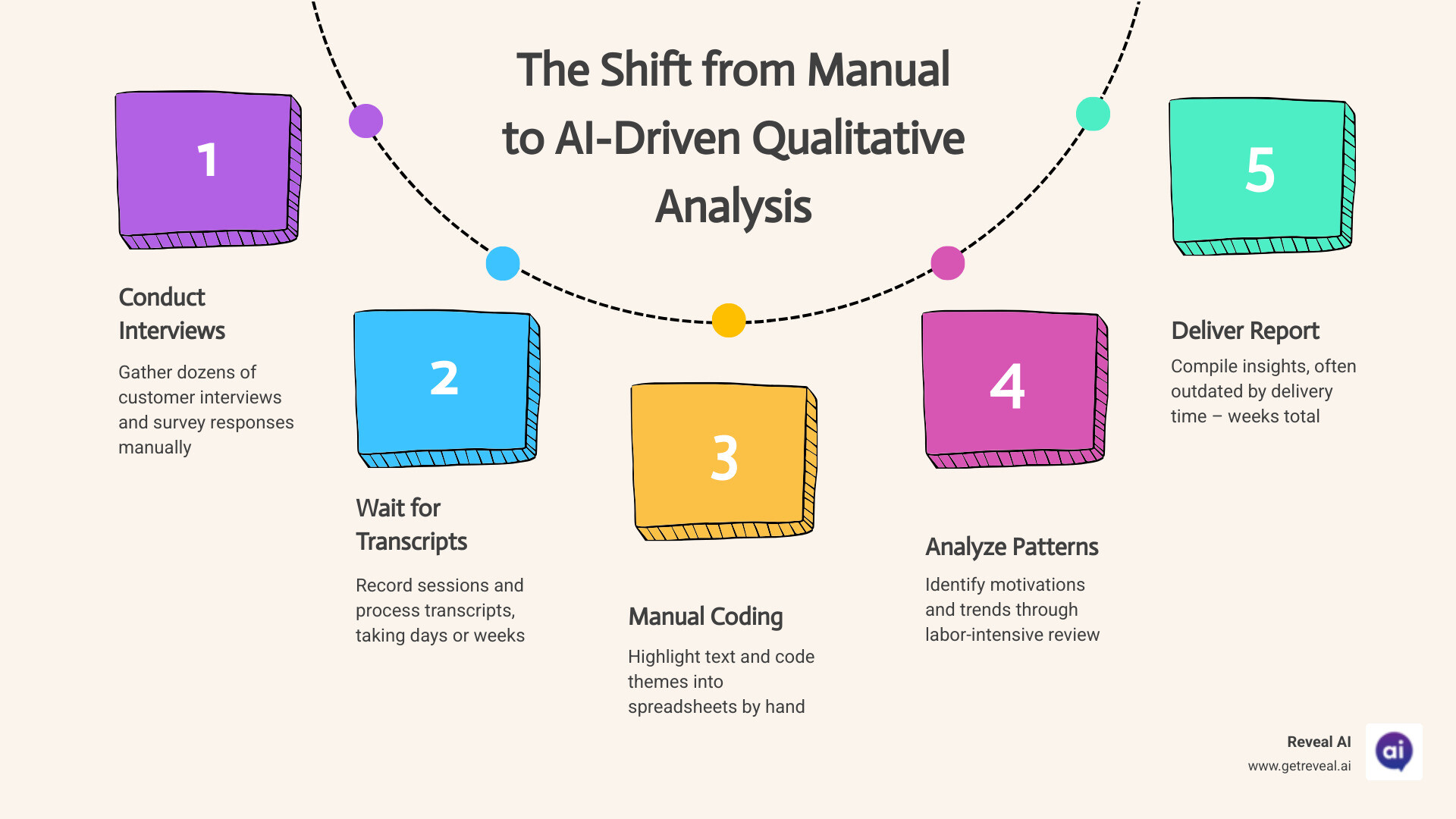
In the old days (which, in tech years, was about three years ago), qualitative research was a marathon. If you wanted to understand the "why" behind customer behavior, you had to conduct dozens of interviews, record them, wait for transcripts, and then spend weeks highlighting text and "coding" themes into a spreadsheet. By the time you had a report ready, the market had often already moved on.
Today, we are seeing a massive paradigm shift. AI-driven customer insights allow us to move at the speed of conversation. Unlike traditional data analysis methods that often stop at "what" happened (e.g., 20% of users dropped off), AI tells us "why" it happened by processing thousands of open-ended responses in real-time.

Traditional qualitative research is notoriously difficult to scale. You can't easily interview 1,000 people one-on-one without an army of moderators and a massive budget. Reveal AI changes that math. Our AI research platform conducts short, conversational interviews at scale, allowing you to reach hundreds or thousands of participants simultaneously.
Research shows that AI can save professionals up to 3.6 hours per week through automation — that’s nearly a month of vacation time every year! In market research, some teams report saving up to 80% of their analysis time compared to manual coding in legacy tools.
Human analysts are brilliant, but we are also prone to fatigue and "confirmation bias"—the tendency to look for answers that prove what we already believe. AI doesn't get tired. It can sift through vast amounts of unstructured data — images, emails, chat logs, and long-form survey answers — to find the "hidden" signals that a human might blink and miss.
FeatureTraditional Qualitative AnalysisReveal AI-Driven InsightsAnalysis TimeWeeks or MonthsHours or DaysScalabilityLimited by human headcountVirtually unlimitedData TypeMostly structured/limited qualMassive unstructured datasetsBias RiskHigh (Human subjectivity)Low (Algorithmic consistency)AttributionManual & slowInstant with direct quotes
According to IBM, unstructured data reflects the biggest opportunity for businesses today because it contains the raw, unfiltered voice of the customer.
To truly know a customer, you have to understand their language. This is where Natural Language Processing (NLP) comes in. We use NLP to go beyond simple keyword counting. We look for intent, emotion, and behavioral patterns.
When we conduct conversational AI interviews, the platform doesn't just ask a static question. It analyzes the response in real-time. If a participant gives a brief or vague answer, the AI can dynamically probe deeper to get the "why" behind the answer. This automated qualitative analysis ensures that the data we collect is rich and meaningful, not just a pile of "yes/no" responses.
Why do customers leave? Why do they choose a competitor? These are qualitative questions that require qualitative answers. By using ai driven customer insights, we can identify the qualitative drivers of market trends with precision.
Predictive analytics plays a huge role here. While traditional analytics looks at the past, AI uses that past data to forecast future behavior. For example, by analyzing the sentiment and specific complaints in open-ended feedback, we can predict which customer cohorts are at the highest risk of churning before they actually cancel.
This level of audience intelligence allows product teams to map customer journeys with rich, verifiable data. Instead of guessing where the friction is, you can see the exact moments where customers feel frustrated or delighted, backed by their own words.
How does this look in the real world? It’s more than just fancy charts; it’s about making better business decisions.
In the rush to adopt AI, many companies have fallen into the "novelty trap." They use generic LLMs (Large Language Models) that are prone to "hallucinations"—making things up that sound confident but are factually wrong. For a market researcher, a hallucinated insight is worse than no insight at all; it’s a liability.
At Reveal AI, our core philosophy is Trust First. We believe that for AI to be useful in research, it must be verifiable.
Data privacy isn't just a legal requirement; it's the foundation of the researcher-participant relationship. We ensure full GDPR compliance and adherence to CCPA standards. But we go a step further with our "Walled Garden" data integrity model.
Generic AI tools often train on public web data, which can introduce noise and bias. Our AI operates within a secure environment using only the data provided for that specific project. This eliminates the risk of outside data "polluting" your results.
By focusing on text-based conversational AI, we maintain a clean, high-quality data stream that is easier to verify and protect.
The biggest challenge with AI today is the "Black Box" problem — insights go in, a summary comes out, but you have no idea where it came from. Reveal AI solves this through direct attribution.
Every insight our platform generates is backed by direct quotes from real participants. If the AI says, "Users are frustrated with the checkout process," you can click a button and see the exact quotes from the 50 people who said so. This market research without doubt is what gives researchers the confidence to present findings to stakeholders.
Our leveraging AI in market research approach includes:
We know that integrating AI into an existing strategy isn't always a walk in the park. Businesses often face three main hurdles:
The future of research isn't about replacing humans; it's about giving them superpowers. As AI continues to evolve, we will see even more nuanced "multi-level clustering," where AI can detect subtle shifts in consumer sentiment before they become mainstream trends.
We are moving toward a world of "always-on" insights. Imagine a brand that doesn't just do a "quarterly study," but has a continuous, conversational pulse on its audience. This allows for:
At the end of the day, ai driven customer insights are only as valuable as the trust you place in them. In an era of deepfakes and AI hallucinations, being the "trusted voice" in the room is a competitive advantage.
By choosing a research-grade platform like Reveal AI, you aren't just getting faster results. You are getting a verifiable, attributable, and secure window into the minds of your customers. You are moving from "we think" to "we know," backed by the irrefutable truth of the customer's own words.
Ready to see what your customers are really thinking? It’s time to move beyond the spreadsheet and into the conversation.
Key Takeaways for Researchers:
Learn more about our AI research platform and how we can help you turn customer voices into your most powerful strategic asset.