Why Trustworthy Qualitative Research Matters More Than Ever
What is employee listening in the context of qualitative research? For market research firms and UX teams, it is a strategic stream of qualitative inquiry focused on gathering, analyzing, and acting on open-ended feedback from internal or external stakeholders. It is about understanding the "why" behind behaviors and experiences to drive product innovation and organizational strategy.
Quick Answer: Qualitative Research Defined
- What it is: A continuous process of collecting qualitative feedback through conversational methods (AI-powered interviews, open-ended surveys) to uncover motivations and unmet needs.
- Why it matters: Research-driven organizations are 6x more likely to exceed financial targets when they leverage deep human insights.
- The challenge: Traditional qualitative methods are slow and prone to analyst bias, leading to delayed insights and eroded client trust.
- The solution: An AI-powered qualitative research platform that scales conversational insights while maintaining trust, attribution, and verifiability.
Research teams face mounting pressure to deliver insights faster without sacrificing scientific rigor. Generic AI tools promise speed but introduce significant risks: hallucinations, lack of attribution, and a loss of nuance. Meanwhile, 81% of professionals in research-heavy roles report burnout, largely from the manual analysis of unstructured data.
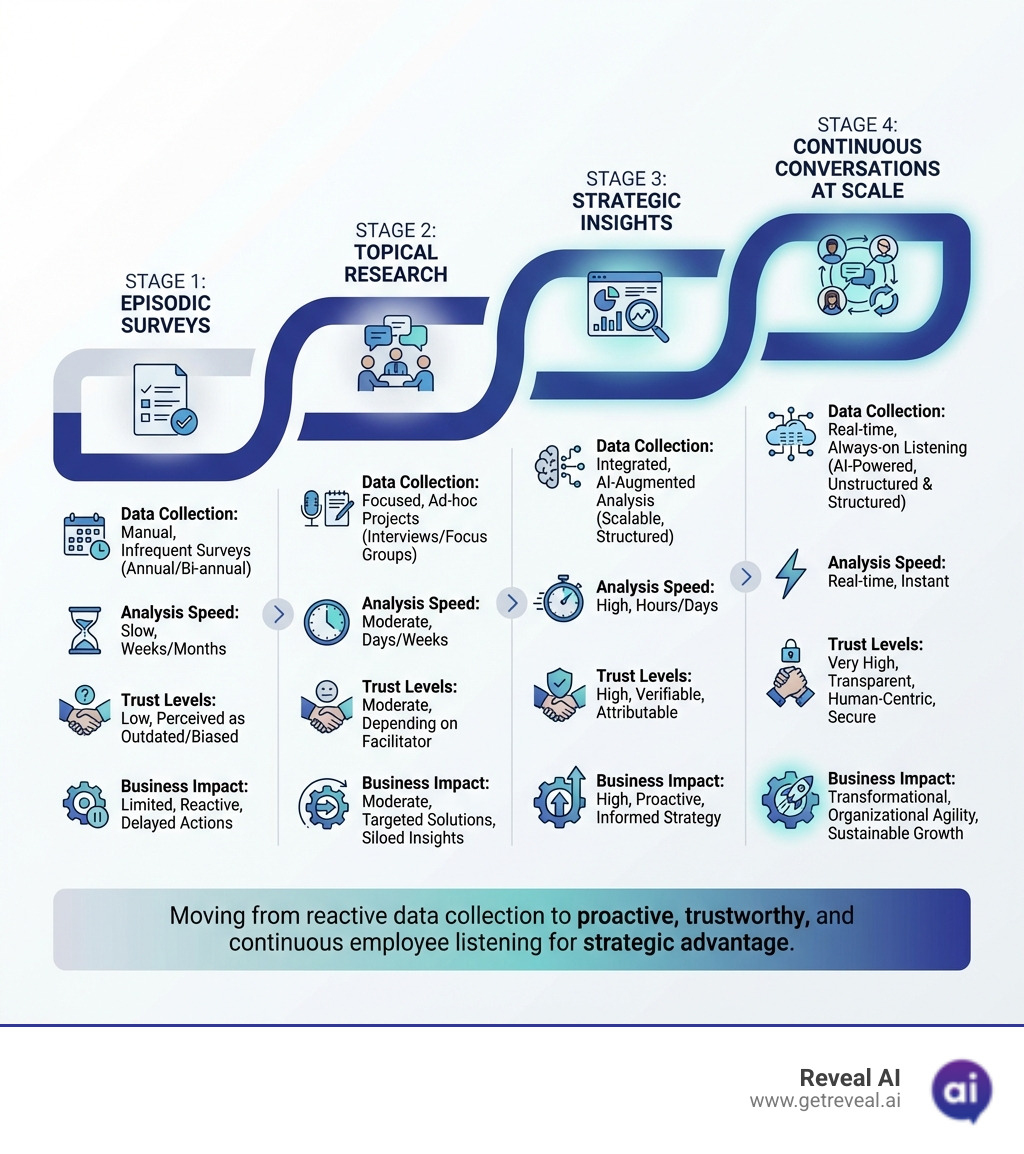
The most mature research organizations—those operating at "Continuous Conversations at Scale"—are 9x more likely to achieve high customer satisfaction. They have moved beyond episodic data collection to structured, continuous qualitative research powered by research-grade AI.
This shift requires a fundamental change: moving from generic AI tools to platforms built specifically for researchers, with guardrails that ensure every insight is verifiable and attributable to real human sources.
Easy what is employee listening word list:
- AI for workforce
- qualitative research AI
What is AI-Powered Qualitative Research and Why is it a Strategic Imperative?
In the modern research landscape, analysts often find themselves drowning in numbers but starving for meaning. We know what is happening, but we rarely understand why. This is where an AI-powered qualitative research platform becomes a strategic imperative. It allows research teams to move beyond the rigid constraints of multiple-choice questions and enter the realm of genuine human sentiment.
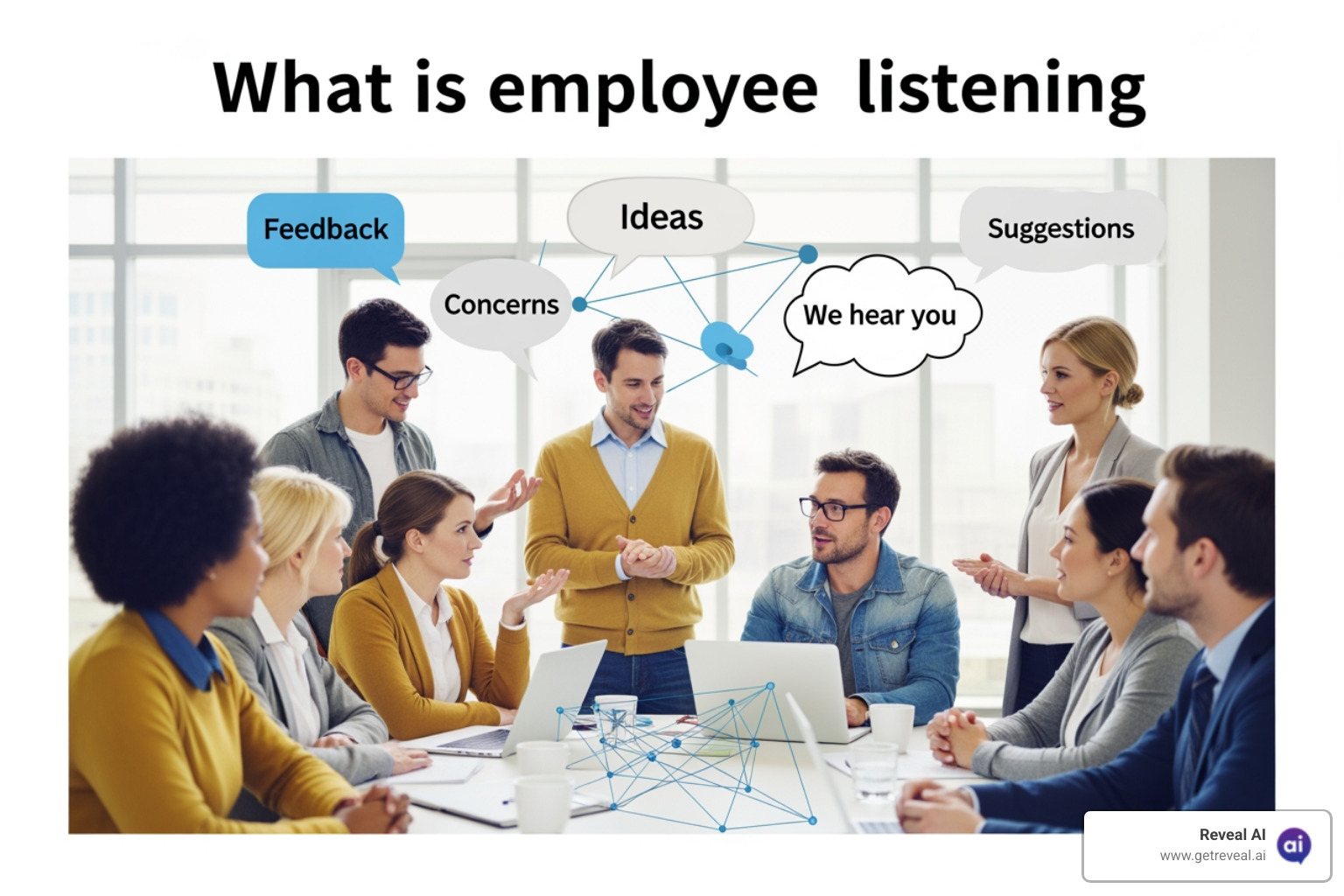
By aligning research efforts with business goals, organizations ensure every "listening event" serves a purpose. Whether you are exploring the role of AI in research or looking for more info about AI-powered qualitative research use cases, the objective remains the same: to turn user voices into business decisions rapidly and reliably.
Defining AI-powered qualitative research in the modern research landscape
To truly understand what is employee listening as a research methodology today, we must look at how technology has evolved the practice. In the past, qualitative research meant manual, time-consuming interviews that were impossible to scale. Today, we use AI-powered qualitative research platforms to conduct conversational AI interviews that feel natural to the participant but provide structured, verifiable data to the researcher.
This modern approach prioritizes:
- Data Verifiability: Ensuring every insight can be traced back to a specific, anonymized human source.
- Researcher Trust: Providing tools that augment a researcher’s skills rather than replacing them with "black box" algorithms.
- Multi-method Approaches: Combining pulse interviews with deeper thematic dives.
Research from Zenger Folkman highlights that the power of listening is a secret weapon for building trust. When we scale this through AI, we are fostering a thriving research culture where insights lead to real change.
The business impact of trustworthy qualitative insights
Trust is a currency in market research. According to Zenger Folkman, poor listening leads to low trust percentiles, while great listening reaches the 86th percentile. In a research context, this translates to the quality of the data you receive. If participants don't trust the process, they won't provide the "real" story.
When organizations implement high-quality listening, the results are transformative. McKinsey research on continuous user feedback shows that companies adopting a continuous-listening strategy build a distinct competitive advantage. This is about strategies to accelerate research team success. When 74% of participants feel heard, the ROI on your qualitative research platform becomes undeniable.
Overcoming common challenges in qualitative research
Traditional qualitative research can be a nightmare to manage. Between survey fatigue and researcher burnout, the system often breaks down. A 2024 report found that 81% of research professionals are burned out due to the sheer volume of unstructured data they must manually code.
Common hurdles include:
- Inaction: Collecting feedback and doing nothing with it, which erodes participant trust.
- Lack of Attribution: Knowing a theme exists but not being able to prove who said it or why it matters to a specific demographic.
- Confidentiality: Ensuring participants feel safe sharing concerns about sensitive topics.
Using an HBR guide on turning feedback into action is a great start, but you also need the right tools. Understanding how real-time qualitative feedback enhances research practices allows us to address these challenges head-on, replacing manual drudgery with automated, research-grade analysis.
How to Implement a High-Maturity Qualitative Research Strategy
Implementing a strategy for what is employee listening requires more than just buying software; it requires a shift in research maturity. Most organizations start at Stage 1 (Episodic), where they run one big survey a year. The goal is to reach Stage 4 (Continuous), where qualitative inquiry is baked into the daily flow of work.
Leveraging diverse channels and the research calendar
A robust strategy doesn't rely on a single channel. We recommend a "multi-method" approach that creates a continuous dialogue. This might include:
- Pulse Interviews: Short, frequent conversational checks.
- Focus Groups: Targeted sessions for deep dives into specific issues.
- Research Panels: Leveraging specialized groups to ensure underrepresented voices are heard. McKinsey reports that 83% of participants feel more included when these groups are used effectively.
An ideal research calendar doesn't just schedule the "ask"; it schedules the "action." This includes monthly "You Said → We Did" updates to keep the feedback loop closed. For more on how to structure these groups, see the McKinsey report on effective research groups.
FeatureEpisodic Strategy (Low Maturity)Continuous Strategy (High Maturity)FrequencyOnce a yearWeekly or "Always-on"Data TypeQuantitative (Scores only)Qualitative (The "Why")AnalysisManual (Takes weeks)AI-Powered (24-48 hours)ActionDelayed or non-existentReal-time and transparentTrustLow (Transactional)High (Relational)
Scaling qualitative insights with research-grade AI
The secret to high-maturity research is scaling without losing the human touch. We use Natural Language Processing (NLP) to analyze thousands of open-ended responses in the time it used to take to read ten. However, not all AI is created equal.
RevealAI utilizes a Walled Garden data integrity model. Unlike generic AI that might hallucinate or use public web data, our platform operates only on the data you provide. This ensures:
- Verifiable Trust: You can verify every theme with a direct quote.
- Attribution: We provide the "who" behind the "what" while maintaining necessary anonymity.
- Structure: Turning messy conversations into clean, actionable reports.
For a deeper look at how this works, check out the role of AI in modern research.
Measuring ROI and sustaining long-term research impact
If you need to convince the C-suite that what is employee listening matters, talk about the bottom line. It costs between 6 and 9 months of a researcher's salary to replace them. For a senior analyst earning $100k, that’s a $75k mistake every time someone walks out the door.
By using RevealAI to identify risks early, organizations can see a massive reduction in turnover. One platform user reported a 46% average reduction in turnover by simply listening and acting on qualitative data.
To sustain this, adopt the "You Said → We Did" loop. Transparency is the best antidote to survey fatigue.
- Research on the cost of replacing researchers
- More info on the "You Said → We Did" feedback loop
- Start your AI-powered qualitative research journey
Comparing Reveal AI to Other Survey and Research Platforms
When exploring what is employee listening and the tools available, it’s easy to get distracted by flashy features. However, for research-grade work, the "Trust First, Not Novelty First" philosophy is non-negotiable.
Most common survey providers (like those used for simple polls or basic engagement scores) fall short in three critical areas:
- Lack of Attribution: They can tell you people are unhappy, but they can't give you the specific quotes or context needed to fix it.
- Generic AI Risks: Many platforms have "bolted on" AI that may hallucinate or fail to capture the nuance of industry-specific language.
- Data Privacy: Generic tools often use open-web models that put sensitive internal data at risk.
Reveal AI sets itself apart by focusing on verifiability. We provide human source verification and direct quote attribution for every insight generated. Our "Walled Garden" approach means your data stays yours, and our AI is trained to be a researcher’s assistant, not a replacement. This ensures that the insights you present to leadership are grounded in reality, not algorithmic guesswork.
For a more detailed breakdown of how we compare to others in the market, visit our RevealAI Resources page.
Conclusion: The Future of Qualitative Research is Trustworthy, Scalable, and AI-Powered
As we have explored, understanding what is employee listening is no longer just an HR checkbox—it is a sophisticated branch of qualitative research that drives business survival. In an era of constant disruption, the organizations that "come off mute" and truly listen to their people will be the ones that thrive.
Key takeaways for your strategy:
- Trust is everything: Without verifiability and attribution, your data is just noise.
- Maturity matters: Strive to move from episodic surveys to continuous, AI-powered conversations.
- Action is the goal: Use the "You Said → We Did" loop to maintain engagement and prevent researcher burnout.
The future of research belongs to those who can scale the human voice without losing its soul. By prioritizing research-grade AI and data integrity, your team can lead with confidence, innovation, and unwavering client trust.
Explore Reveal AI’s platform or request a demo today and transform your feedback into a strategic advantage.