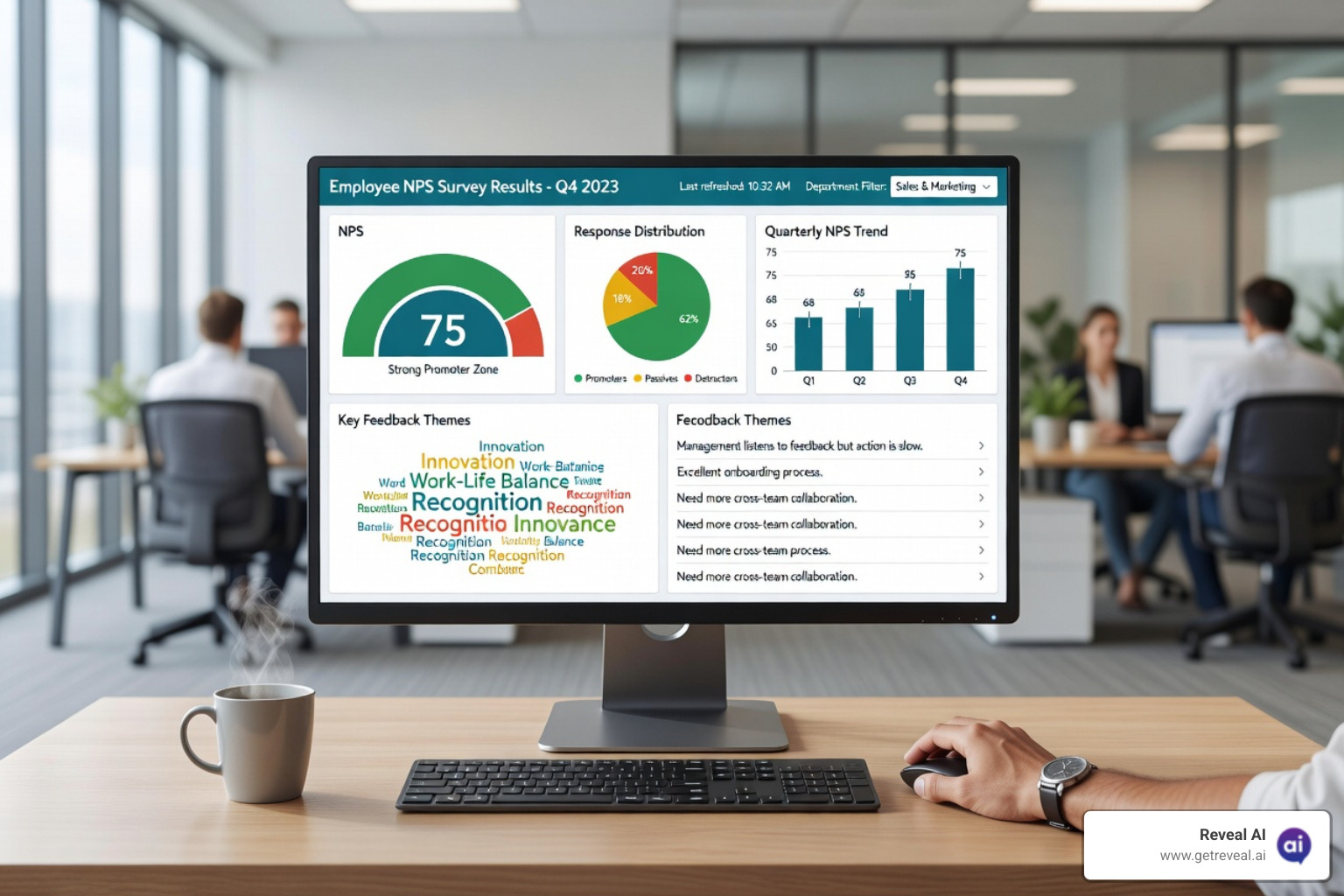

Why Employee Net Promoter Score Tools Are Critical for Understanding Sentiment
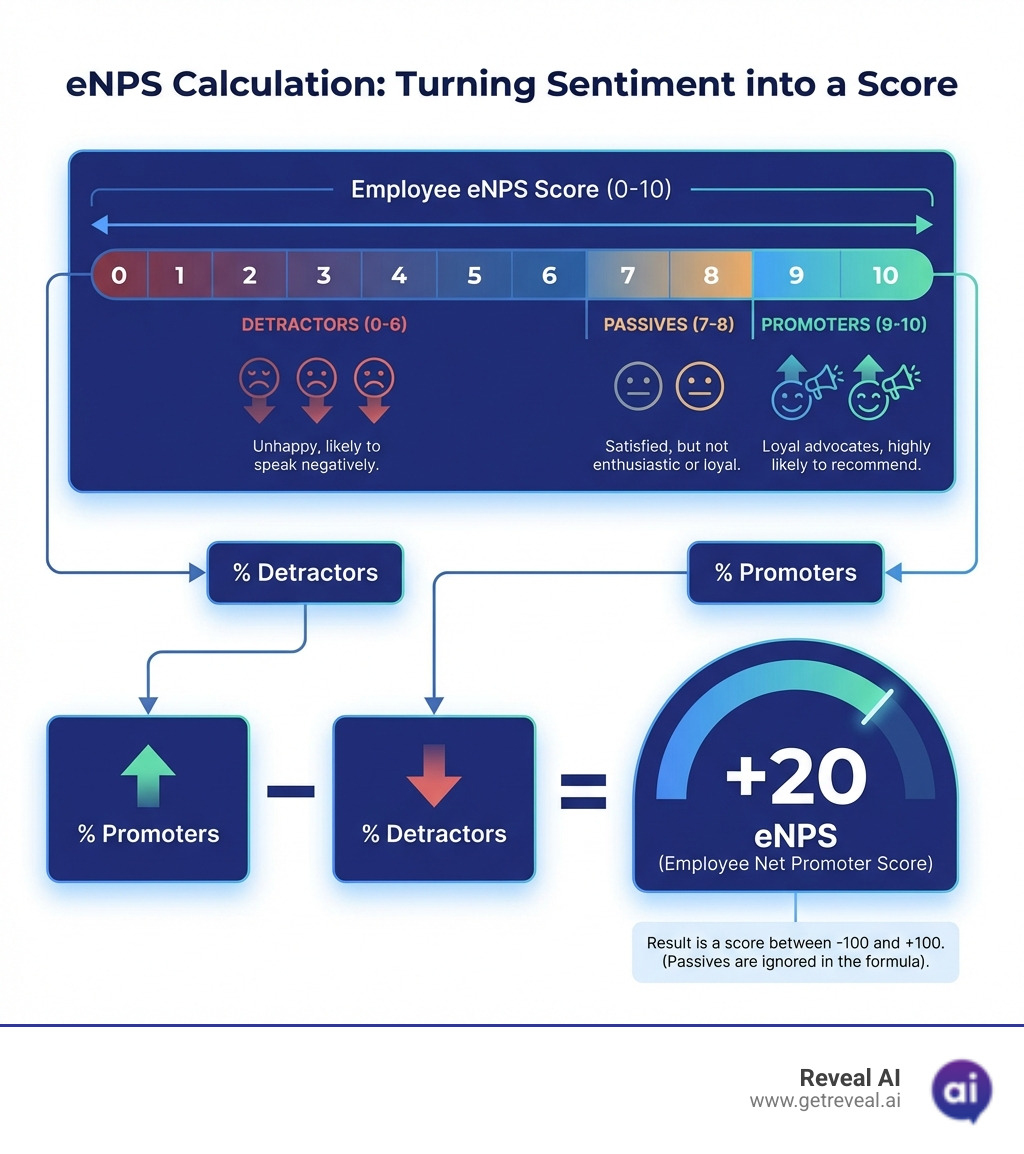
An eNPS survey tool measures how likely employees are to recommend your organization as a great place to work. These tools typically ask one simple question on a 0-10 scale, then categorize responses into Promoters (9-10), Passives (7-8), and Detractors (0-6). The score is calculated by subtracting the percentage of Detractors from the percentage of Promoters, resulting in a number between -100 and +100.
Top eNPS Survey Tools at a Glance:
| Tool | Best For | Key Feature |
|---|---|---|
| RevealAI | Market research firms, product teams | Research-grade AI with quote attribution |
| Delighted | High-volume surveys | Powers 300M+ surveys annually |
| Culture Amp | People science approach | Industry benchmarks & analytics |
| BambooHR | HR systems integration | Native HRIS connectivity |
| Empuls | Recognition programs | Links feedback to rewards |
Most companies see a "good" eNPS score as +10 to +30, though this varies by industry. Scores above +30 indicate strong employee loyalty. The metric gained popularity because it provides a quick pulse check on workforce sentiment—something that's become critical as organizations face retention challenges.
But here's the problem most research teams encounter: a number alone doesn't tell you what to fix. When an employee rates your organization a 6, you know they're a Detractor. You don't know why. As one frustrated employee put it in survey feedback: "I am disappointed that our Medical insurance provider hasn't changed after the complaints during last year’s enrollment. Can we at least get clarity when things don’t change, if we’re expressing our opinions every year?"
That quote reveals the real issue. Basic eNPS survey tools collect scores, but they don't capture the nuanced context that market researchers and product teams need to drive strategic decisions. Traditional platforms leave you with data but no actionable intelligence—just a score that might look good in a board meeting but offers little guidance for improvement.
For research professionals, this creates a dilemma. You're under pressure to use AI for speed and cost savings, but generic survey tools and AI analysis risk hallucinations, loss of nuance, and declining client trust. The solution isn't abandoning quantitative metrics like eNPS. It's pairing them with research-grade qualitative depth that provides verifiable, attributed insights.
Understanding the eNPS Methodology: More Than Just a Score
The Employee Net Promoter Score (eNPS) is a metric adapted from the customer-focused Net Promoter Score (NPS) to gauge employee loyalty. For market and product research teams, it provides a quantitative pulse check on employee sentiment, which is a powerful leading indicator of brand health and potential product delivery issues. But its strategic value is only open uped by analyzing the qualitative data behind the score.
What is an eNPS Survey Tool and How is the Score Calculated?
An eNPS survey tool asks one core question: "On a scale from 0–10, how likely are you to recommend working at [your company] to a friend or colleague?" Responses are categorized as:
- Promoters (Scores 9-10): Enthusiastic advocates who positively influence brand perception.
- Passives (Scores 7-8): Satisfied but neutral employees.
- Detractors (Scores 0-6): Unhappy employees who may pose a risk to brand reputation and productivity.
The score is calculated with a simple formula:
eNPS = (% of Promoters) – (% of Detractors)
The result is a score between -100 and +100. For more on the metric's origins, see the Employee Net Promoter Score Wikipedia entry.
The Benefits and Benchmarks of eNPS
While simple, eNPS offers several benefits for research teams when used as a starting point for deeper analysis:
- Quick, Measurable Signal: eNPS provides a fast, digestible metric for tracking sentiment trends over time, allowing researchers to spot shifts in organizational health that could impact market perception.
- Indicator of Business Risk: A high number of Detractors can signal internal issues that affect productivity and innovation. For product teams, this is an early warning of potential downstream problems.
- Correlation with Business Outcomes: High eNPS scores are linked to better business performance, including revenue growth. For researchers, this connection validates the importance of employee experience as a driver of market success.
A "good" eNPS score is typically between +10 and +30, with scores above +30 considered excellent. However, the most valuable benchmark is an organization's own historical data, which allows for tracking progress and the impact of strategic initiatives.
Beyond the Score: Why a Basic eNPS Survey Tool Isn't Enough
While an eNPS score provides a quantitative signal, its core limitation for research teams is the actionability gap. A score tells you what employees feel, but not why. Without this context, the data is interesting but not actionable, making it impossible to formulate effective strategies. Relying on numbers alone is like navigating with an incomplete map—you know the general direction but lack the details to steer effectively.

Why Traditional eNPS Survey Tools Fall Short for Research Teams
Traditional eNPS survey tools are designed for pulse checks, not deep research. They fall short for market and product teams because they offer:
- Limited Qualitative Depth: Analysis of open-ended feedback is often superficial, relying on basic keyword searches that miss critical nuances.
- Survey Fatigue: Long, static follow-up surveys to get qualitative data lead to declining response rates and lower-quality feedback.
- Data Without Insight: Dashboards show numbers but fail to explain their meaning, making it difficult to connect employee sentiment to product or market outcomes.
- Risk of Cynicism: When feedback is collected without visible, meaningful action, employees lose trust in the process, compromising future data quality.
The Power of Conversational AI for Deeper Understanding
Research-grade conversational AI transforms employee feedback from a simple score into a rich source of strategic insight. RevealAI's AI-powered qualitative research platform is built for the rigor that market and product teams demand.
- Uncover Nuance with Conversational Surveys: Our platform uses short, conversational AI interviews that encourage natural, detailed responses, uncovering subtle drivers of sentiment that static forms miss.
- Verbatim Quotes for Direct Insights: We extract and analyze verbatim quotes, giving you authentic employee perspectives to validate findings and understand the emotional context behind the numbers.
- Research-Grade AI with Guardrails: Unlike generic AI, RevealAI is built for research. It operates with guardrails to prevent hallucinations and ensure accuracy, providing insights you can trust.
- Walled Garden Data Model: Our 'Walled Garden' model guarantees data integrity and confidentiality by analyzing your data in isolation, without pulling from the public web.
- Attribution and Trustworthy Insights: Every insight is backed by direct quote attribution. This transparency allows you to trace findings back to the source, building trust with stakeholders. For more on AI's role, read The Role of AI in HR.
By leveraging conversational AI, research teams can move beyond superficial scores to gain a deep, trustworthy understanding of employee sentiment that fuels strategic decisions.
Choosing the Right Research Platform: A Framework for Trust and Verifiability
For market research and product teams, choosing a platform to analyze employee feedback is a strategic decision. It's not about finding another eNPS survey tool; it's about adopting an AI research platform that delivers depth, trust, and verifiability. Our philosophy is "Trust first, not novelty first," prioritizing accuracy and data integrity above all.

Key Criteria for Selecting an Advanced Feedback Platform
When moving from eNPS scores to actionable insights, evaluate platforms on these criteria:
- Depth of Insight: Does it uncover the why behind the data, revealing motivations and context?
- Trust and Verifiability: Are insights backed by verifiable evidence, like direct quote attribution?
- Speed and Scale: Can it process large volumes of qualitative data quickly without sacrificing accuracy?
- Research-Grade Guardrails: Does the AI operate within ethical and methodological boundaries to prevent hallucinations and ensure research integrity?
This table compares how traditional tools stack up against a dedicated AI qualitative platform:
| Criteria | Traditional Survey Tools (e.g., Delighted, Culture Amp, Empuls) | AI-Powered Qualitative Platforms (e.g., RevealAI) |
|---|---|---|
| Depth of Insight | Limited; focuses on quantitative scores and basic keyword analysis of open-text responses. | High; uncovers nuance, motivations, and specific context through conversational AI interviews and advanced qualitative analysis. |
| Verifiability | Low to Moderate; open-text responses often summarized without direct attribution, prone to subjective interpretation. | High; every insight backed by direct quote attribution and human source verification for transparency and trust. |
| Analysis Speed | Moderate; manual review of open-text responses is time-consuming; automated summaries lack depth. | High; analyzes large volumes of qualitative data rapidly and accurately, delivering insights at scale. |
| Actionability | Moderate; "why" is often unclear, leading to generic or speculative action plans. | High; provides specific, attributed insights that directly inform targeted, strategic interventions. |
Why RevealAI Sets the Standard for eNPS Research
RevealAI is purpose-built for the demands of market and product research, where trust and depth are non-negotiable. We empower you to complement quantitative metrics like eNPS with reliable qualitative intelligence.
- Research-Grade AI: Our platform is engineered with robust guardrails to deliver accurate, verifiable analysis, preventing the hallucinations common in generic AI tools.
- Walled Garden Data Integrity: We operate within a strict 'Walled Garden' model. Your proprietary data is analyzed in complete isolation, ensuring confidentiality and security across regions like the United States and Europe.
- Verifiable, Attributed Insights: Every insight is tied directly to source quotes and includes human source verification. This transparency provides the evidence-based foundation needed for confident decision-making.
- A Trust-First Approach: We prioritize reliability over novelty. Our platform is designed to transform employee feedback into strategic business intelligence you can depend on.
Conclusion: Moving Beyond Scores to Strategic Insights
The eNPS survey tool is a useful starting point for measuring employee sentiment. However, for market research firms and product teams, a simple score is not enough. Traditional platforms often fail to analyze the critical "why" behind the numbers, creating an actionability gap and leaving strategic insights on the table.
The future of sentiment analysis lies in combining quantitative metrics with research-grade qualitative depth. RevealAI’s AI-powered qualitative research platform bridges this gap. By facilitating conversational surveys and delivering verifiable, attributed insights, we empower researchers to move beyond scores to strategic understanding. Our 'Walled Garden' data model and "Trust First" philosophy ensure you can convert employee feedback into confident business decisions.
Stop guessing "why" and start building strategy on a foundation of trustworthy, deep insights. A platform that prioritizes verifiability is key to understanding the feedback that can help you foster a thriving organizational culture and drive meaningful business impact.