No items found.

Blog
Unlocking Competitive Edge: AI for Market Intelligence Explained

Riddhi Patel


Market intelligence AI is changing how businesses gather and analyze consumer insights. It combines artificial intelligence with traditional research methods to deliver faster, more accurate, and more actionable market data. Here's what you need to know:
What Market Intelligence AI Does:
Key Capabilities:
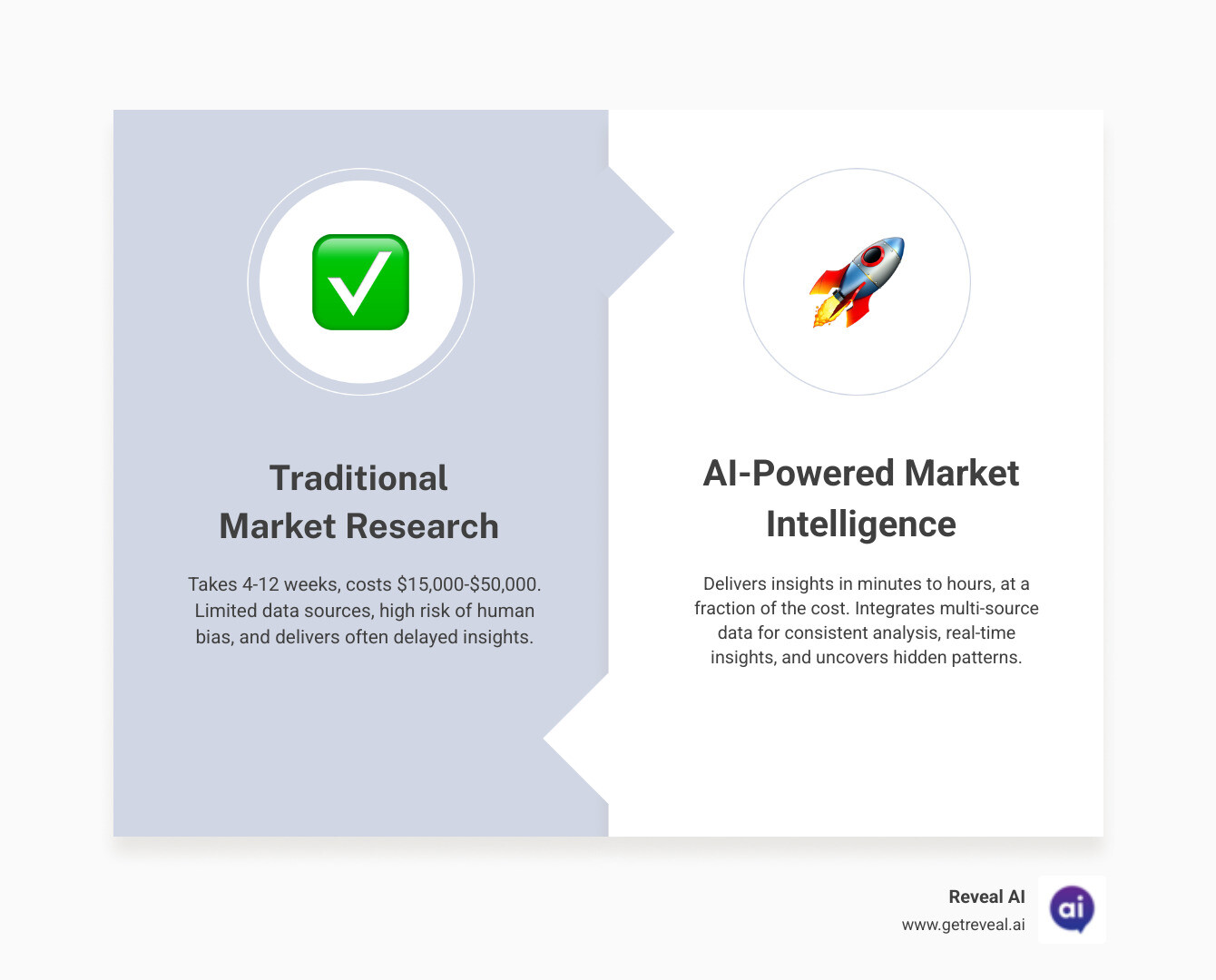
The global market research industry is valued at $140 billion. But traditional methods have a problem: they're slow and expensive. Custom market research typically takes 4-12 weeks and costs $15,000-$50,000. By the time insights arrive, market conditions have often changed.
AI-powered market intelligence platforms solve this speed and cost challenge. They process data from sources like conversational surveys and in-depth interviews simultaneously. They identify patterns humans might miss. And they generate actionable reports in real-time.
This shift matters for market researchers and product teams facing pressure to deliver insights faster while maintaining quality. The question isn't whether to adopt AI for market intelligence—it's how to do it right. Generic AI tools can hallucinate findings or lose critical nuance. Research-grade AI platforms built specifically for market intelligence offer the speed benefits without sacrificing accuracy or verifiability.
The stakes are high. Companies using AI market research report 74% improved product launch success rates and an 83% reduction in time-to-insight. Those still relying solely on traditional methods risk falling behind competitors who can spot opportunities and threats weeks or months earlier.
The integration of AI into market intelligence isn't just an upgrade; it's a fundamental shift that provides a powerful competitive edge. For market researchers and product teams, this means moving beyond reactive analysis to proactive strategy. Here are five critical ways market intelligence AI empowers businesses:
One of the most profound impacts of market intelligence AI is the dramatic reduction in time-to-insight. Traditional market research can be a marathon, often taking anywhere from 4 to 12 weeks to complete. This lengthy process, coupled with costs ranging from $15,000 to $50,000, often means that by the time insights are delivered, market conditions have already shifted.
Our AI-powered qualitative research platform revolutionizes this. We automate many of the time-consuming and repetitive tasks that bog down traditional research. From data collection to the initial phases of analysis and even report generation, AI streamlines the entire process. This means that instead of waiting months, market researchers can gain actionable insights in minutes or hours, and at a fraction of the cost.
AI tools are adept at analyzing vast amounts of data quickly, identifying patterns that human analysts might miss due to sheer volume or complexity. By leveraging large language models (LLMs), these tools add a layer of intelligence to existing workflows, enhancing their capability to process and interpret information. The result is a significant acceleration in the research cycle, allowing for faster, more efficient, and data-driven decision-making. This shift allows our users to focus their valuable time on strategic interpretation and action, rather than manual data grunt work.
To understand more about this change, explore The Evolution of Market Research.
Understanding the 'why' behind customer actions and opinions is paramount for any business. Market intelligence AI excels at delving into the nuances of customer sentiment and behavior, particularly through the analysis of qualitative data.
Our AI-powered qualitative research platform is specifically designed to transform open-ended consumer feedback into actionable intelligence. We achieve this by employing advanced Natural Language Processing (NLP) to analyze conversational survey responses. This allows us to uncover key themes, emotions, and trends hidden within vast amounts of text-based feedback. We can identify what customers truly feel, what motivates their decisions, and what pain points they experience, providing a depth of understanding that is difficult and time-consuming to achieve manually.
This capability moves beyond surface-level metrics to provide rich, contextual insights. By structuring and analyzing qualitative feedback at scale, we empower market researchers to gain a holistic view of customer sentiment and behavior patterns. This deeper understanding is critical for refining product offerings, optimizing marketing messages, and better meeting customer needs.
For more on how AI can bring structure to qualitative data, read about Why Multi-Level AI Clustering is a Game-Changer for Market Research.
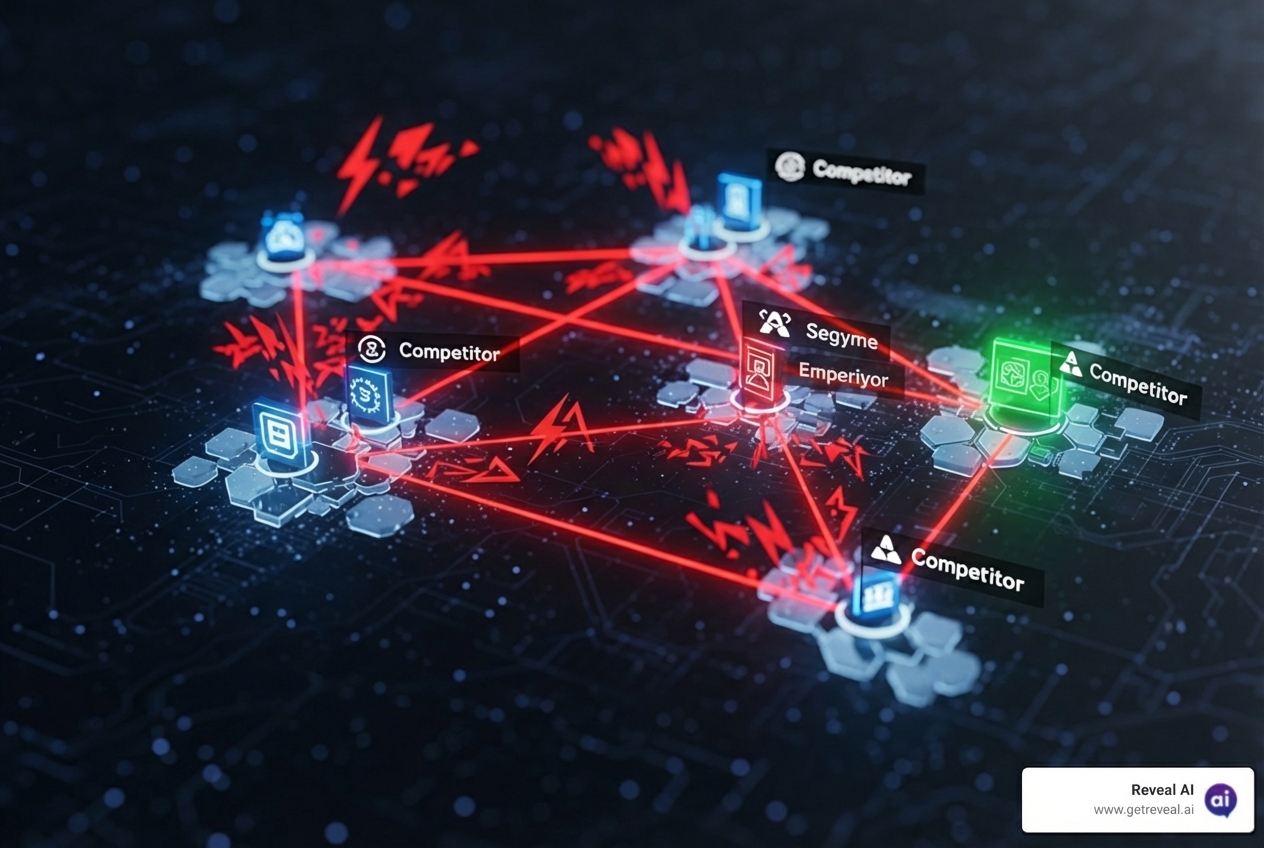
In today's business environment, staying ahead of the competition requires more than just knowing what they're doing now—it requires anticipating their next move. Market intelligence AI plays a crucial role in competitive intelligence gathering and analysis, offering businesses a strategic advantage.
While our AI-powered qualitative research platform focuses on delivering unparalleled customer insights, these insights are invaluable for informing competitive strategy. By understanding customer needs and preferences in depth, we help businesses identify market gaps, anticipate shifts in demand, and pinpoint areas where competitors may be underperforming. This customer-centric view provides a unique lens through which to evaluate the competitive landscape.
By analyzing qualitative feedback, businesses can uncover what customers value, where their pain points are, and how they perceive competitors. These insights allow companies to identify strategic opportunities, such as market gaps competitors are failing to address or areas where a product can be differentiated. This customer-centric approach to competitive analysis provides a powerful, evidence-based foundation for making informed decisions to maintain or gain market leadership.
Understanding the broader landscape of predictive market intelligence is key to leveraging these capabilities. You can explore more about this at Predictive Market Intelligence.
The ability to look into the future and anticipate market shifts is the holy grail of market intelligence. Market intelligence AI is making this a reality through advanced predictive analytics and hyper-personalization.
AI algorithms are no longer limited to merely reporting on past trends; they are increasingly capable of forecasting future trends with remarkable accuracy. By analyzing vast datasets—including historical performance, economic indicators, and customer behavior patterns—AI can identify subtle signals and project potential market trajectories. This predictive capability allows businesses to proactively adjust their strategies, optimize resource allocation, and capitalize on emerging opportunities before competitors.
Furthermore, AI enables a new level of personalization in market research and marketing efforts. By analyzing individual customer data, AI can identify preferences, predict future behaviors, and even anticipate needs. This hyper-personalization allows for more targeted product development, customized marketing campaigns, and a more relevant customer experience. Our qualitative insights, derived from conversational surveys, provide the 'why' behind these predictive models, offering rich context that improves their accuracy and actionable nature. By understanding the underlying motivations and sentiments, businesses can develop more effective predictive models and truly tailor their offerings.
For a deeper dive into how AI can predict future trends and personalize experiences, refer to Leveraging AI in Market Research.
Traditional market research, while valuable, can sometimes be susceptible to human biases in data collection, interpretation, and reporting. Market intelligence AI offers a powerful solution by significantly improving research accuracy and reducing these inherent biases.
AI tools process data with objective algorithms, eliminating the subjective interpretations that can creep into manual analysis. Our AI-powered qualitative research platform, for instance, provides consistent analysis of open-ended feedback, ensuring that patterns and themes are identified based purely on the data, rather than a researcher's preconceived notions. This systematic approach allows us to process large-scale datasets without fatigue or oversight, identifying subtle patterns that humans might easily miss.
The result is more reliable and trustworthy insights. By minimizing human error and ensuring neutrality in bias control, AI empowers market researchers to make decisions based on a clearer, more accurate understanding of the market. This improved accuracy is crucial for building confidence in research findings and ensuring that strategic decisions are grounded in verifiable data.
Find how AI is making research more reliable and trustworthy by visiting Market Research Without Doubt, Powered by AI.
Embracing market intelligence AI is no longer optional for businesses aiming to maintain a competitive edge. However, a strategic approach is essential to harness its full potential while mitigating potential risks.
Integrating AI tools into existing market research workflows requires careful planning. The goal is to augment human capabilities, not replace them. While AI can automate many tasks, human expertise remains critical for interpreting nuanced insights, validating findings, and formulating strategic recommendations.
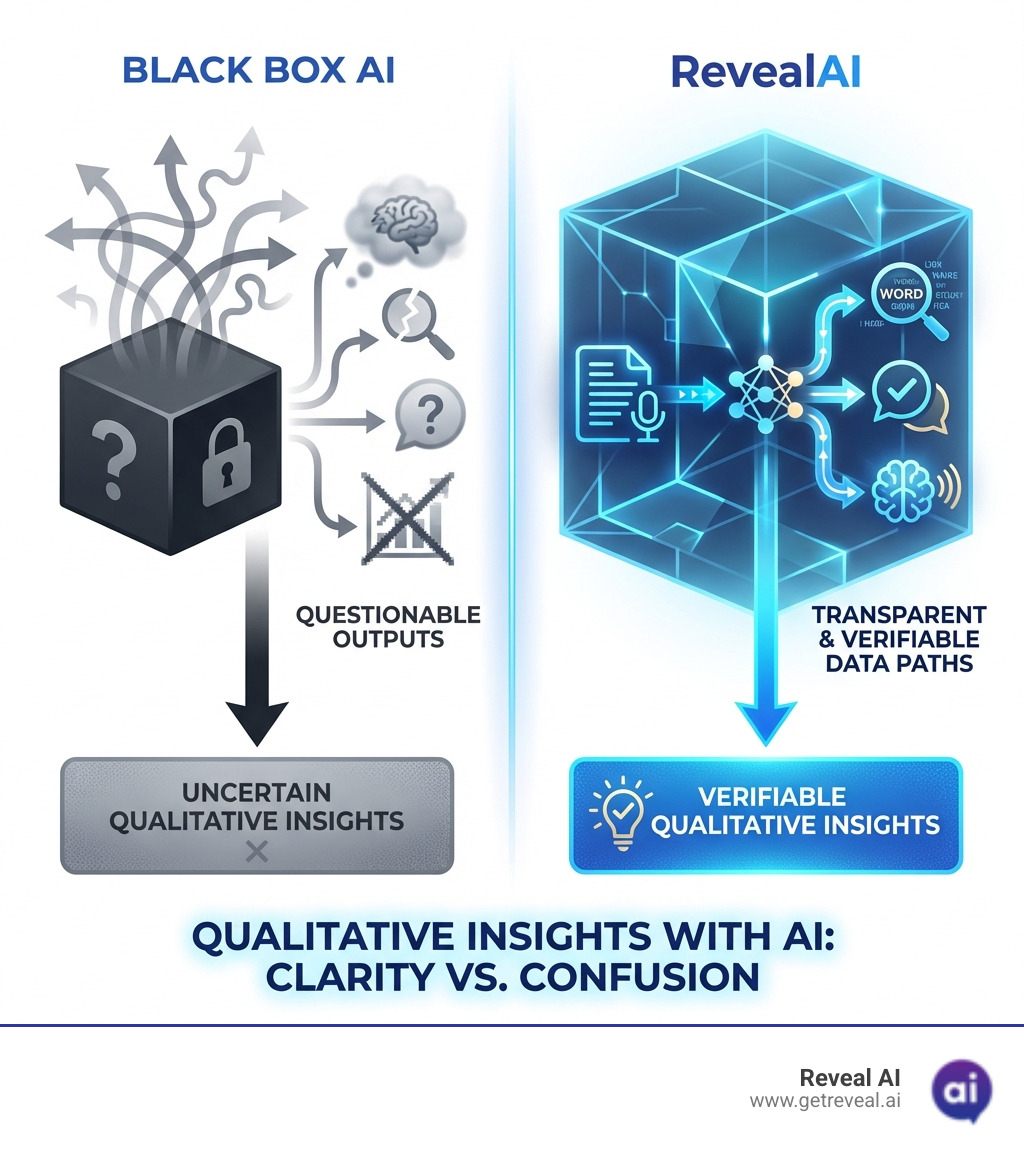
One of the significant challenges with generic AI tools is the risk of "hallucinations"—where the AI generates plausible but incorrect information. There's also the concern of a lack of attribution, where the source of insights is unclear, and a potential loss of nuance from qualitative data. These issues can lead to declining client trust and flawed decision-making.
This is where our approach at Reveal AI shines. We believe in "Trust first, not novelty first." Our AI-powered qualitative research platform is built with research-grade AI and built-in guardrails specifically designed to address these challenges. We operate within a "Walled Garden" data integrity model, meaning our AI analyzes data that is securely collected and within a controlled environment, ensuring no external web data is unknowingly introduced. This commitment to data integrity and security is paramount.
Crucially, our platform provides insights with direct quotes for attribution, maintaining transparency and allowing for human source verification. This ensures that every insight can be traced back to its origin, giving market researchers the confidence and verifiability they need. By integrating such robust AI tools, businesses can streamline their processes, focusing on higher-level analytical tasks and strategic planning. We help market researchers improve their Audience Intelligence by providing reliable, in-depth insights into their target demographics.
The future of market intelligence AI is not just about speed and automation; it's fundamentally about trust and verifiability. As AI capabilities continue to evolve, we will see even more advanced predictive analytics, hyper-personalization driven by deeper customer insights, and the automation of an increasing number of repetitive research steps, freeing up researchers for more strategic work. AI will continue to act as a powerful co-pilot, enhancing human intelligence rather than replacing it.
However, the proliferation of AI tools also underscores the importance of choosing platforms that prioritize accuracy, transparency, and ethical data handling. The market research industry needs "research-grade AI" that delivers insights that are not only fast but also rigorously defensible. This means AI that provides clear attribution, avoids hallucinations, and respects data privacy.
At Reveal AI, we are committed to leading this charge. Our core philosophy of "Trust first, not novelty first" guides our development. We ensure our AI-powered qualitative research platform offers unparalleled verifiability through our "Walled Garden" data integrity model and the provision of direct quotes for attribution. This "human-in-the-loop" approach ensures that while AI automates and accelerates, human researchers maintain oversight and can verify every insight. This powerful combination of advanced AI and human expertise ensures that businesses can confidently steer complex markets, make data-driven decisions, and truly open up a competitive edge.

The journey into this new era of market intelligence is exciting, and with the right AI partner, the possibilities are limitless. To explore how our platform can transform your market research, visit our Product page.