Blog
Market Research Without Doubt — Powered by AI

Riddhi Patel

What if the data guiding your biggest business decisions wasn’t as accurate as you thought?
What if a single bias in a survey, or a small inconsistency in collection, quietly tilted the truth? Every researcher knows that sinking feeling when client scrutiny reveals data inconsistencies you thought you had already fixed, or when hours disappear to manual cleaning instead of real analysis.
In a world where credibility is your currency, even small data flaws can erode confidence in the findings you deliver.
Researchers juggle tight timelines, panel quality issues, respondent fatigue, and rising client expectations for transparency.
Traditional cleaning and QA workflows can’t keep up with the scale and speed modern studies demand. That’s where AI reinforces researcher’s expertise, acting as a second set of eyes that never tires, never skips a check, and always explains its reasoning.
That’s the hidden challenge of market research today: finding data that doesn’t just look right but feels real. Because accuracy isn’t a number; it’s trust. And trust is fragile when every answer, every click, every word can carry noise or bias.
Across surveys, social listening, and open feedback, information shifts in tone, context, and quality. It’s no wonder researchers spend countless hours cleaning, checking, and rechecking, hoping the picture they’re painting is still true.
This is where AI quietly changes the game, not as a replacement for human insight, but as a lens that brings clarity, spotting blind spots, balancing samples, and showing why results look the way they do. It turns accuracy from an afterthought into a built-in discipline.
Because when research is this clean, fast, and transparent, the decisions that follow don’t just move quickly, they move confidently.
When we talk about accuracy and reliability, we’re talking about integrity across the entire data journey. For research firms, data integrity isn’t an abstract concept - it is what protects credibility, ensures replicability, and keeps clients coming back.
AI supports each of these layers, checking, adjusting, and learning continuously in ways humans can’t do alone.
Every strong project starts with solid instrument design. AI helps researchers refine this step before fieldwork even begins.
Accuracy starts before any answers come in. AI helps design and sampling feel more thoughtful and fairer:
This level of pre-fieldwork intelligence saves hours of rework and reduces client revisions later because quality starts upstream.
Data cleaning and normalization often consume 30–40% of a project’s timeline. AI accelerates this process while preserving the researcher’s judgment.
Real-world data is messy. There are missing responses, duplicates, and things that just don’t fit neatly. AI helps make sense of that:
The end result is data that feels complete, honest, and ready to work with. Instead of endless Excel checks or back-and-forth with vendors, analysts can focus on storytelling and insight knowing their data foundation is solid.
Today’s studies often blend survey data with digital behavior, CRM exports, or social sentiment - each with its own quirks and coding. AI helps unify these worlds with precision.
That means fewer hours aligning definitions across teams, and more time interpreting what the signals actually mean for your client’s brand.
Clean data is only half the story. What matters just as much is how insights take shape and how they can be explained.
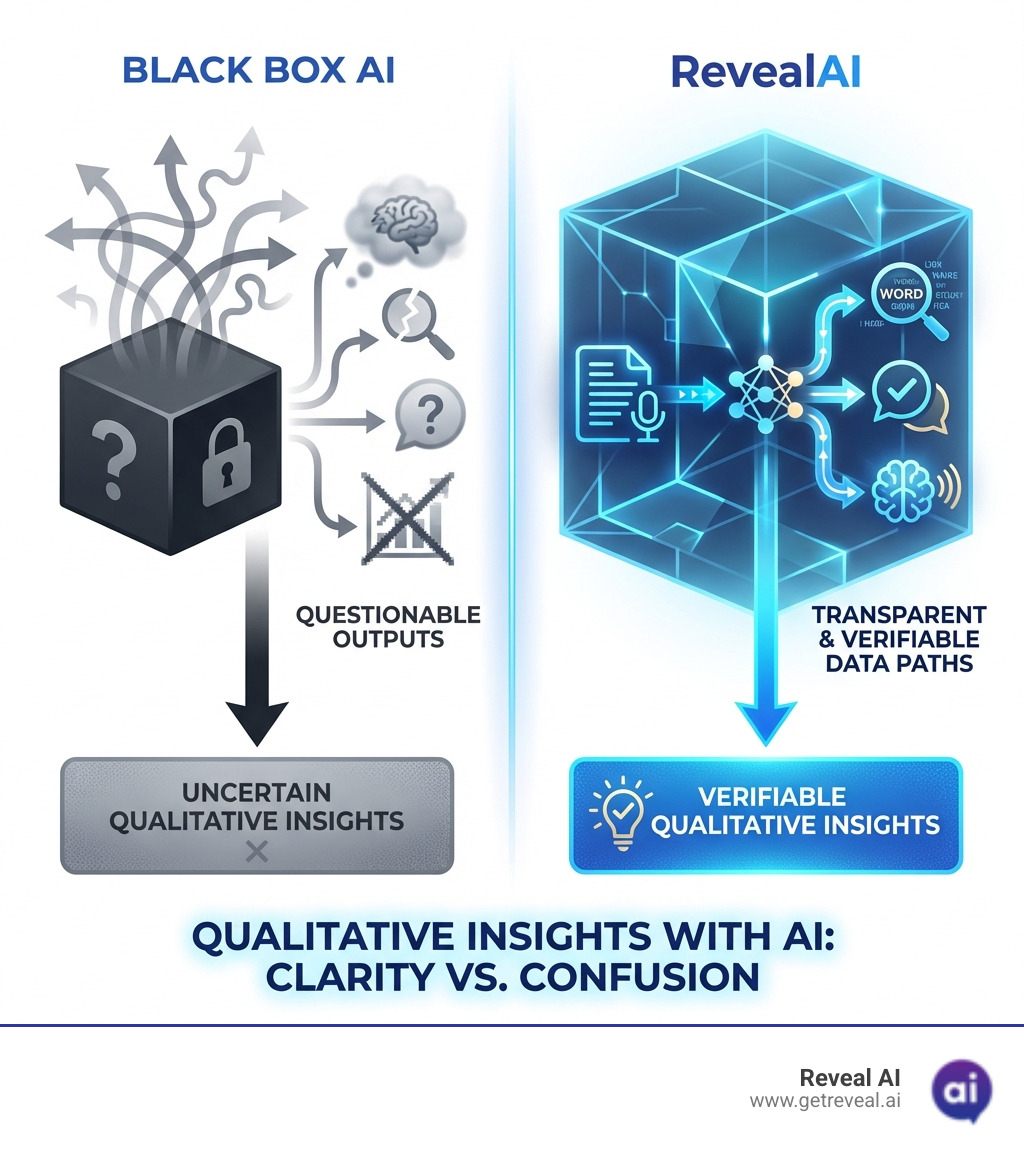
AI now makes that transparency real. It reveals the “why” behind every result, keeps analysts in the loop to refine patterns, and records every step for full traceability. For firms, explainability isn’t just a technical benefit, it is a client conversation advantage. When analysts can show how insights were derived, clients see not just the “what,” but the rigor behind it.
When nothing is hidden, trust grows, and insights become something you can truly stand behind.
When done right, AI fits smoothly into every stage of research:
For market research teams already using platforms like Decipher, Qualtrics, or Confirmit, AI can slot directly into existing pipelines, augmenting rather than replacing the existing stack.
Accuracy then becomes something built in, not an afterthought.
Making research truly accurate and reliable isn’t about fixing errors at the end; it’s about caring for the data all the way through. AI makes that possible. It doesn’t replace researchers; it empowers them to work with precision and transparency.
For market research firms, this isn’t just about faster turnarounds, it is about stronger deliverables, higher client confidence, and fewer post-project challenges.. Because clients don’t just want numbers; they want confidence that those numbers reflect real people and real truths.
With AI guiding the process, accuracy stops being an aspiration and becomes a standard, measurable, repeatable, and deeply human.
Reveal AI helps organizations see what’s real and act on it with confidence. Because when data is honest, decisions become truly intelligent.
They can use training models on local language and context, and human reviewers can check interpretations to keep cultural meaning intact.
AI can re-weight responses to reduce imbalance, but the best results come from guiding sampling proactively.
No. AI helps with the heavy work, but people still make sense of it all. Insight needs human judgment; machines can’t replace that.
By keeping things open. Let clients see how the data was gathered and what shaped the results. When the process is clear, trust follows on its own.