Blog
Why Multi-Level AI Clustering is a Game-Changer for Market Research

Riddhi Patel

Ever wonder why traditional qualitative research often feels overwhelming? Research firms and insight teams are buried under mountains of unstructured data - open-ended surveys, interview transcripts, call notes, and endless streams of conversational feedback. Meanwhile, executives demand crisp answers and strategies tailored to each region. How can research teams move beyond surface summaries to insights precise enough for confident decisions?
Traditional AI clustering helps, but only partly. Single-layer grouping can sort audiences into broad categories. Useful for high-level themes, yes, but what about the subtle differences that often decide success in competitive or diverse markets? That is where traditional approaches fall short.
Multi-level AI clustering changes the game.
With this, conversations keep their richness, while machine-level precision adds clarity. The outcome? Deeper segmentation, sharper priorities, and insights that drive confident, actionable decisions every time.
Single-level clustering works by grouping data points based on overall similarity, and while mathematically sound, it is interpretively shallow. The issue is that complexity collapses into broad categories. For example, a dataset might yield clusters labeled “price sensitivity” or “brand loyalty,” yet within those clusters, important distinctions remain invisible. Some customers are motivated by fairness, others by prestige, but traditional clustering treats them as the same.
Decisions based on these averaged clusters mask critical signals, misrepresenting smaller but strategically significant voices. Research firms relying on single-layer clustering often miss chances to tailor messaging, prioritize features, or localize strategies. Multi-level clustering sees that audiences aren’t uniform; they have layers within layers. The second segmentation layer uncovers subtle drivers of behavior while keeping the big-picture themes intact.
Two-level clustering is purpose-built for qualitative research, where context and nuance drive value.
The process ensures meaning is preserved at every stage:
In terms of the architecture -
This architecture lets research teams see both the forest and the trees - the big picture supported by detailed, actionable distinctions.
The power of two-level clustering isn’t just in having two passes; it’s in how they work.
These refinements ensure secondary clusters are not spurious statistical artifacts but meaningful human patterns. For research agencies, this precision translates directly into trustworthy insights that enable confident decision-making.
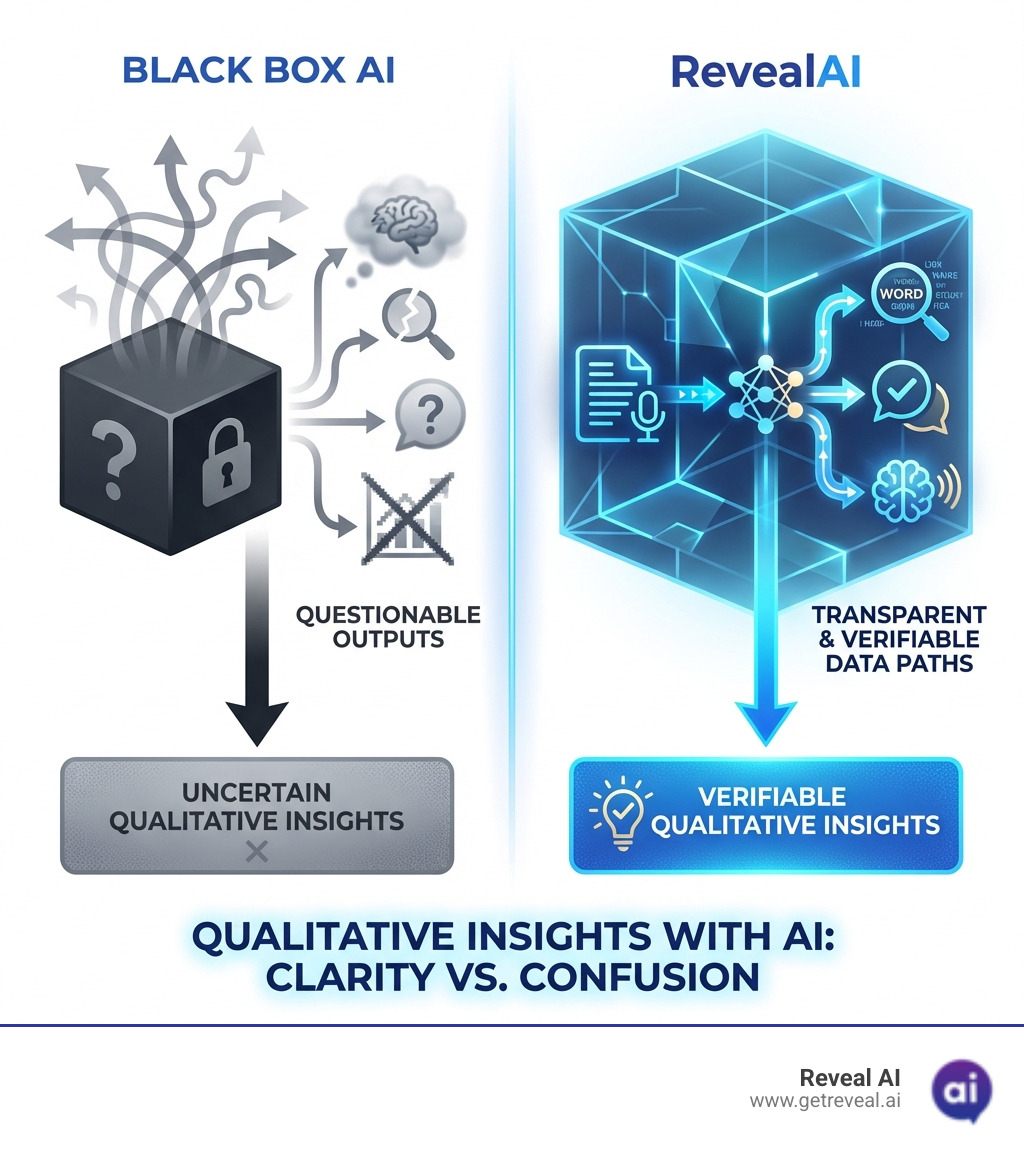
Research firms cannot afford to treat AI clusters as black boxes.
Governance complements validation: provenance tracking, bias audits, and privacy controls ensure reliability and ethical compliance. This means the power of multi-level clustering is applied responsibly, generating insights that teams can act on confidently.
The transition from single-layer to multi-layer clustering transforms how research firms operate.
Stakeholders gain dual-level clarity:
Cluster outputs integrate directly into dashboards, CRMs, and analytics systems, turning insights into seamless, ready-to-use decisions.
Reveal AI is changing qualitative research with multi-level AI clustering. Instead of static groupings, Reveal’s two-level approach captures both big themes and subtle nuances that drive behavior.
The result? Clearer segments, faster iterations, better localization, and stronger stakeholder alignment. In today’s competitive markets, surface-level insights are no longer enough. Layered clustering turns complexity into clarity and research into confident, decisive action.
Reveal delivers two actionable levels, primary themes, and sub-clusters, whereas hierarchical clustering produces many levels, often too coarse or too granular to be useful.
Yes. The method adapts to dataset size; sub-clusters can capture local dialects and cultural nuances while remaining interpretable.
Only marginally. Reveal optimizes embeddings and clustering with approximate nearest-neighbor techniques, keeping analysis efficient.
That depends on market dynamics. For active panels or rapidly shifting sectors, monthly re-computation ensures sub-clusters remain valid.
Yes. Reveal’s outputs include stable identifiers and confidence scores designed for downstream operational use.