No items found.

Blog
Turning messy survey data into pure business intelligence gold

Riddhi Patel


AI-powered feedback analysis is the use of an AI-powered qualitative research platform — utilizing natural language processing (NLP) and large language models (LLMs) — to automatically read, organize, and extract meaning from large volumes of unstructured text-based feedback. This includes open-ended survey responses, text-based interview transcripts, and usability notes.
In practice, this technology:
If you work in market research, UX, or product research, you already know the problem. You have hundreds — sometimes thousands — of open-ended responses sitting in a spreadsheet. The insights are in there, but getting to them requires hours of manual coding and synthesis. Unlike legacy survey tools like SurveyMonkey or Qualtrics, which often provide surface-level word clouds or basic sentiment scores, a dedicated AI research platform provides the depth required for professional Qualitative Research.
This is not a niche problem. Senior researchers often spend weeks on manual coding that AI can now cluster in minutes. The pressure to move faster is real, but so is the pressure not to get it wrong. Generic AI tools promise speed, but they introduce risks: hallucinations, lack of attribution, and loss of nuance. For market research firms where client trust is everything, that trade-off is unacceptable.
That is the gap Reveal AI is built to close — research-grade AI analysis that is fast, structured, and verifiable.
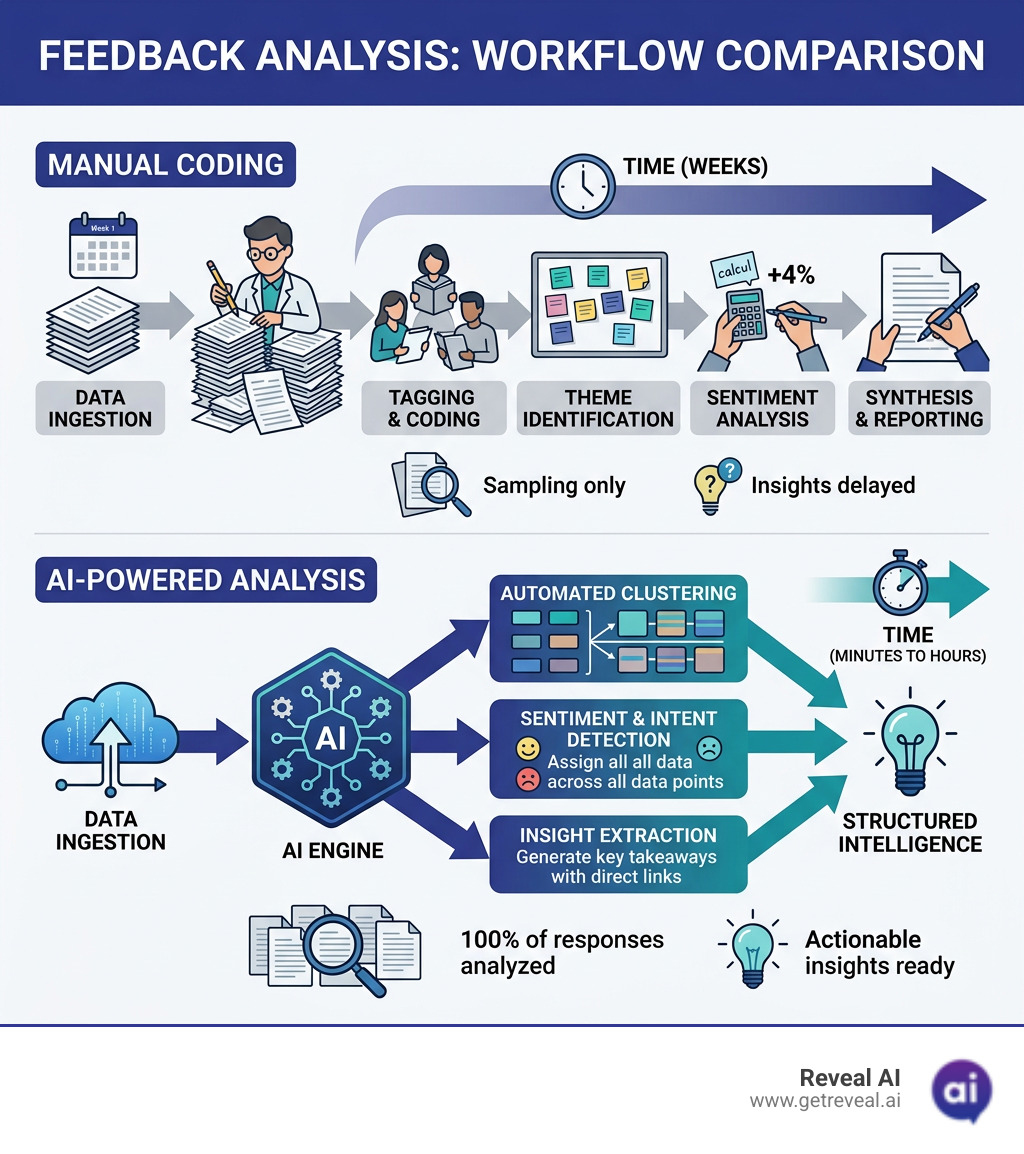
In the past, qualitative research was viewed as the "slow" sibling of quantitative data. While you could get quantitative metrics in seconds, understanding why those numbers were trending took weeks of grueling manual labor. Researchers were forced to sample responses simply because there wasn't enough time to process the "tsunami" of unstructured text.
Today, AI powered feedback analysis has flipped the script. For market research firms and UX teams, the ability to process 100% of open-ended feedback without losing human nuance is a competitive necessity.
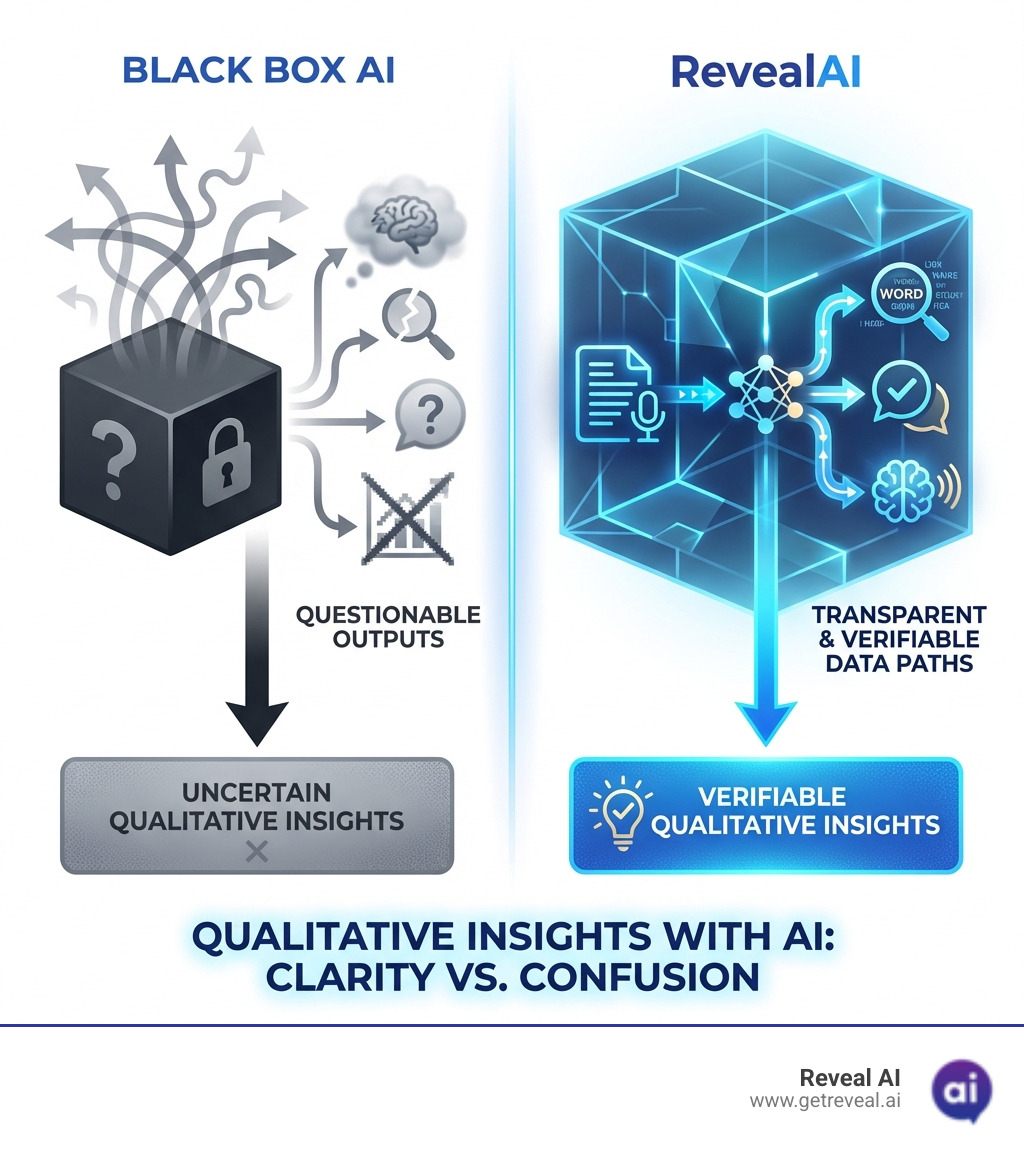
At Reveal AI, we operate with a "trust-first" philosophy. While novelty is fun, in professional research, data integrity is paramount. We operate within a "Walled Garden" model. Unlike generic LLMs that may pull from the general internet, our AI stays strictly within the boundaries of your specific research data. This eliminates the risk of hallucinations and ensures every insight is anchored in a real human response.
By Leveraging AI in Market Research, teams move at the speed of business without sacrificing the rigor that stakeholders demand.

Traditional tools look for specific keywords. If a user says "the app is clunky" and another says "the navigation is difficult," a keyword tool might miss the connection. Our AI powered feedback analysis uses sophisticated NLP and text embeddings to understand context.
This process of Automated Qualitative Analysis ensures no minority voice is lost. Even if only 4% of users mention a specific friction point, our AI flags it.
For product teams, shipping the wrong feature is a costly mistake. Our AI-powered qualitative research platform provides "research-grade" intelligence you can trust.
By integrating AI Customer Feedback into your research workflow, you turn messy data into a structured roadmap.
Standard sentiment analysis is often too shallow. Knowing a respondent is "unhappy" isn't enough; you need to know why. Our platform excels at capturing nuance because we use conversational AI to conduct short, text-based interviews. The AI can "probe" deeper in real-time to uncover underlying motivations.
This leads to a much richer thematic synthesis. We look at the story behind the feedback, distinguishing between a "confused" user and an "annoyed" user — two different states requiring different product solutions. This level of Happiness Analysis provides the depth needed for product iteration.
We solve the fear of AI "hallucinations" through several layers of protection:
When Traditional Research Methods Fall Short: How Conversational AI Redefines Qualitative Research, it is usually because they cannot handle the volume. Our platform removes those bottlenecks while maintaining data integrity.
Data silos are a major headache. You have survey data in one tool and written transcripts in another. Our AI powered feedback analysis allows you to centralize these sources into a unified research view.
Whether you are pulling in data from:
The platform creates a single source of truth, allowing for "continuous research" and a constant pulse on participant sentiment.
We expect to see several key trends emerge:
At Reveal AI, we are building toward this future by moving from "insight systems" to "outcome systems" that show you exactly what to do.
The goal of AI powered feedback analysis isn't to remove the human from the research; it is to empower the researcher to listen to every voice in the room. When you spend less time tagging and more time thinking, your product teams get clearer direction and your stakeholders get verifiable results.
Key Takeaways for Research Teams:
By choosing a trust-first, research-grade platform, you ensure your business intelligence is real. You gain the speed of AI with the rigor of traditional qualitative methods. Ready to turn your messy data into actionable intelligence?
Start your journey with Reveal AI and discover what your research participants are really trying to tell you.