No items found.

Blog
Steal These Brilliant Employee Experience Examples Today

Rhythm Dahiya


Employee experience examples are real-world strategies and case studies showing how organizations design better workplaces — from onboarding and learning to wellbeing, recognition, and flexible work.
Here are some of the most impactful examples at a glance:
Company / OrganizationEX Focus AreaKey OutcomeAirbnbTreating staff as customers and hostsRanked 6th on Employee Experience IndexAccentureValue pockets, moments that matter, co-creationRanked 7th on Employee Experience IndexCiscoDedicated EX team, continuous improvement#1 Great Place to Work in multiple countriesNASAMicrolearning LMS for standardized trainingScalable global learning at speedBeyondHousingVision-led culture, CEO onboarding meetings85% engagement score, 96% employee pridePost-merger org (Project Harmony)Personas, recognition, accountabilitySatisfaction jumped from 21% to 57% in one year
Most organizations know employee experience matters. Fewer know what it actually looks like in practice.
The gap is costly. 61% of employees still have one foot out the door, according to the Achievers Workforce Institute. And yet companies with strong employee experience cultures generate 1.8x greater average revenue growth over three years.
The difference between those two realities? Intentional design.
Employee experience (EX) is not a single perk or policy. It is the sum of every interaction an employee has with your organization — from the moment they first hear about you, through onboarding, daily work, career growth, and even exit. It spans culture, technology, physical environment, leadership, and purpose.
The seven stages of that journey look like this:
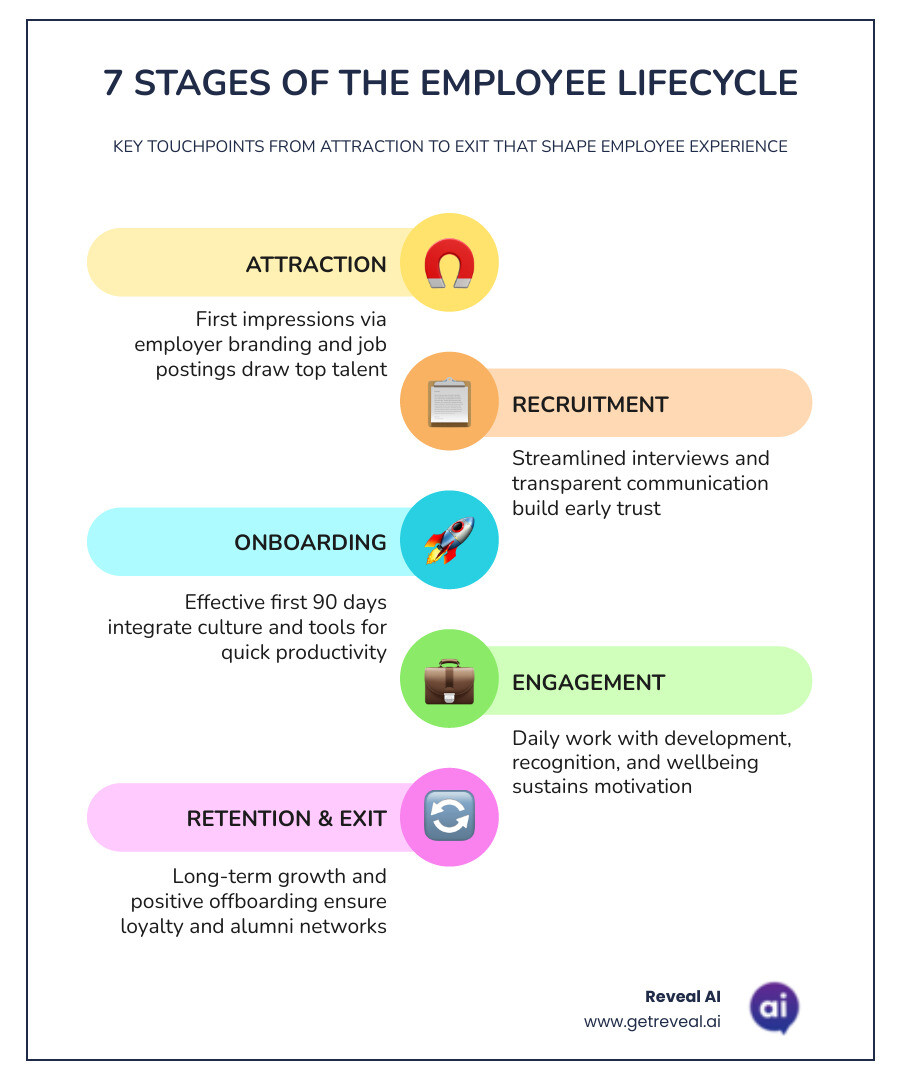
The good news: you do not have to build a great EX from scratch. The examples in this article show exactly what works — and why.
Employee experience examples vocabulary:
When we look at high-performing organizations, we see that they don't treat EX as a "nice-to-have" HR initiative. They treat it as a primary driver of competitive advantage. According to research from the Future Organization, companies that invest heavily in EX see 1.3x greater average total shareholder return.
To understand why, we have to distinguish between "engagement" and "experience." Engagement is the result (how an employee feels); experience is the input (the environment an organization provides).
FeatureEmployee Experience (EX)Employee EngagementDefinitionThe sum of all interactions/touchpoints.The emotional commitment to the company.ScopeLong-term (Hire to Retire).Short-term (Point-in-time sentiment).ResponsibilityShared (IT, HR, Operations, Facilities).Primarily HR and Management.FocusDesigning the environment.Improving the "vibe" or morale.
Here are ten employee experience examples that show how top organizations bridge this gap.
The first 90 days are a critical window in the employee lifecycle. Research cited by HR practitioners frequently links strong onboarding to higher commitment and lower early attrition; however, exact multipliers vary by study and industry.
A practical example comes from Worldpay (now part of FIS). They divided onboarding into three distinct sections: company-wide orientation, job-specific productivity training, and industry-specific regulatory knowledge. By structuring the journey this way, new hires could build confidence quickly and contribute sooner.
For leadership roles, structured onboarding reduces time-to-impact and helps new leaders integrate into culture and stakeholder networks. See: executive onboarding success.
Modern professionals value growth almost as much as compensation. Cisco offers self-directed learning that helps employees align skills with strengths. NASA provides another strong example: it launched a Learning Management System (LMS) focused on microlearning (short, standardized lessons that can be consumed quickly), which is useful for global teams that need consistent training.
Investing in development pathways is also essential for accelerating new leader success, because it supports internal mobility and long-term retention.
Wellbeing is not only about physical health benefits. It includes psychological safety, sustainable workloads, and access to mental health support. Recognition also plays a measurable role in retention: employees who receive frequent, specific recognition report lower intent to leave in multiple workplace studies (rates vary by sector and measurement method).
A commonly cited example is PURE Insurance, which uses virtual coffee chats and Employee Resource Groups (ERGs) to foster connection.
In a post-2020 world, the Digital Employee Experience (DEX) is often the primary experience remote workers have. Accenture has described treating employees like customers, co-creating digital workspaces that adapt to evolving needs.
For distributed teams, the home setup still matters (equipment, ergonomics, secure access). Rather than highlighting a third-party workplace-equipment vendor, the takeaway is the EX principle: organizations that standardize remote-work enablement reduce friction and signal care.
BeyondHousing, an Australian community housing organization, maintains strong engagement by linking decisions back to organizational vision. They hold "CEO onboarding meetings" where new starters hear the mission directly from leadership.
Transparency is the other side of the coin. Interest in pay transparency has increased across markets, and organizations that clearly explain compensation decisions tend to build trust faster. When employees understand the "why" behind goals and rewards, they are more likely to contribute discretionary effort.
If you are a market research team, UX research group, or analyst writing about employee experience, the hardest part is not finding examples. It is validating what actually drove outcomes and separating signal from anecdote.
Reveal AI is an AI-powered qualitative research platform built for research teams under pressure to move faster without sacrificing rigor. Use it to:
This is the practical advantage of a Trust first, not novelty first approach: you can publish employee experience examples with clearer evidence and fewer unverified claims.
If you want a deeper view of how we analyze qualitative data responsibly, start with: fostering a thriving culture.
You cannot improve what you do not measure. But traditional once-a-year engagement surveys are often too slow to drive real change. To sustain a great experience, organizations map journeys and listen continuously.
From Reveal AI's perspective, this matters because many employee experience examples published online are based on surface-level metrics. For research and insights teams, the goal is to document what actually changed, which touchpoints mattered, and how leaders proved impact.
Every employee journey is different. A workstation-anchored developer has different needs than a highly mobile sales executive. Cisco identified five key personas to help design workplaces and digital tools.
By mapping journeys, teams can identify "moments that matter." These are touchpoints like:
Effective journey mapping requires qualitative depth. It is not just about the "what," but the "how" and "why." Understanding the happiness analysis in research helps researchers capture the emotional layers behind an experience. When teams use real-time qualitative feedback, they can catch issues before they become turnover drivers.
Qualitative research is notoriously difficult to scale. You either spend weeks conducting interviews and coding responses, or you use generic AI tools that can hallucinate, drop nuance, and make it hard to defend findings to stakeholders.
Reveal AI is an AI-powered qualitative research platform designed for market research firms, UX and product research teams, and analysts who need speed and rigor.
What makes Reveal AI research-grade:
Important scope note: Reveal AI is built for market and product research workflows. It is not positioned as an employee listening or employee engagement platform.
Explore advanced qualitative research with Reveal AI
Improving the employee experience is not a one-time project. It is an ongoing design challenge. The employee experience examples in this article share a common thread: intentional choices, reinforced through measurement.
From Reveal AI's perspective, the practical takeaway is how you validate and explain these examples. Many EX claims fail scrutiny because the underlying evidence is thin, slow to collect, or hard to attribute.
Key takeaways for research teams documenting employee experience examples:
If you are a market research or product research team tasked with analyzing workplace experiences (for example, publishing thought leadership, benchmarking studies, or research-backed case studies), Reveal AI helps you move faster without trading away trust. Our AI-powered qualitative research platform is built on a Trust first, not novelty first philosophy, with guardrails designed for research-grade outputs.
Ready to turn qualitative feedback into decisions you can stand behind? Explore Reveal AI here: https://www.getreveal.ai