
No items found.
Why the Advantages of AI-Powered Automated Research Report Generation Are Reshaping How Teams Work
The advantages of AI-powered automated research report generation are hard to ignore when you see the numbers: one company cut report creation time by 80%, another reduced content generation from four hours to just 10 seconds, and a third eliminated manual report generation entirely.
If you're evaluating whether AI-powered report generation is worth it, here's the short answer:
Top advantages of AI-powered automated research report generation:
- Speed - Reports that took hours or days now take minutes or seconds
- Consistency - Identical structure and formatting across every report, every time
- Cost reduction - Direct research costs can drop by up to 85%
- Depth - AI surfaces patterns and insights humans would likely miss in large datasets
- Scalability - One system handles hundreds of reports without added headcount
- Accuracy - Reduced human error in data processing and synthesis
But speed isn't the whole story.
Research teams — especially those working with qualitative data and open-ended customer feedback — face a deeper problem. It's not just that reports take too long. It's that manual workflows produce inconsistent quality, fragment insights across tools, and leave researchers buried in low-value tasks instead of doing the thinking that actually matters.
AI-powered report generation changes that equation. It handles the heavy lifting of data ingestion, pattern recognition, and structured drafting — so researchers can focus on interpretation, strategy, and decisions.
This guide breaks down every major advantage (and a few real limitations worth knowing) so you can evaluate whether automated report generation fits your team's needs.
What is Automated Research Report Generation?
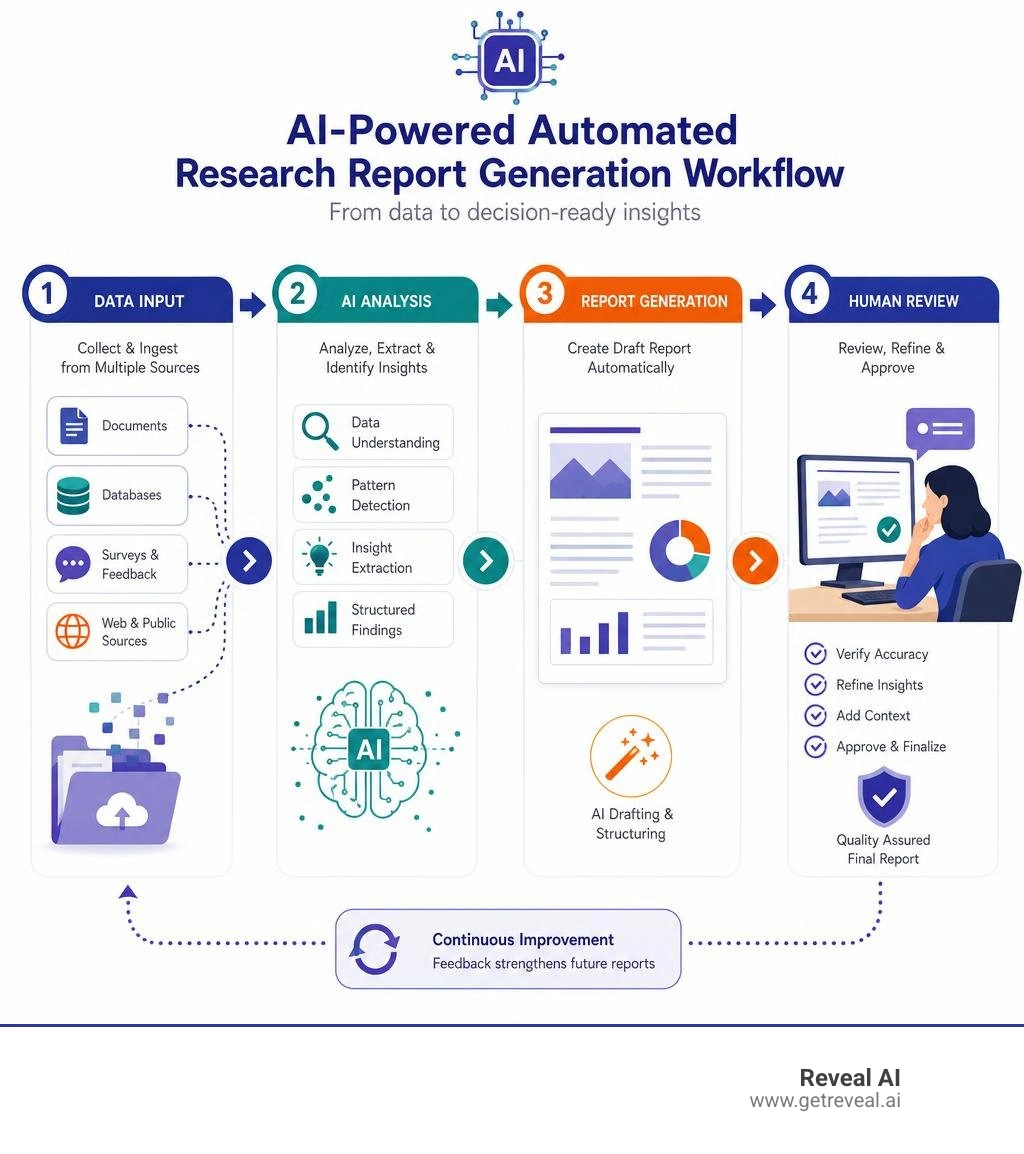
Automated research report generation with AI is the structured, repeatable process of converting raw datasets into polished, comprehensive business or academic reports using artificial intelligence. It acts as a continuous digital bridge linking data collection, deep analysis, draft creation, and human validation.
Rather than treating report writing as a series of disconnected manual tasks, modern AI systems treat it as an end-to-end workflow.
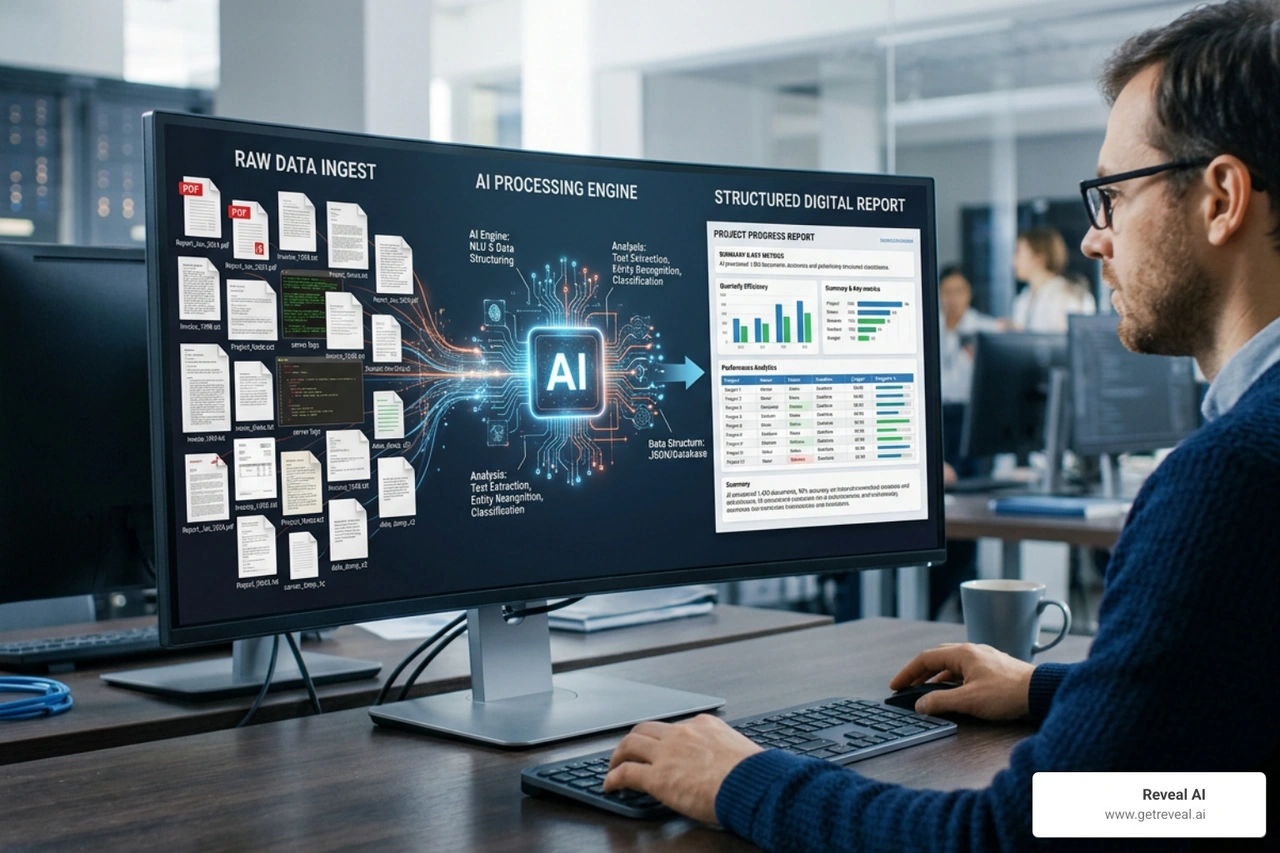
To understand this shift, let's look at how AI-driven workflows compare directly with traditional, manual reporting:
| Feature | Traditional Manual Reporting | AI-Powered Report Generation |
|---|---|---|
| Time to Draft | Days or weeks of manual compilation | Minutes or seconds |
| Data Ingestion | Manual copy-pasting, risk of data omission | Automated, multi-source hybrid retrieval |
| Structural Consistency | Variable; depends on the analyst's fatigue | 100% consistent across all documents |
| Scalability | Linear cost growth (requires more analysts) | Exponential scale at near-zero marginal cost |
| Traceability | Difficult to trace summarized points to raw data | Built-in citation mapping and audit trails |
Traditional Manual Reporting vs. AI-Driven Workflows
Traditional manual reporting is notorious for slow insights and fragmented data. When researchers have to manually gather customer feedback, clean survey data, organize transcripts, and draft summaries, the cycle time drags. By the time a report is finished, the market may have already shifted.
In contrast, modern AI workflows leverage agentic pipelines to split these massive tasks among specialized virtual agents. As outlined in the guide on choosing an AI Agent for Research: Pick and Use the Right Tool (2026), a typical multi-agent architecture uses:
- A Triage Agent to clarify the research intent and scope.
- A Planner Agent to outline the report structure.
- A Search Agent to query databases or web sources.
- A Writer Agent to draft the final segments in clear markdown.
By organizing the process this way, organizations can completely modernize how they build intelligence. For a deeper look at how these technologies are transforming standard methodologies, explore our AI Market Research Complete Guide.
The Primary Advantages of AI-Powered Automated Research Report Generation
The business impact of implementing automated reporting is immediate and measurable. When organizations shift the heavy lifting to AI, they experience massive improvements in speed, structural quality, and overhead expenses.

- 80% Faster Report Cycles: Across multiple industries, teams are reducing their report creation times by 80%, allowing them to react to market shifts in real time.
- 100% Structural Consistency: AI guarantees that every report follows the exact same logical layout, brand voice, and formatting guidelines.
- Up to 85% Savings in Direct Costs: By automating data retrieval and synthesis, organizations can slash direct research costs by up to 85%.
For research leaders, the strongest advantage is not simply faster drafting. It is the ability to create a repeatable insight operating model: every project follows the same intake logic, coding taxonomy, evidence standard, review workflow, and stakeholder-ready output. That consistency makes findings easier to compare across waves, brands, segments, and markets.
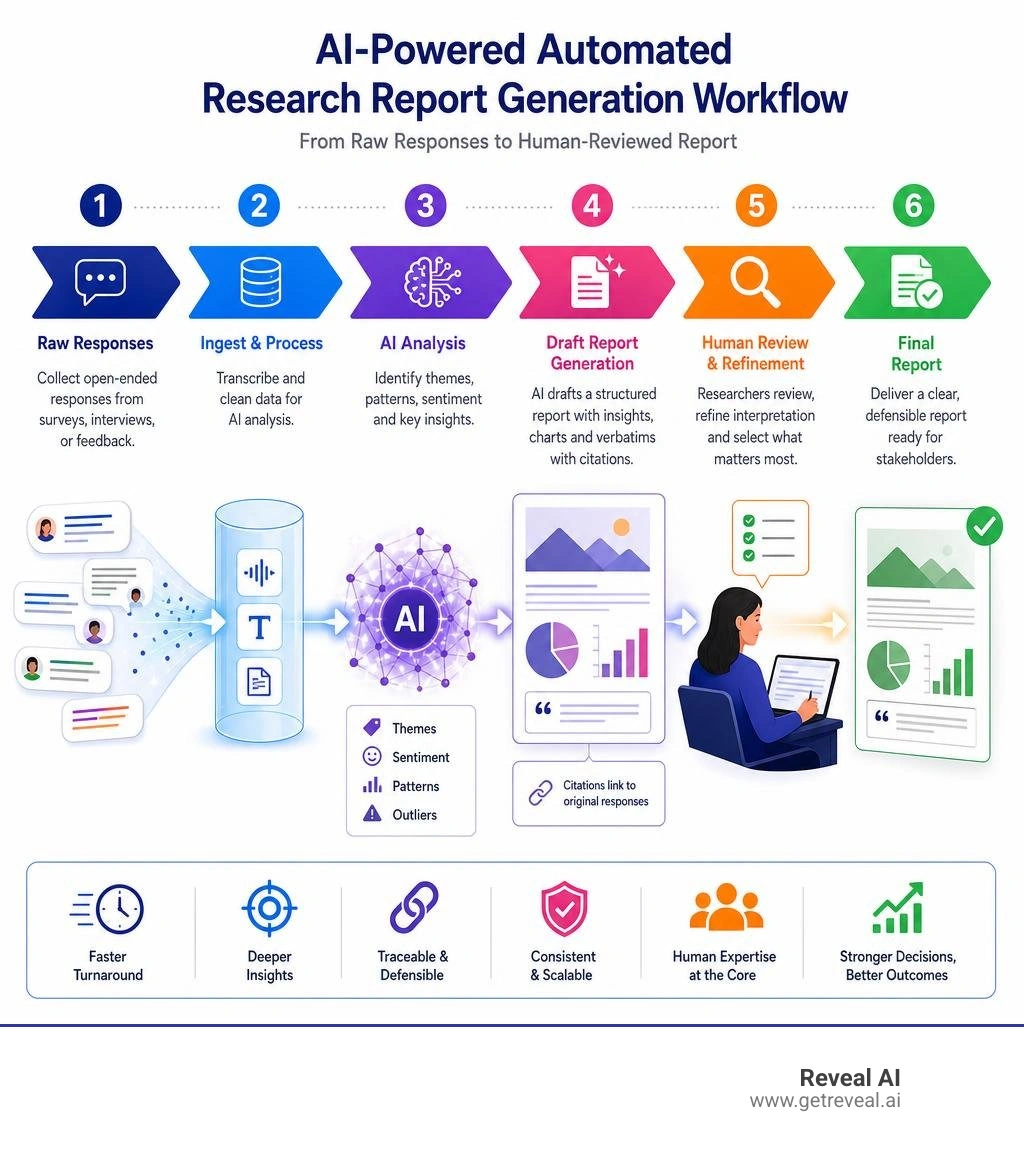
Practical Example: From Open-Ended Responses to a Defensible Report
Imagine a customer research team collecting 1,000 open-ended responses about why buyers choose, delay, or reject a product. In a manual workflow, analysts must read responses, code themes, reconcile inconsistent labels, pull representative verbatims, and then translate those findings into a report. The process is slow, and two analysts may code the same response differently.
An AI-powered workflow changes the sequence. The system can transcribe or ingest responses, group them into macro-themes and micro-themes, flag sentiment patterns, surface unusual but important outliers, and draft a first-pass report with links back to respondent-level evidence. Researchers still review the logic, refine the interpretation, and decide what matters strategically, but they no longer start from a blank page.
This is especially valuable in qualitative market research because open-ended data is where many of the highest-value insights live. Automated report generation helps teams preserve the richness of respondent language while making the analysis process faster, more traceable, and easier to explain to stakeholders.
To understand how these savings translate to customer intelligence, see our AI Driven Customer Insights Complete Guide and learn how to pair these workflows with AI Survey Analysis Tools.
Realizing the Advantages of AI-Powered Automated Research Report Generation in Market Research
In market research, the biggest bottleneck is qualitative data. While quantitative numbers are easy to chart, open-ended responses, user interviews, and conversational surveys require hours of reading, coding, and summarizing.
This is where the advantages of AI-powered automated research report generation truly shine. By using specialized engines to analyze AI Driven Surveys, teams can extract clear themes instantly. Instead of manually reviewing hundreds of transcripts, researchers can use AI Powered Feedback Analysis to cluster responses and generate draft reports in minutes.
Whether you are synthesizing AI Customer Feedback or conducting deep AI Interview Analysis, automated report generation ensures that qualitative insights are structured, actionable, and ready for stakeholders without the manual drag.
How Organizations Can Maximize the Advantages of AI-Powered Automated Research Report Generation
To get the most out of these tools, organizations must understand the balance between expanding information and human cognitive limits.
The landmark Generative AI for Analysts study highlighted a fascinating dynamic: while AI tools expand an analyst's information capacity, they also introduce "synthesis costs." The study found that analysts using AI produced reports with:
- 40% more distinct information sources
- 34% broader topical coverage
- 25% greater use of advanced analytical methods
However, because the AI provided so much balanced, multi-perspective information, human analysts sometimes faced higher cognitive friction when making final, singular predictions. To maximize the benefits, organizations should use AI not just to dump more data, but to structure that data into clear, hierarchical hypotheses. This ensures teams can make swift, Data Driven Decisions without getting bogged down by information overload.
Advanced Data Analysis and Collaboration Capabilities
Beyond speed, AI-powered systems can process complex datasets at a scale that is impossible for human teams alone.
Processing Large Datasets and Identifying Patterns
Unstructured data—like open-ended survey answers, chat logs, and call transcripts—often contains the most valuable customer insights. However, analyzing it manually is incredibly slow.
AI-powered systems solve this by using multi-level clustering. This technology automatically groups thousands of open-ended responses into macro-themes and micro-themes. Combined with respondent-level analysis, researchers can drill down into the exact sentiment of specific user groups. For an in-depth look at how this works, check out our Market Research AI Complete Guide and our guide on AI Powered Feedback Analysis.
Fostering Better Collaboration and Knowledge Sharing
Automated report systems also act as a collaboration hub for global teams:
- Real-Time Translation: Instantly translates research inputs and reports across international teams.
- Shared Knowledge Base: Consolidates fragmented data into a single searchable repository, preventing teams from duplicating research.
- Collaborator and Citation Mapping: Dynamic citation mapping helps researchers track how different studies, internal documents, and insights connect over time.
Challenges, Limitations, and the Role of Human Oversight
While the benefits are massive, relying blindly on AI-generated reports introduces risks like the "AI productivity paradox" (where information supply grows faster than our ability to digest it) and potential "speed-over-review" errors.
Addressing Bias, Hallucinations, and Data Privacy
AI models can occasionally hallucinate facts or perpetuate biases present in their training data. Furthermore, uploading sensitive customer data to public AI models raises serious data privacy and ethical concerns.
To mitigate these risks, cutting-edge research platforms are adopting architectures like those proposed in Mind2Report: A Cognitive Deep Research Agent for Expert-Level Commercial Report Synthesis. Rather than loading massive amounts of raw data directly into the LLM's primary context window, these systems use dynamic memory as a buffer. They apply multi-dimensional reflection to evaluate the freshness, integrity, and source of every piece of data before it is written into the final report.
What High-Quality Human Review Should Include
Human oversight should be designed into the workflow before the first report is generated. Strong review processes usually include a source audit, a theme audit, and a recommendation audit. The source audit checks whether each claim is tied to a respondent verbatim, transcript, survey answer, or approved dataset. The theme audit checks whether AI-generated clusters are coherent and whether minority viewpoints have been buried. The recommendation audit asks whether the final conclusions are supported by the evidence rather than by the model's most polished-sounding language.
This review layer is what turns AI-generated output into defensible research. It also gives stakeholders more confidence because the final report can show not only what the finding is, but where it came from and how it was interpreted.
Ensuring Quality and Reliability Through Human-in-the-Loop Workflows
To guarantee reliability, organizations must implement a strict "human-in-the-loop" verification workflow.
As explored in the academic paper Towards end-to-end automation of AI research, while AI can autonomously draft complex papers and even pass basic peer reviews, human oversight remains essential. A robust workflow should always include:
- Schema Validation: Ensuring the AI outputs match predefined structures.
- Citation Checking: Verifying that every claim links back to a real, verifiable respondent verbatim or data point.
- Strategic Editing: Allowing human researchers to refine the tone, add context, and draw strategic conclusions.
Frequently Asked Questions About Automated Research Reports
Can AI completely replace human researchers?
No. AI is designed to automate repetitive tasks, handle data ingestion, and accelerate drafting. It cannot replace human judgment, strategic creativity, empathy, or critical thinking. Instead, it acts as a productivity multiplier, freeing researchers to focus on high-value strategy.
How do AI research agents avoid hallucinations and ensure accuracy?
Modern AI research agents avoid hallucinations by using Retrieval-Augmented Generation (RAG). Instead of generating answers from their training data, they search specific databases (or raw survey files), extract the exact text, and write reports using strict citation verification and dynamic memory.
What are the main cost benefits of automated report generation?
Automated report generation can deliver up to an 85% reduction in direct research costs. By speeding up the report creation cycle by 80%, organizations gain massive operational efficiency, allowing existing teams to handle a much larger volume of projects without adding headcount.
Conclusion
The advantages of AI-powered automated research report generation are clear: it takes the tedious, manual work out of data synthesis and allows teams to deliver insights in minutes rather than weeks.
At RevealAI, we help research teams unlock these benefits without sacrificing accuracy or trust. Our platform is built specifically to gather richer qualitative data through conversational surveys, automatically organize it using multi-level clustering, and generate reports backed by respondent-level audit trails. This means every single insight in your automated report can be traced directly back to a real customer verbatim.
Ready to transform your research workflow? Discover how our automated qualitative analysis platform can help your team move from raw human feedback to defensible, boardroom-ready reports in record time.