

No items found.
Why Voice of Customer Analysis Separates Growing Companies From Stagnant Ones
Voice of customer analysis is the process of systematically collecting, organizing, and interpreting what customers say, write, search, and do — then connecting those signals to specific business decisions.
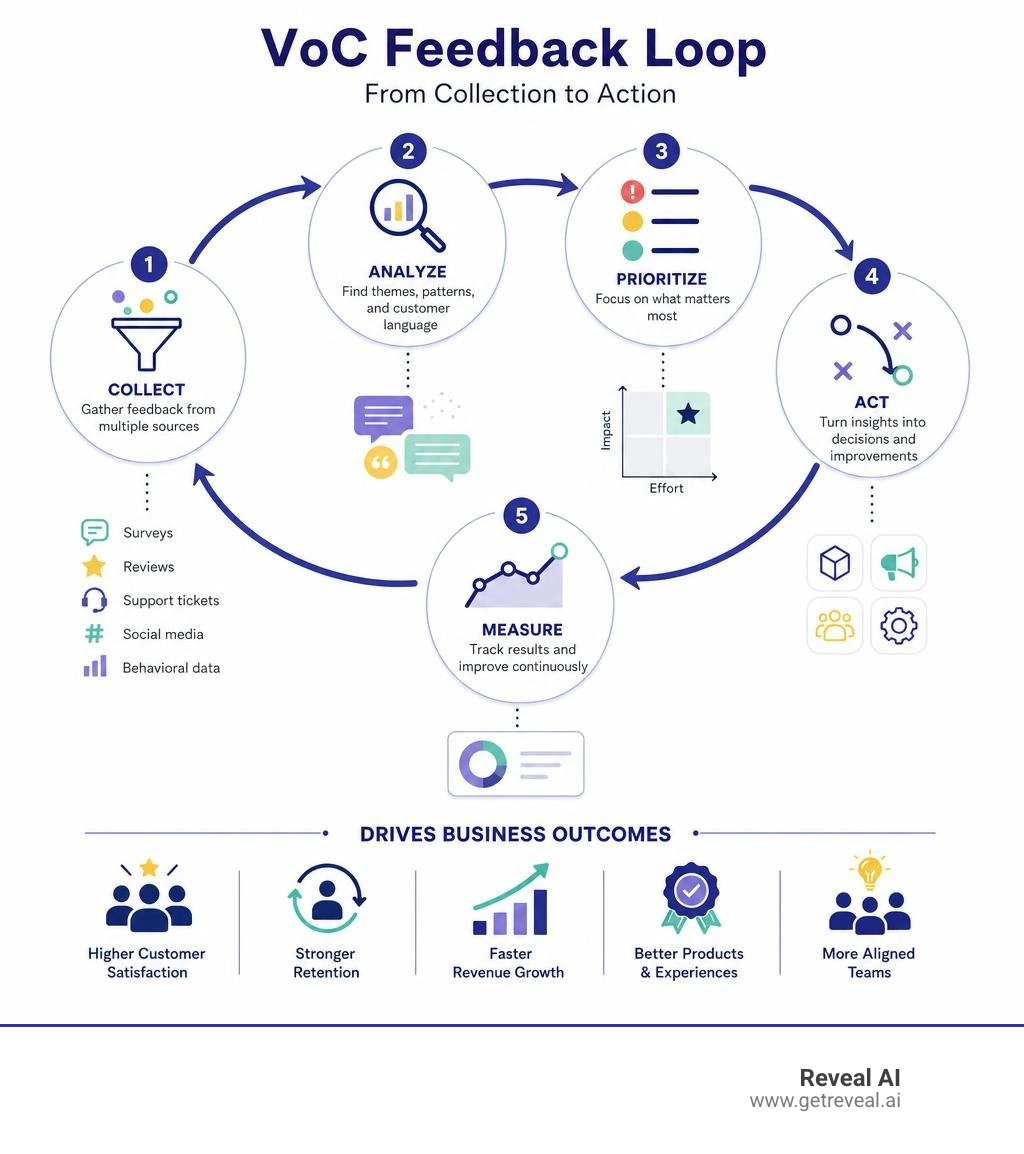
Here's a quick breakdown of what it involves:
| Stage | What Happens |
|---|---|
| Collect | Gather feedback from surveys, reviews, support tickets, social media, and behavioral data |
| Analyze | Identify themes, patterns, and the specific language customers use |
| Prioritize | Separate high-severity issues from high-frequency noise |
| Act | Connect findings to product, marketing, sales, or operations decisions |
| Measure | Track whether actions improved retention, satisfaction, or revenue |
Most organizations stop at "collect." That's the gap that kills VoC programs.
The stakes are real. Companies with strong VoC initiatives see up to a 55% boost in retention. Customer-obsessed organizations grow revenue 41% faster than their peers. And yet, only one in three CX leaders believes their VoC program actually shapes outcomes.
The problem isn't a lack of data. It's the distance between data and decisions.
CX leaders and market researchers today are drowning in feedback — low survey response rates, shallow open-ended answers, and analysis cycles that take weeks to complete. By the time insights reach the teams who need them, the moment to act has often passed.
This guide walks through the full arc of voice of customer analysis: where to find the highest-signal data, how to analyze it without falling into bias traps, why the exact words customers use matter more than sentiment scores, and how to connect findings directly to cross-functional decisions that move the business forward.
What is VoC and How Does It Differ From Feedback Collection?
To understand how to drive impact, we must first clear up a common misunderstanding: collecting customer feedback is not the same as conducting a voice of customer analysis.
Feedback collection is a transactional activity. It is the act of gathering data points — sending out a customer satisfaction (CSAT) survey after a support call, hosting a feedback form on a website, or compiling online reviews. It is a passive or semi-active capture mechanism. If you are merely storing thousands of survey responses in a database or displaying them on a dashboard, you are collecting feedback. You are listening, but you are not yet understanding.
Voice of customer analysis, on the other hand, is the strategic discipline of transforming that raw, unstructured customer signal into structured, commercial intelligence. It is the active process of parsing, categorizing, and interpreting customer sentiment, intent, and language to answer specific business questions.
When we analyze VoC data, we don't just look at what customers said; we seek to understand why they said it, who said it, and what commercial decisions that insight should inform.
This distinction is what separates customer-obsessed organizations from those that merely pay lip service to customer-centricity. True customer obsession yields massive dividends: customer-obsessed organizations experience 41% faster revenue growth, 49% faster profit growth, and 51% better retention than their peers.
To transition from a passive collector to an active analyst, organizations must shift from a reactive mindset to a proactive one, as outlined in Voice of the Customer: How to collect and use this data.
The Strategic Role of voice of customer analysis in 2026
In June 2026, the marketplace is more volatile and competitive than ever. Brand loyalty is no longer a given; it must be earned and re-earned with every interaction. Research shows that 65% of customers expect companies to adapt to their changing needs, and 72% of consumers will switch brands simply because they found a better deal elsewhere. Furthermore, 81% of service professionals note that customers expect a significantly more personal touch than they did in the past.
In this environment, voice of customer analysis serves as an early-warning radar system. It allows us to detect subtle shifts in buyer expectations, identify emerging competitive threats, and spot product defects before they lead to catastrophic churn.
By analyzing the qualitative nuance of customer feedback, we can go beyond retrospective metrics like churn rates and build predictive models of customer behavior. For a deeper dive into how this fits into your overall customer understanding, check out our Customer Insights Complete Guide.
The Inner vs. Outer Loop of Customer Feedback
A robust VoC program operates across two distinct feedback loops that serve different but complementary purposes: the Inner Loop and the Outer Loop.
- The Inner Loop (Individual Recovery): This is the rapid-response mechanism. When a customer leaves a highly negative review, submits a low Net Promoter Score (NPS), or flags a critical issue in a support ticket, the Inner Loop triggers immediate action. Frontline teams — such as customer success, support, or account managers — reach out within 24 to 48 hours to resolve the individual's issue. The goal here is immediate customer recovery and churn prevention.
- The Outer Loop (Systemic Fixes): While the Inner Loop handles individual symptoms, the Outer Loop addresses the root disease. The Outer Loop compiles feedback across thousands of interactions, identifies systemic patterns, and routes these insights to product, engineering, operations, or marketing teams. If fifty customers in a week complain about a confusing checkout step, the Outer Loop ensures the product team redesigns that flow.
Without both loops, a VoC program is incomplete. If you only run the Inner Loop, you will spend all your resources fighting fires. If you only run the Outer Loop, you will let valuable individual customers slip through the cracks while you plan long-term fixes.
Designing a High-Signal VoC Data Strategy
To run an effective analysis, you need high-quality data. But not all customer data is created equal. Some sources are filled with high-frequency noise, while others contain high-signal insights that can reshape your business strategy.
To build a balanced data strategy, we must combine three distinct types of customer feedback:
| Feedback Type | Definition | Key Sources | Pros | Cons |
|---|---|---|---|---|
| Direct (Solicited) | Feedback you explicitly ask for. | Surveys, user interviews, focus groups, feedback widgets. | Structured, targeted, easy to quantify. | Subject to response bias, can feel transactional. |
| Indirect (Unsolicited) | Feedback customers share without being prompted. | Online reviews, support tickets, social media, forum discussions. | Extremely honest, highly emotional, context-rich. | Unstructured, noisy, harder to analyze at scale. |
| Inferred (Behavioral) | What customers do rather than what they say. | Product usage data, website heatmaps, return rates, search queries. | Objective, free from cognitive bias, shows actual utility. | Tells you what happened, but not why it happened. |
Prioritizing High-Signal Unsolicited Feedback
While surveys are the traditional backbone of VoC, unsolicited feedback is often where the highest-signal data lives. When a customer fills out a survey, they are performing for an audience and answering your specific questions. When they submit a support ticket, write an online review, or initiate a product return, they are acting on their own terms.
Support tickets are arguably the most honest channel available because they represent a direct expenditure of a customer's time and energy to solve a real-world problem. Similarly, product return data and return reasons are incredibly high-signal; they are unambiguous, tied directly to specific SKUs, and expose immediate gaps between marketing expectations and product reality.
By prioritizing these unsolicited channels, we can capture the raw, unvarnished voice of our market.
Designing Surveys for Maximum Insight
When we do solicit feedback through surveys, we must design them to maximize qualitative value without causing survey fatigue.
First, keep them short. Surveys that take longer than 7 to 8 minutes experience a 5% to 20% drop in completion rates. Ideally, a transactional survey should feature just one quantitative rating question (like NPS or CSAT) followed by a single, open-ended question: "Why did you give us that score?"
Second, make them conversational. Traditional, rigid form surveys often yield flat, one-word answers. By using conversational interfaces, we can encourage customers to share deep, descriptive feedback.
Our research at Reveal AI shows that conversational AI surveys yield 2.5x more high-value words and 41% higher response rates than standard forms, because they probe in real-time based on what the customer writes.
For guidance on crafting effective prompts, read our guide on the Best Customer Feedback Survey Questions to Fuel Product Growth.
Step-by-Step Guide to Conducting a voice of customer analysis
Conducting a voice of customer analysis requires a structured methodology to ensure that raw data is systematically converted into operational decisions.

Step 1: Defining Commercial Decisions Before Data Collection
The most common failure point of a VoC program is collecting data without a clear destination. We call this "expensive listening." Before you write a single survey question or pull support transcripts, you must define the commercial decisions the research is meant to inform.
Ask yourself and your stakeholders:
- Are we trying to decide which features to prioritize on our Q3 product roadmap?
- Are we evaluating whether to adjust our pricing tiers?
- Are we trying to understand why customer churn increased in our enterprise segment last quarter?
By defining the decision context upfront, you can tailor your data collection to gather the specific signals required, rather than drowning in a sea of irrelevant feedback.
Step 2: Executing the voice of customer analysis Without Bias
Once you have gathered your data, the analysis phase begins. To do this effectively, you must actively guard against cognitive biases — particularly confirmation bias, where analysts cherry-pick feedback that aligns with their pre-existing beliefs.
To analyze your VoC data objectively:
- Normalize the Data: Consolidate your feedback from different channels into a single schema. Every record should include the raw text, customer segment metadata (e.g., plan type, region, customer lifetime value), timestamp, and source channel.
- Separate Frequency from Severity: It is easy to confuse how often an issue is mentioned with how badly it hurts. A minor UI glitch might be mentioned by 500 free-trial users (high frequency, low severity), while a critical database error that prevents checkout might only affect 5 enterprise customers (low frequency, high severity). Prioritize your themes by weighting volume against customer segment value and emotional intensity. For more on this, consult Voice of Customer Analytics: What the Data Tells You.
- Segment Your Findings: Never treat all feedback as equal. Segment your analysis by customer personas or spending tiers. A feature request from a customer in your target enterprise tier should carry more weight in product decisions than a request from a user on a free plan.
Step 3: Translating Insights into Cross-Functional Action
An analysis is only as valuable as the action it provokes. Once you have identified your prioritized themes, you must translate them into actionable inputs for different teams:
- For Product Teams: Translate customer pain points into functional requirements. Instead of sending a report that says "users find the app confusing," deliver a targeted brief: "30% of onboarding drop-offs are caused by users failing to find the database integration button." Learn more in our Actionable Customer Feedback Guide.
- For Marketing Teams: Use the exact language and metaphors your customers use to describe their problems to write highly resonant copy. If customers consistently describe your software as a "lifesaver for tired managers," that phrase should find its way into your ad campaigns.
- For Operations & Support: Use common support ticket themes to build self-service documentation or train chatbot agents, deflecting high-volume, low-complexity cases.
The Language Layer: Why Verbatims Outperform Sentiment Scores
In the early days of CX technology, organizations relied heavily on quantitative metrics like Net Promoter Scores (NPS) or automated sentiment scores (positive, negative, neutral). While these numbers are easy to display on an executive slide, they are lagging indicators that offer very little operational utility.
An NPS score can tell you that your customers are unhappy, but it cannot tell you why they are unhappy or what you should do to fix it.
The true value of VoC lives in the language layer — the specific, qualitative verbatims and metaphors customers use when they describe their experiences.

Moving Beyond Vanity Metrics
When we reduce customer feedback to a simple sentiment score, we strip away all the context. For instance, a sentiment analysis tool might flag the sentence "Your software is stupidly fast" as negative because of the word "stupidly," completely missing the highly positive user experience.
Furthermore, customers often use vivid metaphors to describe their pain points. A customer who writes, "I felt completely abandoned by the support team after the onboarding call," is expressing a deep emotional disconnect that a simple "CSAT: 2/5" score fails to capture.
By analyzing these verbatims, we can uncover the underlying psychological drivers of customer loyalty and churn.
Essential Features of Modern VoC Platforms
To analyze unstructured customer language at scale, organizations need modern, AI-powered tools. When evaluating Voice of Customer Platforms, look for these essential features:
- Natural Language Processing (NLP) & Topic Modeling: The ability to automatically cluster thousands of unstructured text entries into distinct, semantic themes without manual tagging.
- Speech Analytics: Tools that can transcribe and analyze recorded customer calls, capturing not just the words spoken, but also voice tone, hesitation, and emotional spikes.
- Systems Integration: The platform must seamlessly connect with your existing CRM, support ticketing systems, and product analytics tools to enrich qualitative feedback with real-world customer metadata.
- Citations and Traceability: With the rise of generative AI, make sure your platform doesn't just summarize feedback. It must provide direct click-through citations back to the original customer quotes to prevent AI hallucinations.
Overcoming Common Pitfalls in VoC Programs
Even with the best tools, many VoC programs fail to deliver business impact. Here are the most common pitfalls we observe and how to avoid them:
- Over-Surveying Customers: Sending a survey after every single micro-interaction ruins the customer experience. Instead, focus on key journey milestones (e.g., post-onboarding, renewal) and rely heavily on passive, unsolicited data sources like support tickets and reviews.
- Keeping Data in Silos: When support tickets stay in the support tool, reviews stay with marketing, and product feedback stays in JIRA, the organization loses the unified view of the customer. Centralize all feedback into a single, accessible repository.
- Lack of Clear Ownership: If everyone is responsible for customer experience, no one is. A VoC program must have a single, accountable owner (often a dedicated CX Director or Product Lead) who bridges departmental gaps and ensures insights are acted upon.
Integrating VoC into a Broader Research Framework
Finally, voice of customer analysis does not exist in a vacuum. It is one pillar of a comprehensive market research framework.
To build a complete picture of your market, you must blend VoC with competitive intelligence, broad market research, and behavioral analytics.
While behavioral data tells you what is happening in your product, and market research tells you where the industry is heading, VoC tells you why your specific customers are behaving the way they do. See how we apply this holistic approach in our Customer Research Use Case.
Frequently Asked Questions about Voice of Customer Analysis
What is the difference between VoC and NPS?
Net Promoter Score (NPS) is a single, quantitative metric designed to measure customer loyalty by asking how likely a customer is to recommend your brand on a scale of 0 to 10. Voice of the Customer (VoC) is a broader, holistic program that includes NPS as one of many inputs, but also encompasses qualitative feedback, support tickets, reviews, and behavioral data to understand the complete customer experience.
How often should an organization conduct a voice of customer analysis?
Rather than treating VoC as an annual or quarterly project, modern organizations should adopt a continuous listening approach. Unsolicited feedback (reviews, tickets) should be monitored and analyzed in real-time. Deeper, structured reviews of qualitative themes and systemic product roadmapping should occur monthly or quarterly, as customer expectations can change rapidly.
What is the role of AI in modern VoC analysis?
AI, particularly Large Language Models (LLMs), has revolutionized how we process customer feedback. AI can instantly normalize unstructured text from different channels, automatically cluster feedback into accurate semantic themes, and detect subtle anomalies in customer sentiment.
Furthermore, AI-driven conversational surveys can actively probe customer responses in real-time, asking follow-up questions to uncover deep, qualitative insights that traditional static forms miss. To learn more, read our article on AI Customer Feedback.
Conclusion
Listening to your customers is no longer a differentiator; it is a baseline requirement for survival. The organizations that will win the next decade are those that can translate raw customer signal into rapid, cross-functional business decisions.
At Reveal AI, we help you bridge the gap between listening and acting. Our conversational AI surveys engage your users in natural, dynamic dialogues, yielding 2.5x more high-value words and 41% higher response rates than traditional, static forms. By probing deeper in real-time, we help you uncover the rich, qualitative verbatims that contain the real keys to retention and growth.
Ready to stop guessing and start understanding? Automate your customer insights with Reveal AI.