
No items found.
Why the Market Research Industry Is at a Turning Point
AI-powered market research solutions are changing how companies understand their customers — faster, cheaper, and at a scale that was impossible just a few years ago.
Here's a quick look at the most common types available today:
| Solution Type | What It Does | Best For |
|---|---|---|
| Conversational AI surveys | Asks real-time follow-up questions | Qualitative depth at scale |
| AI qualitative coding | Automatically themes open-ended responses | Faster analysis, less manual work |
| Generative agent simulations | Models synthetic consumer populations | Concept testing, hard-to-reach audiences |
| Social listening & sentiment tools | Tracks consumer emotion across channels | Brand and trend monitoring |
| AI research platforms (end-to-end) | Handles the full research lifecycle | Teams needing one unified tool |
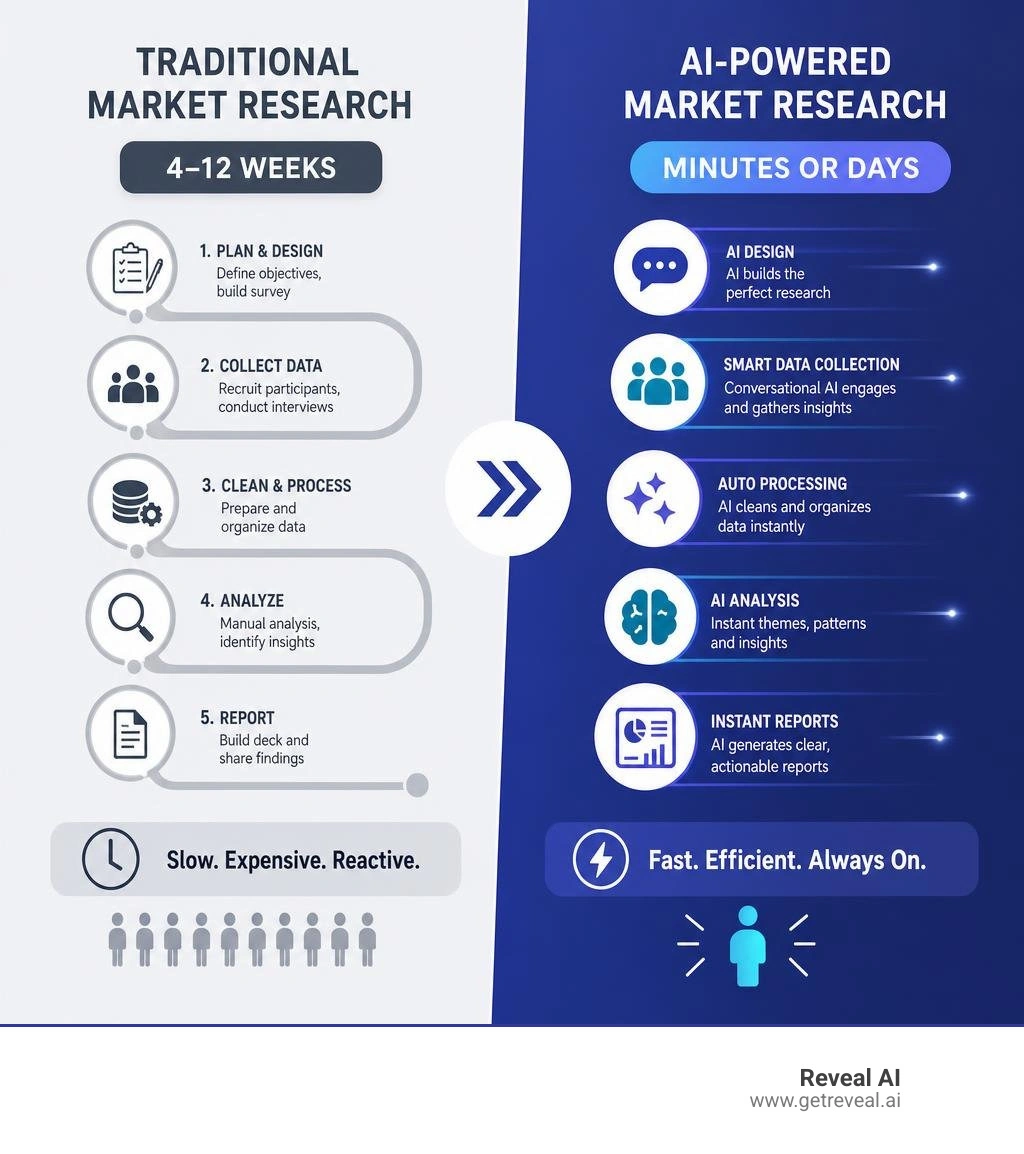
For decades, market research has been slow, expensive, and reactive. A typical project takes 4 to 12 weeks and costs anywhere from $15,000 to $50,000 — and by the time insights land on a decision-maker's desk, the moment has often passed.
The global market research industry spends $140 billion every year. Yet most of that spend still goes to traditional consulting firms and human-driven fieldwork, not software.
That's starting to shift — fast.
In 2026, worldwide software spending is projected to grow by 14.7%, crossing $1.4 trillion. Spending on generative AI specifically is expected to jump by 80.8% in the same period. Businesses aren't just experimenting with AI research tools anymore. They're rebuilding their insight workflows around them.
The core appeal is simple: AI can automate the repetitive parts — survey design, data cleaning, coding open-ended responses, generating reports — so researchers can focus on what humans do best: interpretation, strategy, and judgment.
But not all AI research tools are built the same. Some replace slow surveys with conversational interviews. Others simulate entire consumer populations. Some plug into your existing CRM and social data to surface patterns you'd never find manually.
This guide breaks down what's available, what works, and how to choose the right solution for your team.
The Evolution of Market Intelligence: Traditional vs. AI-Powered Market Research Solutions
To understand why AI-powered market research solutions are gaining massive traction, we have to look at where the industry is coming from. Historically, the $140 billion spent annually on market research has been dominated by traditional human-driven consulting firms. Industry giants like Gartner and McKinsey are valued at roughly $40 billion each, demonstrating how much enterprises have been willing to pay for manual, bespoke strategic advice.
However, as we navigate June 2026, the market research landscape is experiencing a massive shift toward software-driven models. Traditional research methods—relying on physical focus groups, phone interviews, and static online surveys—are no longer fast enough to keep up with rapid shifts in consumer behavior.
According to Gartner research on software spending growth, worldwide software spending is projected to rise by 14.7% this year, with a strong focus on automation and intelligence platforms. This rapid budget reallocation highlights a growing preference for AI Enabled Market Research over slow, legacy consulting methodologies.
By replacing manual fieldwork with automated systems, companies can bypass the typical multi-week delays and astronomical consulting fees, transforming research from a lagging quarterly report into a continuous, real-time strategic advantage.
Key Types of AI-Powered Market Research Solutions
Modern AI technologies, specifically natural language processing (NLP) and machine learning (ML), have unlocked new ways to collect and analyze both qualitative and quantitative data. Instead of choosing between the broad reach of quantitative surveys and the deep nuance of qualitative focus groups, we can now achieve both simultaneously.
When exploring the market, you will find several distinct categories of tools, as detailed in our AI Market Research AI Complete Guide. Let's look at the primary categories shaping the industry today.
Conversational AI-Powered Market Research Solutions for Deeper Feedback
Traditional surveys are notorious for yielding flat, uninspired answers. When asked an open-ended question, most human respondents type the bare minimum just to reach the end of the form.
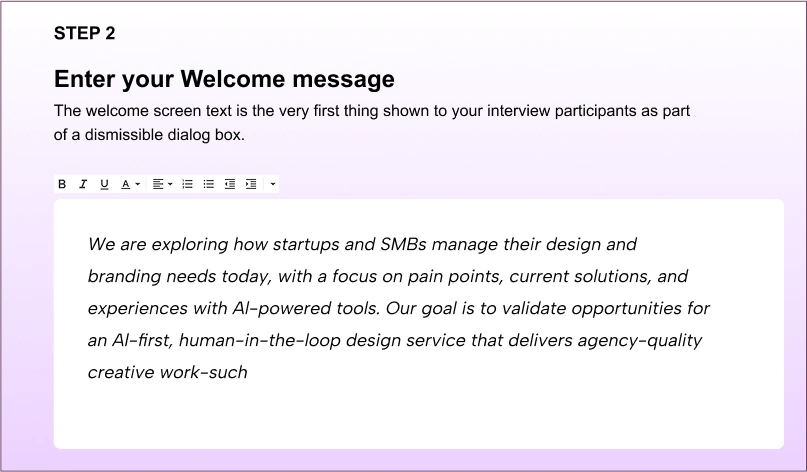
This is where conversational surveys change the game. By using AI Driven Surveys, platforms can dynamically probe respondents based on their initial answers. If a customer mentions they "disliked the setup process" of a new app, the AI doesn't just move to the next question. It instantly reads the text and asks a tailored follow-up: "What specific part of the setup felt confusing or slow?"
This conversational approach, complete with real-time probing and automated transcription, allows us to capture rich, qualitative depth at the scale of a quantitative survey.
AI-Powered Qualitative Coding and Sentiment Analysis
Once you have gathered hundreds or thousands of open-ended responses, the next bottleneck is analyzing them. Historically, researchers had to manually read, tag, and code every single response—a process prone to human fatigue and subjective bias.
Modern natural language processing tools automate this entire workflow. They instantly categorize unstructured data into thematic clusters, track sentiment, and map consumer emotions. In fact, a landmark Columbia University study on natural language processing in consumer research highlighted how machine learning models can identify subtle cognitive patterns and emotional triggers in consumer text that human analysts frequently overlook.
Advanced Market Analytics: Scaling Qualitative Insights
AI doesn't just help us understand what a single customer is saying; it helps us scale those qualitative insights across entire markets. By applying Advanced Market Analytics, we can combine conversational feedback with external data streams—such as competitor pricing, social listening, and e-commerce reviews—into a unified workflow. This gives product and marketing teams an automated pipeline for competitive intelligence and category-wide trend mapping.
The Business Case: Speed, Cost, and Scalability Benefits
The financial and operational arguments for adopting AI-powered market research solutions are undeniable.
Consider the personnel costs alone: a traditional market research analyst's salary typically ranges from $45,000 to $85,000 annually. While skilled human analysts remain vital for final strategic planning, using them for manual data cleaning, survey drafting, and basic transcript coding is an expensive use of resources. AI tools provide identical baseline processing capabilities at a fraction of the cost, with the added benefit of 24/7 availability.
By utilizing AI-Driven Market Insights, organizations can scale their research efforts globally without a linear increase in budget.
| Metric | Traditional Market Research | AI-Powered Market Research |
|---|---|---|
| Project Timeline | 4 to 12 weeks | Minutes to days |
| Average Cost | $15,000 – $50,000 per study | Hundreds of dollars (or subscription-based) |
| Availability | Restricted to working hours / panels | 24/7, instant deployment |
| Scalability | Hard caps on human panel sizes | Millions of simulated or real global respondents |
| Data Processing | Manual cleaning and coding | Automated NLP clustering and transcription |
Evaluating Accuracy: Can You Trust AI-Generated Insights?
A common question among enterprise decision-makers is: How accurate are these AI-generated insights compared to traditional human-led research?
The short answer is that they are incredibly reliable when anchored to real-world consumer data. In comparative industry tests, AI-driven qualitative analysis has shown a 90% parity with multi-million dollar traditional consulting studies. Many CMOs and research directors report that they are highly comfortable with AI outputs because they eliminate human coder bias and provide clear, source-linked evidence.
Rather than relying on generic, out-of-the-box LLMs—which can hallucinate or speak in broad generalities—specialized platforms focus on Market Research AI Powered by AI models that ground their findings in real, verifiable verbatims.
Benchmarking AI-Powered Market Research Solutions Against Human Panels
Recent benchmarking studies have shown that AI-powered research platforms can achieve incredibly high correlation scores when compared to traditional, human-only panels. Because AI-moderated surveys adapt to the user's language, they also boast higher engagement, lower drop-off rates, and near-perfect completion rates.
Furthermore, using AI Survey Analysis Tools allows researchers to clean out low-quality human responses (like gibberish or speed-running through forms) automatically, ensuring the final dataset is pristine.
Hybrid Models: Combining AI Efficiency with Human Strategy
The most successful research teams do not use AI to completely replace human strategic thinking. Instead, they run a hybrid model.
AI handles the heavy lifting—drafting the guides, conducting the interviews, transcribing the audio, and clustering the themes. The human strategist then steps in to apply creative problem-solving, industry context, and executive decision-making. By leveraging AI Powered Feedback Analysis, researchers can spend 90% of their time on strategy and only 10% on administrative execution.
How to Choose the Right AI Market Research Platform
Selecting the right software depends heavily on your specific business goals, the data sources you require, and your security standards.
When evaluating Market Research Survey Software, keep the following evaluation criteria in mind:
- Data Traceability: Can the tool trace every summary and insight back to a specific, real-world respondent verbatim? (Avoid "black-box" AI tools that do not provide audit trails).
- Security & Compliance: Is the platform GDPR-compliant and SOC2-certified? This is non-negotiable for protecting proprietary customer data.
- Conversational Probing Capabilities: Does the AI simply ask static questions, or can it dynamically probe open-ended answers in real time?
- Integration Options: Can the tool easily ingest your existing data sources, such as CRMs, CSVs, or customer support transcripts?
- Ease of Use: Does the platform require data science expertise, or can product, marketing, and UX teams use it out of the box?
Frequently Asked Questions about AI Market Research
Can AI completely replace traditional human panels?
No. While AI can simulate certain audience behaviors for initial hypothesis testing, high-stakes business decisions still require validation from real human consumers. The best approach is a hybrid one: use AI to conduct conversational interviews with real humans at scale, then use AI analysis tools to synthesize their responses.
How do AI tools ensure data privacy and security?
Reputable enterprise AI platforms prioritize strict data governance. They build their systems with SOC2 security frameworks, maintain strict GDPR compliance, and ensure that your proprietary customer data is never used to train public, third-party LLM models.
What is the cost difference between traditional and AI-powered research?
Traditional research projects often start at $15,000 and scale upward depending on the audience's complexity. AI-powered platforms typically operate on software-as-a-service (SaaS) subscription models or charge a nominal fee per report, representing a cost reduction of up to 90% while delivering results in hours rather than months.
Conclusion
The future of market intelligence belongs to companies that can listen to their customers in real time. Static, slow, and expensive research methods are rapidly giving way to continuous, dynamic insights.
At Reveal AI, we built our platform to bridge the gap between qualitative depth and quantitative scale. By combining conversational AI surveys, real-time probing, automated analysis, and respondent-level audit trails, we help research and product teams move from raw human feedback to defensible, client-ready insights in record time.
Ready to transform how your business gathers consumer intelligence? Learn more about Leveraging AI in Market Research and start outsmarting your competition today.