
No items found.
Performance Reviews Don't Have to Be Painful — But Most Still Are
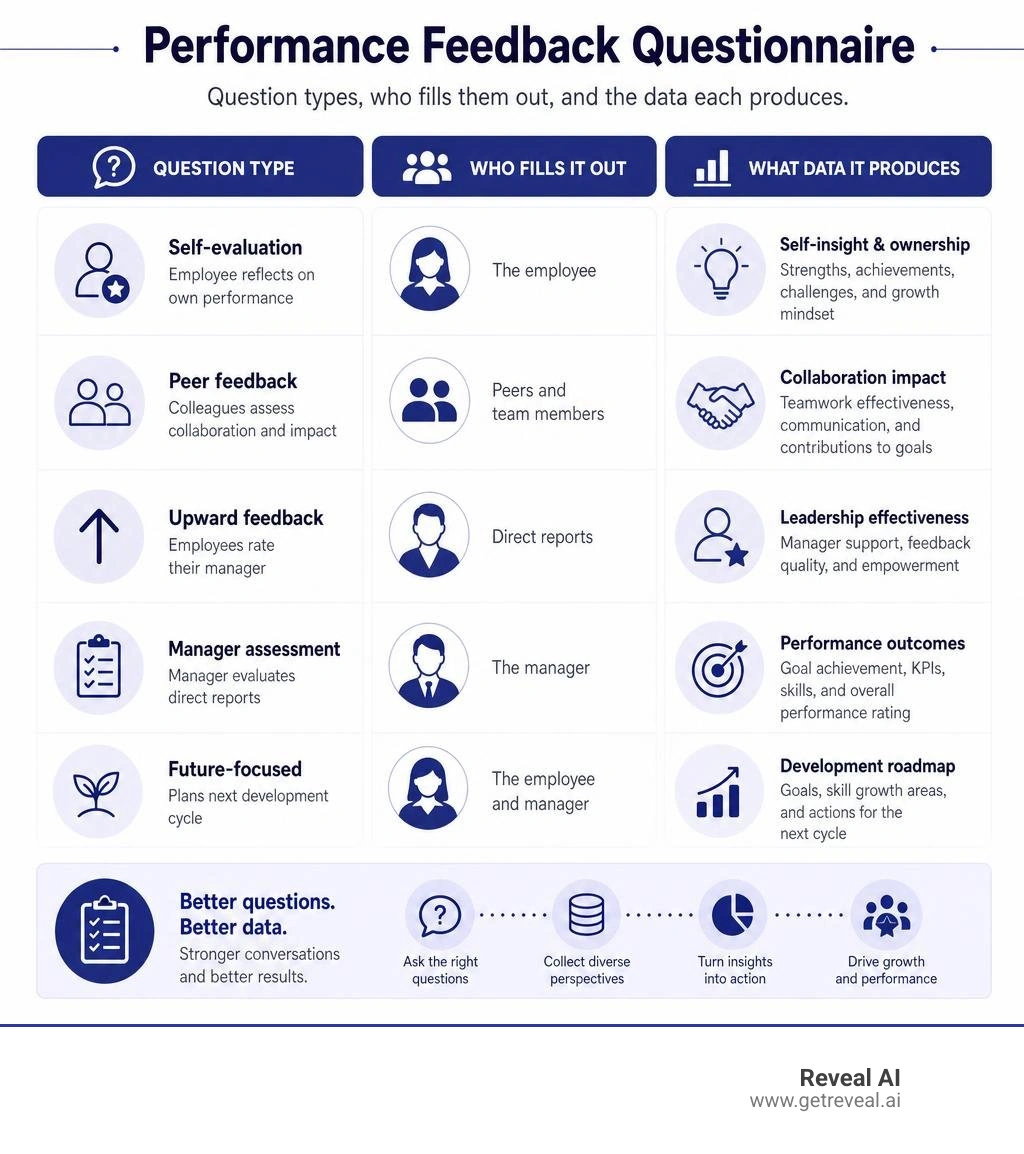
A performance feedback questionnaire is a structured set of questions used to evaluate employee performance, gather multi-source input, and guide development conversations. Here's a quick breakdown of what one typically includes:
| Question Type | Purpose | Example |
|---|---|---|
| Self-evaluation | Employee reflects on own performance | "What accomplishments are you most proud of this quarter?" |
| Peer feedback | Colleagues assess collaboration and impact | "How has this person contributed to team goals?" |
| Upward feedback | Employees rate their manager | "How well did your manager support your growth?" |
| Manager assessment | Manager evaluates direct reports | "How effectively did this person meet their KPIs?" |
| Future-focused | Plans next development cycle | "What skills do you want to build in the next six months?" |
Here's a number that should stop you cold: only 26% of organizations say their managers are highly effective at enabling team performance, according to Deloitte's 2025 Global Human Capital Trends survey.
Yet managers still spend over 210 hours a year grinding through annual performance reviews.
That's a lot of time for a process that isn't working. In fact, 64% of employees report feeling that performance reviews are a waste of time — and only 20% say their company's performance practices actually motivate them to do great work.
The disconnect is real. Managers believe they're giving constructive feedback. Employees disagree. Career development conversations are happening too rarely, too vaguely, or not at all — and 90% of millennials say career growth is what matters most to them in a job.
The root of the problem isn't performance reviews themselves. It's the questions being asked inside them.
A poorly designed questionnaire produces generic answers, defensive employees, and data you can't act on. A well-designed one opens up honest conversations, surfaces real skill gaps, and gives both managers and employees a clear path forward.
This guide gives you 30+ ready-to-use questions — organized by review type, role, and cycle — so your next performance review actually moves the needle.
Why Traditional Appraisals Fail (and How a Structured performance feedback questionnaire Helps)
Traditional performance appraisals fail because they are treated as administrative chores rather than development tools. When evaluations happen only once a year, they suffer from recency bias (evaluating an employee based solely on their last three weeks of work) and the halo/horn effect (allowing one shining achievement or minor slip-up to color the entire evaluation).
Furthermore, the number of direct reports per manager has increased by 61% recently, leaving managers with less time than ever to dedicate to deep, thoughtful talent assessments. In fact, managers spend just 13% of their time actually developing their people.
A structured performance feedback questionnaire solves these structural failures by standardizing the evaluation criteria. Standardizing your approach ensures:
- Legal Defensibility: Consistent, documented evaluation metrics are critical for supporting promotion or termination decisions.
- Calibrated Talent Analysis: Using parameter-level ratings (e.g., separating "work quality" from "productivity") tells a much clearer story. An employee who scores a 5 on quality but a 2 on productivity is thorough but slow—which is a completely different coaching conversation than someone who scores low on both.
- Organizational Insight: If 30% of your managers' improvement notes mention "communication bottlenecks," you have identified an organizational training need rather than an individual failure.
To build a balanced review, you need a mix of quantitative (rating scales) and qualitative (open-ended) questions.
| Question Type | What It Measures | Best For | Why You Need It |
|---|---|---|---|
| Quantitative (Likert / Rating Scales) | Standardized metrics, scores, and comparative trends over time. | Calibration, performance tracking, HR reporting. | Establishes a baseline and removes subjective guesswork during calibration. |
| Qualitative (Open-Ended) | Context, specific examples, obstacles, and the "why" behind the numbers. | Coaching, professional growth, identifying root causes. | Gives employees a voice and uncovers systemic issues that numbers hide. |
To make sure you are capturing both sides of this coin, organizations should leverage specialized Employee Survey Software to automate distribution and ensure a healthy mix of question types. By implementing structured Employee Feedback Solutions, you can easily transition from painful annual evaluations to a continuous feedback model that employees actually value.
Categorizing Questions and Adapting for Review Cycles
To build an effective performance feedback questionnaire, you must categorize your questions logically. This keeps the cognitive load low for reviewers and ensures you cover all key performance dimensions: overall performance, strengths, areas for improvement, and future growth.
Self-Evaluation Questions for Personal Reflection
Self-assessments are not about getting employees to grade themselves; they are about understanding how they perceive their own contributions, obstacles, and alignment with company goals. Comparing an employee's self-evaluation against their manager’s assessment is the quickest way to identify blind spots on both sides.
Using structured templates like the Business Centers, HR/Finance COE, and kNEXT SET Performance Appraisal is a great way to align self-reflection with organizational expectations.
- "What experience, project, or action are you most proud of since your last review?"
Why it works: It starts the review on a positive note and highlights what the employee values most in their daily work. - "Which of our corporate goals or values did you live best in the last few months, and how?"
Why it works: It forces the employee to connect their daily activities directly to the company's broader mission. - "What accomplishments have you been most proud of this past year, and what metrics back them up?"
Why it works: Encourages employees to bring data to the table rather than vague assertions of hard work. - "What aspects of your current role do you find most challenging, and why?"
Why it works: Surfaces obstacles before they lead to burnout or disengagement. - "What training, resources, or support do you wish you had to perform your job more effectively?"
Why it works: Shifts the conversation from a passive critique to an active, solution-oriented growth plan.
Peer-to-Peer Questions in a 360-Degree performance feedback questionnaire
Teammates often observe more of an employee's day-to-day behavior than leadership does. Peer feedback is vital for assessing teamwork, collaboration, and cultural alignment.
For a complete breakdown of how to structure these multi-source assessments, check out our 360 Employee Review Software Complete Guide. To gather peer insights that are actually useful, use these questions:
- "What are the main strengths of [Name] that should be leveraged going forward?"
Why it works: Identifies specific, observable skills that peers rely on. - "How effectively does [Name] communicate and collaborate on shared projects?"
Why it works: Measures interpersonal dynamics and emotional intelligence in real-team scenarios. - "Describe a meaningful contribution that [Name] has made to the team recently."
Why it works: Requests a concrete example to prevent general, unhelpful praise. - "What is one piece of constructive advice you would share with [Name] to help them increase their impact?"
Why it works: Normalizes constructive feedback in a safe, peer-to-peer format. - "How well does [Name] adapt to changing priorities and handle unexpected project shifts?"
Why it works: Evaluates resilience and adaptability under pressure.
To make this process even simpler, you can customize a standardized employee performance survey template to distribute peer reviews quickly and securely.
Upward Feedback Questions for Manager Assessment
Remember: performance reviews measure your managers as much as your employees. Only 46% of employees feel satisfied with their career development opportunities at their current organization. Upward feedback helps organizations identify whether managers are acting as coaches or roadblocks.
To build trust and protect employees, upward feedback should be gathered using secure Employee Survey Software.
- "How has your manager helped you achieve your goals during the past few months?"
Why it works: Directly measures whether the manager is actively enabling team success. - "Do you feel comfortable taking risks and approaching your manager with new ideas? Why or why not?"
Why it works: Evaluates the level of psychological safety within the team. - "How well does your manager accept employee feedback and act upon it?"
Why it works: Identifies if the manager is modeling a growth mindset. - "What could your supervisor do to better support you in your role over the next quarter?"
Why it works: Gives the employee a structured, respectful way to request changed management behaviors. - "Does your manager provide ongoing feedback that helps you improve your performance, or do you only hear from them during formal reviews?"
Why it works: Flags managers who are neglecting continuous communication.
Standardizing these leadership evaluations helps ensure consistency and fairness across all departments.
Adapting Questions for Annual, Mid-Year, and Quarterly Cycles
You shouldn't ask the same questions in an annual review that you do in a quick quarterly check-in. The frequency of your review cycle dictates the scope of your questions.
- Quarterly Reviews: Focus on immediate goals, tactical obstacles, and resource requests. Keep questionnaires short (4-8 questions) to avoid review fatigue. You can use a structured quarterly performance review template to keep these cycles incredibly light and fast.
- Mid-Year Reviews: Focus on tracking progress toward annual goals, identifying required course corrections, and checking in on well-being and engagement.
- Annual Reviews: Focus on overall impact, long-term career aspirations, compensation calibration, and promotion readiness.
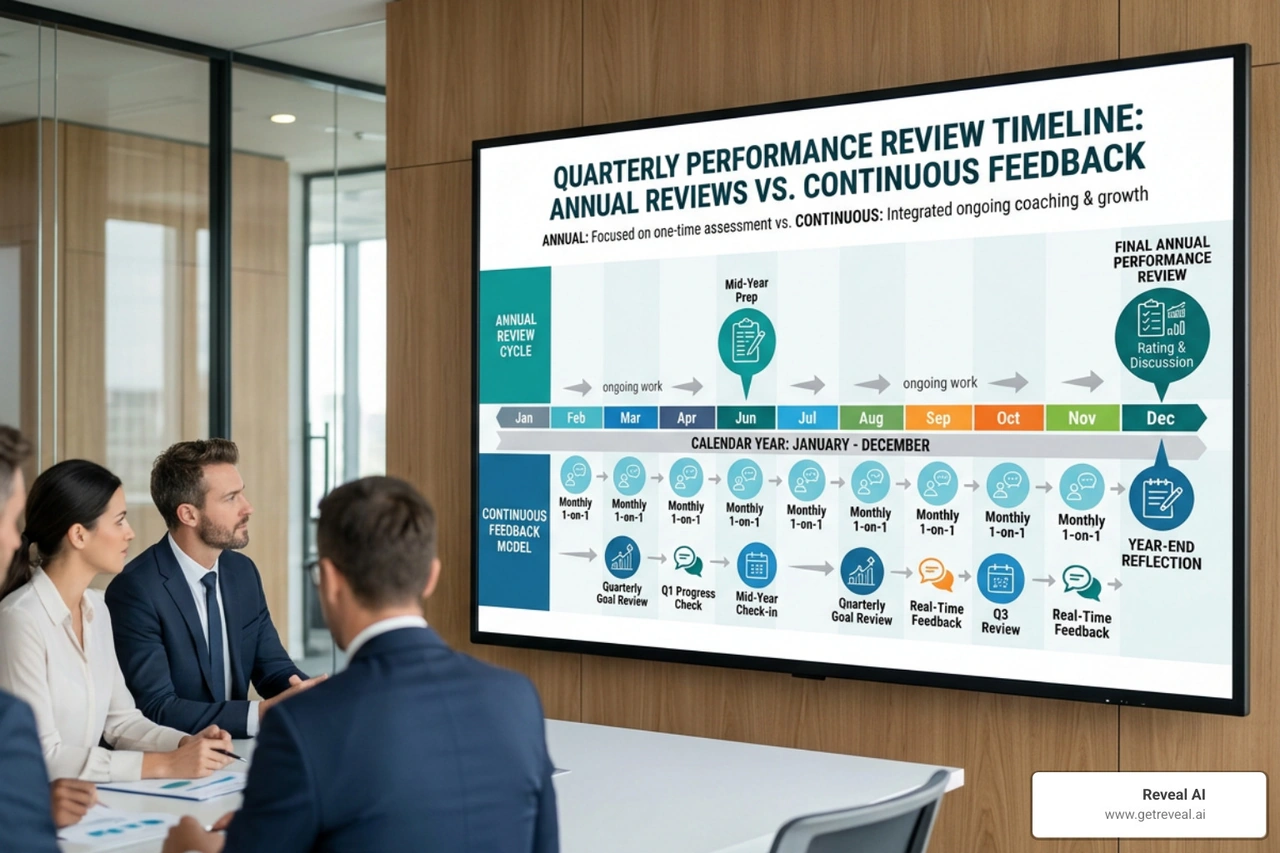
By integrating Real Time Employee Feedback channels alongside these cycles, organizations can completely eliminate the anxiety of "surprise" feedback during annual cycles.
Best Practices for Designing Actionable Review Surveys
Designing a performance feedback questionnaire is an art. If your questions are poorly phrased, your data will be useless.
Best Practices for Writing a Bias-Free performance feedback questionnaire
- Avoid Vague or Double-Barreled Questions: Asking "How would you rate this person's communication and technical skills?" is a trap. What if they are a brilliant coder who never speaks? Split these into two distinct questions.
- Use Behaviorally Anchored Rating Scales (BARS): Instead of a generic 1-5 scale (where "3" means different things to different managers), anchor your ratings in observable behaviors. For example:
- 1 - Unsatisfactory: Frequently misses deadlines and requires constant supervision.
- 3 - Meets Expectations: Consistently meets deadlines with standard quality work.
- 5 - Distinguished: Exceeds deadlines and proactively identifies ways to optimize processes.
- Require Written Examples for Extreme Ratings: If a manager rates an employee as a "1" or a "5," make it mandatory for them to write a brief, real-world example. This immediately reduces leniency and horn/halo biases.
- Keep Questionnaires Short: To maintain high-quality responses, limit peer and upward reviews to 5-10 questions. If a manager has to review 10 direct reports, a 50-question survey will result in click-fatigue and low-quality data.
To learn more about optimizing survey design, review our guide on Employee Feedback Solutions.
Using Performance Data to Identify Skill Gaps and Promotion Readiness
Once you've collected the data from your surveys, you need to use it. A structured questionnaire helps you build an Individual Development Plan (IDP) for every employee.
For example, you can cross-reference self-evaluations with manager assessments using standardized templates. If there is a wide gap between how an employee rates their "problem solving" and how their manager rates it, that gap becomes the focus of their next 1:1.
Additionally, you can run a gap analysis across entire departments. If your customer service team scores highly on "empathy" but poorly on "technical domain knowledge," your HR team knows exactly what training programs to fund next quarter.
The Role of AI and Automation in Modern Performance Management
Historically, the hardest part of performance reviews was analyzing the mountains of qualitative text. Managers and HR teams had to read thousands of open-ended comments to find common themes.
Today, AI and automation are changing the game. Modern tools can:
- Summarize Feedback: Transform long, unstructured peer comments into unbiased, constructive bullet points.
- Identify Sentiment Trends: Detect early signs of burnout or disengagement in open-ended text.
- Generate Actionable Next Steps: Automatically suggest learning and development courses based on identified skill gaps.
To dive deeper into this shift, read our comprehensive piece on The Role Of Ai In Hr.
Frequently Asked Questions about Performance Reviews
How many questions should be in a performance review survey?
For managers reviewing multiple direct reports, keep it to 4 to 8 questions per employee to prevent review fatigue. For self-reflections, 10 questions is the sweet spot. For peer and upward reviews, keep it exceptionally tight—around 5 targeted questions is ideal.
What is the difference between a performance survey and a 360-degree review?
A traditional performance survey is typically a single-source evaluation (usually just the manager assessing the employee). A 360-degree performance review is a multi-source assessment that gathers feedback from peers, direct reports, supervisors, and the employee themselves to build a complete, unbiased picture.
How do you handle negative feedback in a performance review?
Negative feedback should never be a surprise. It must be delivered within a framework of psychological safety, focused entirely on objective behaviors rather than personal traits. Every piece of negative feedback must be accompanied by a concrete, co-created action plan detailing the exact steps, resources, and timelines required for improvement.
Conclusion: Turning Groans into Growth
Performance reviews don't have to be a painful administrative check-the-box exercise. By using a structured performance feedback questionnaire, you can transform stressful evaluations into constructive, growth-focused conversations that boost employee retention and drive real business outcomes.
But standardizing your questions is only half the battle. If you're still forcing employees to fill out clunky, boring forms, your response rates and data quality will suffer.
That's where we come in. At Reveal AI, we provide conversational AI surveys that feel like a natural conversation rather than an interrogation. Our platform uses real-time probing and AI transcription to deliver 2.5x more high-value words, 41% higher response rates, and 40% faster project completion times. We help you turn qualitative feedback into actionable, structured insights in minutes.
Ready to build a feedback culture that actually works? Get started with Reveal AI's Employee Feedback Solutions today.