Get The Latest Insights, Tips, And Updates - Straight to Your Inbox.
Thank you! Your submission has been received!
Oops! Something went wrong while submitting the form.
Why Manual Feedback Analysis is Holding Your Business Back
An AI customer feedback tool uses artificial intelligence—specifically natural language processing—to automatically analyze feedback from sources like surveys, reviews, and social media. It turns unstructured comments into actionable insights in minutes, not weeks.
Top AI Customer Feedback Tools at a Glance:
Tool TypePrimary Use CaseKey BenefitConversational AI SurveysCollecting deeper responses3x longer customer responsesSentiment Analysis PlatformsUnderstanding customer emotionReal-time positive/negative/neutral scoringMulti-Channel AnalyticsUnifying feedback sourcesSingle source of truth across all channelsAI Interview ToolsQualitative research at scaleConduct hundreds of interviews simultaneously
You know the feeling. You're drowning in customer feedback—survey responses piling up, app store reviews flooding in, support tickets accumulating. Your team is manually combing through every single comment, trying to find patterns, and by the time you've identified a trend, the moment has passed.
As one product manager put it: "Manually combing through every single review was like a second job."
Here's the reality: AI can blaze through thousands of reviews in minutes—a task that would take humans "forever and a day" manually. More importantly, AI doesn't just work faster. It spots patterns you'd miss, understands sentiment across languages, and turns that mountain of unstructured feedback into clear, actionable insights.
Natural language processing algorithms work tirelessly, without bias, to understand the nuances in customer language. They categorize feedback, detect sentiment, and identify emerging trends before they become major issues.
The market research industry has moved beyond viewing AI as an "emerging trend"—it's now essential infrastructure. Whether you're analyzing app store reviews, processing open-ended survey responses, or monitoring social media sentiment, AI-powered tools help you turn customer voices into business decisions that actually move the needle.
Why Your Business Needs an AI Customer Feedback Tool
Imagine instantly understanding every customer review, survey, and support ticket. An AI customer feedback tool delivers this power, making your business smarter, more efficient, and deeply customer-centric.
From Hours to Minutes: The Speed and Scale of AI
Manual feedback analysis is a monumental task. When you're "drowning in feedback and barely have time to breathe," this is where AI truly shines.
Processing thousands of reviews: AI tools can plow through a mountain of customer reviews in minutes, a task that would take a human "forever and a day." This incredible speed frees your team from the tedious chore of manual data sifting.
Automating repetitive tasks: AI-powered tools automate repetitive tasks, changing product research from manual data sorting to faster iterations. This means less time on data entry and more time on strategy.
Freeing up team resources: By automating the heavy lifting of feedback analysis, your team is liberated to focus on what they do best: creating solutions and driving growth. As one expert noted, AI "compresses hours of work into minutes."
Scaling analysis: Whether you're a small startup or a large enterprise, an AI feedback tool allows you to scale your analysis effortlessly. You can conduct hundreds of AI-moderated interviews at once or monitor millions of comments without breaking a sweat.
Uncovering the Truth: Accuracy and Objectivity
Humans are prone to bias and fatigue. AI, on the other hand, is built for precision and impartiality.
Natural Language Processing (NLP): At the heart of every great AI customer feedback tool are sophisticated Natural Language Processing (NLP) algorithms. They efficiently understand the nuances behind words, processing every piece of feedback with meticulous, unbiased attention.
No human bias: AI "keeps it real," looking at both good and bad feedback without emotional influence. This means you get a truly objective assessment of customer sentiment, free from the biases that can creep into human analysis.
Understanding nuance: NLP algorithms can pick up on context, slang, and implied meanings, providing a deeper understanding of what customers are really saying. This allows for more precise summaries and richer insights.
Consistent analysis: AI applies consistent analytical rules across all data, ensuring your insights are reliable and comparable over time. This consistency is crucial for tracking trends and measuring the impact of your actions.
These benefits lead to real-time insights and better customer satisfaction. Acting quickly on AI-identified issues can significantly improve customer loyalty and drive positive ratings. We believe that AI-powered tools are the only way to efficiently lead your product or service to fulfill customer expectations, ensuring your brand is always evolving to meet customer needs. For more on building a customer-first brand, explore The Power of Customer-Centric Branding.
How AI Transforms Raw Feedback into Actionable Insights
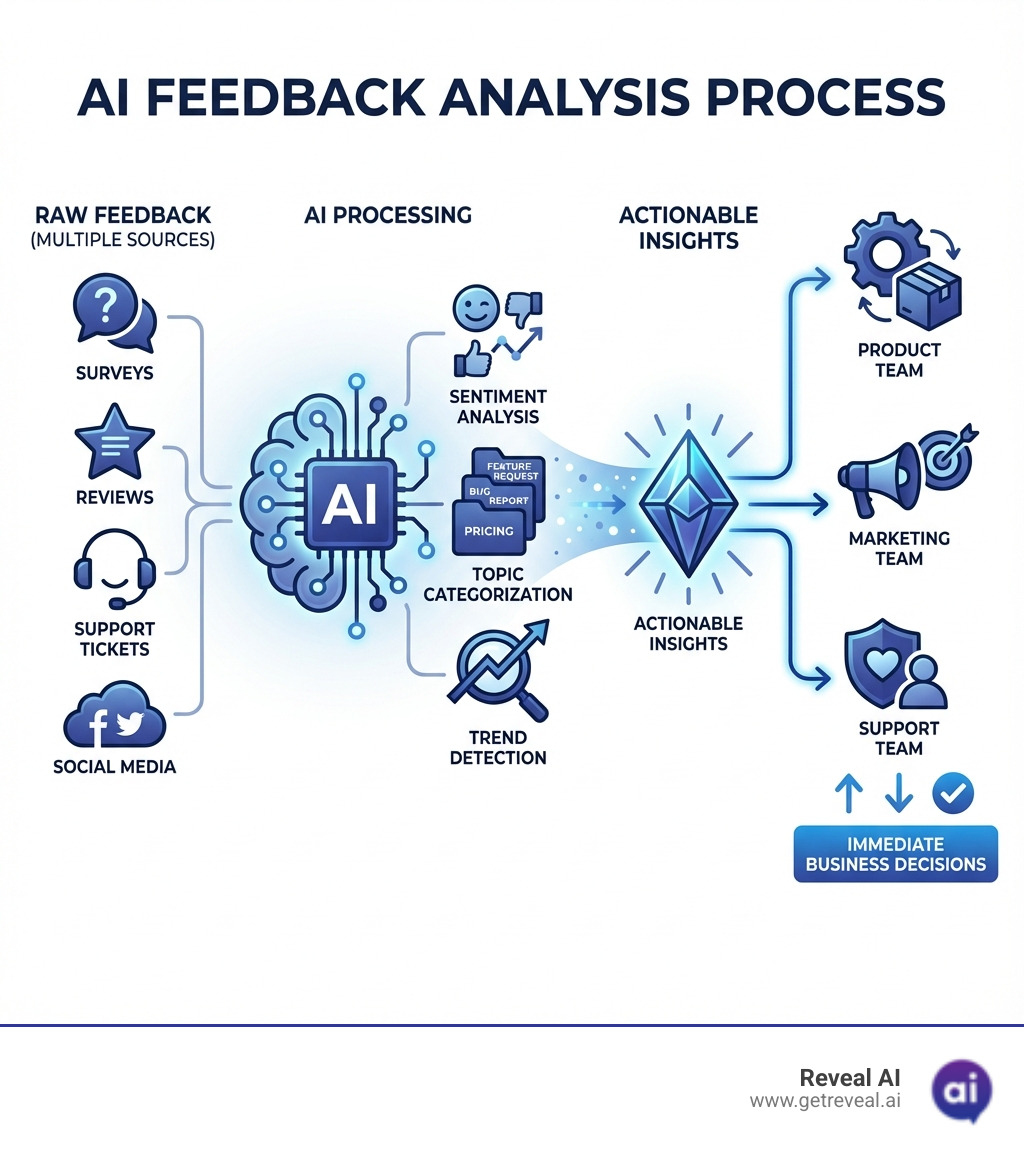
So, how does an AI customer feedback tool actually perform its magic? It's a two-step dance: first, unifying all your disparate feedback channels, and second, applying powerful AI algorithms to make sense of the data. This process transforms a chaotic jumble of opinions into clear, actionable intelligence, enabling you to make data-driven decisions faster than ever. This is a key part of Leveraging AI in Market Research.
Step 1: Unifying All Your Feedback Channels
Customer feedback comes from everywhere these days: surveys, online reviews, social media mentions, support tickets, emails, and even phone calls. Traditionally, this feedback lives in siloed systems, making it nearly impossible to get a holistic view of the customer experience. An AI feedback tool solves this by creating a centralized hub.
Integrating sources: Our platform is designed to bring every customer comment into one intelligent view. This means connecting with various sources like CRMs, helpdesks, survey platforms, and online review platforms.
CRMs and Helpdesks: By integrating with your existing customer relationship management (CRM) and helpdesk software, you can stream customer service interactions directly into your feedback analysis platform. This includes chats, emails, and tickets, capturing valuable context from every customer touchpoint.
Surveys: Whether you're running short pulse surveys or in-depth questionnaires, our platform can centralize all your survey responses, including open-ended text answers that hold a treasure trove of insights.
Online reviews: From app stores to product review sites, AI tools can monitor customer reviews at scale, pulling in comments from across the web.
Social media: While not explicitly mentioned in the provided research, modern AI tools often extend to monitoring social media for brand mentions and sentiment, further enriching the feedback pool.
Creating a single source of truth: The goal is to keep all your customer feedback in one place. This ensures a universal source of truth within your organization, improves collaboration among teams, and allows for a consistent taxonomy system for categorization and analysis.
Step 2: The Magic of AI Analysis
Once all your feedback is unified, the AI goes to work, performing sophisticated analysis that would be impossible for humans at scale.
Sentiment scoring (Positive, Negative, Neutral): One of the most fundamental capabilities of an AI customer feedback tool is sentiment analysis. AI can automatically analyze customer feedback to determine the sentiment behind responses, identifying whether feedback is positive, negative, or neutral. This gives you a bird's-eye view of customer emotion and allows you to quickly gauge reactions to new products, features, or campaigns.
Topic and theme detection: Beyond just sentiment, AI excels at identifying recurring topics and themes within vast datasets. It spots patterns and trends over time, automatically categorizing open-ended responses into relevant topics. For instance, if many customers mention "slow load times" or "crashes," the AI will quickly flag these as common pain points.
Identifying pain points: By clustering similar feedback, AI can pinpoint common customer pain points, allowing your product and support teams to address critical issues quickly.
Spotting feature requests: AI can analyze open-text feedback to identify and aggregate the most frequently requested features from users, providing invaluable input for your product roadmap.
This automated qualitative analysis provides deeper insights and faster decisions, changing raw customer feedback into prioritized, actionable insights.
Key Features to Look for in an AI Feedback Analysis Tool
Choosing the right AI customer feedback tool is crucial. It's not just about having AI; it's about having the right AI features that empower your teams. An ideal tool should be comprehensive, intuitive, and seamlessly integrate into your existing workflows.
Here's a list of must-have features we recommend looking for:
AI form builders and question generation: To assist with crafting effective questions.
Conversational surveys and AI interviewers: For deeper, more engaging feedback collection.
Automated sentiment analysis: To quickly gauge overall customer emotion.
Topic clustering and trend detection: To identify recurring themes and emerging patterns.
Customizable dashboards and reporting: For clear visualization and sharing of insights.
AI-powered chat for querying data: To get instant answers to specific questions.
API access and native integrations: For seamless data flow with other business systems.
Robust data security and compliance: Ensuring GDPR, CCPA, and other standards are met.
Multilingual support: To analyze feedback from a global customer base.
Real-time monitoring: To catch issues and opportunities as they arise.
Essential Features of an AI Customer Feedback Tool for Collection
Collecting feedback effectively is the first step. AI can revolutionize this process, making it easier and more engaging for your customers.
AI form builders: Our platform includes AI form builders that assist with question generation, helping you craft relevant questions based on your goals and industry. These tools can help avoid common survey pitfalls like overly complex phrasing.
AI question generation: Instead of spending hours figuring out the right questions, AI can generate relevant questions based on a simple text prompt. This ensures you're asking questions that feel natural to your customers while delivering useful insights.
Conversational surveys: We offer AI-improved conversational surveys that drive better response rates and deeper insights. Our AI can dynamically adjust follow-up questions based on user answers in real-time, making feedback collection feel more like a natural conversation. This approach can lead to "customer responses more than three times longer than average."
AI interviewers: For qualitative research at scale, our AI interviewer engages participants in rich dialogue and dynamically probes deeper to get the "why" behind their answers. This allows you to conduct hundreds of AI-moderated interviews at once, in any language, via video, voice, or text. AI interviews "reveal what people want, fast."
Reveal AI: Our AI-powered platform for conversational surveys transforms customer voices into business decisions rapidly, offering deeper insights and faster decisions through automated qualitative analysis.
Survey completion time research: It's worth noting that research on survey completion times suggests that shorter surveys lead to higher engagement per question. AI can help optimize survey length and question quality to maximize valuable insights.
Core Analysis and Insight Generation Capabilities
Once collected, the raw data needs to be transformed into usable insights.
Automated sentiment analysis: Our tools automatically analyze customer feedback to determine the sentiment behind responses, categorizing them as Positive, Neutral, or Negative. This provides a clear, bird's-eye perspective of the customer experience.
Topic clustering: AI excels at automatically categorizing customer feedback into relevant topics and themes. This helps you identify common customer pain points, recurring bugs, or frequently requested features without manually sifting through data.
Trend detection over time: Our AI spots patterns and trends over time, allowing you to monitor how customer sentiment evolves after updates or new feature launches. This helps you stay ahead of the curve and make proactive adjustments.
Customizable dashboards: You need to see your data clearly. Look for tools that offer customizable dashboards to visualize key metrics, sentiment scores, and topic trends, making it easier to identify key insights.
AI-powered chat for querying data: Imagine being able to ask your feedback data questions directly. Our AI-powered chat can answer queries like, "What is the general sentiment of customer reviews?" or "What are the top feature requests from our users?" This allows for quick, on-demand insights.
Integration, Security, and Reporting
A powerful AI tool is only as good as its ability to integrate with your existing ecosystem and protect your valuable data.
API access: For custom integrations, robust API access, webhooks, and options for CSV imports are essential. This ensures you can pull in feedback from virtually any source.
Native integrations (Reveal AI integrations with CRMs, helpdesks, etc.): Look for native connectors to common business systems like CRMs, helpdesks, and marketing platforms. This streamlines data flow and creates a unified view of the customer.
Data security (GDPR, SOC 2): Data privacy and security are paramount. Our platform is fully compliant with GDPR and CCPA regulations, ensuring all personal data is handled securely and responsibly. We are also SOC2 Type II and ISO 27001:2022 certified, meeting the highest security and confidentiality standards. Your data is safe with us.
Automated reporting: The best tools provide automated reporting capabilities, changing complex data into easy-to-understand summaries and presentations. This helps you share insights quickly across your organization.
Audience Intelligence: For a deeper dive into understanding your customer segments and their specific needs, our platform also offers Audience Intelligence capabilities, further enriching your feedback analysis.
Putting AI to Work: Use Cases Across Your Organization
An AI customer feedback tool isn't just for one department; it's a cross-functional powerhouse that empowers every team to make better, more informed decisions. By providing accessible, actionable insights, AI fosters a truly customer-centric culture.
Product Management: Using an AI Customer Feedback Tool to Build Better Products
Product managers are often the first to feel the weight of customer feedback. AI transforms this burden into a blueprint for innovation.
Prioritizing feature requests: AI can identify and aggregate the most frequently requested features from users, helping product teams understand "what are the top feature requests from our users?" This ensures your roadmap is aligned with actual customer needs.
Identifying common bugs: By analyzing reviews and support tickets, AI can quickly highlight "common issues among our users," such as "crashes" or "slow load times," enabling rapid bug fixes and continuous improvement.
Understanding user confusion: AI can pinpoint areas where users express confusion or difficulty, answering questions like, "Is there anything our users find confusing or difficult to understand?" This is vital for improving usability and user experience.
Validating roadmap decisions: AI helps product managers validate their decisions by analyzing user sentiment around recent product updates or new features, providing insights into "what are users saying about our recent product update?" This insight is crucial for product success and is a key part of effective Customer Research.
Marketing and Sales Teams
For marketing and sales, understanding the customer voice is key to crafting compelling messages and closing deals.
Refining messaging: AI helps marketing managers understand "what messaging resonates most with customers" by analyzing how customers describe their needs and experiences. This allows for more effective campaign development.
Understanding campaign sentiment: Quickly gauge the sentiment around recent marketing campaigns to see what's working and what needs adjustment.
Identifying customer stories: AI can uncover rich customer stories and use cases from feedback, providing authentic testimonials and narrative for marketing materials.
Finding new use cases: By analyzing open-ended discussions, AI can help identify new opportunities and unexpected ways customers are using your product, which can open up new market segments. This dynamic understanding of the market is central to effective Market Research.
Customer Success and Support
Customer success and support teams can leverage AI to be more proactive, efficient, and ultimately, improve customer retention.
Pinpointing churn reasons: AI can analyze feedback to identify "reasons for potential customer churn," allowing teams to address underlying issues before customers leave.
Analyzing support interactions: By analyzing chats, emails, and tickets, AI can help understand "what do customers say about our response and issue resolution times?" This identifies areas for improving service delivery.
Improving onboarding: Feedback analysis can reveal customer comments about the onboarding process, highlighting pain points and opportunities to make the initial customer experience smoother.
Identifying training gaps: AI can spot patterns in customer questions or complaints that indicate a need for additional support or features, guiding the development of new resources or training materials. This agile approach to understanding and responding to customer needs is a cornerstone of Agile Research for Innovation.
Navigating the Future: Trends and Challenges
The world of AI is constantly evolving, and the future of the AI customer feedback tool is bright with innovation. However, like any powerful technology, it comes with its own set of considerations. Understanding these trends and challenges is key to staying ahead.
Predictive analytics: We anticipate a move towards more sophisticated predictive capabilities. Beyond just understanding past and present sentiment, AI will increasingly predict future customer behavior, anticipate needs, and proactively suggest actions to prevent churn or capitalize on emerging opportunities.
Multimodal analysis (voice, video): While text analysis is powerful, the future lies in multimodal feedback. Our AI-moderated interviews already engage participants via video, voice, or text, allowing for deeper insights by analyzing facial expressions, tone of voice, and other non-verbal cues. This comprehensive approach captures the full spectrum of customer emotion.
Hyper-personalization: AI will enable businesses to understand individual customer preferences at an unprecedented level, leading to hyper-personalized product experiences, marketing messages, and support interactions.
AI bias: A critical challenge is ensuring AI models are free from bias. If the data used to train the AI contains inherent biases, the analysis will reflect them. Continuous monitoring and ethical AI development are crucial to mitigate this risk.
Data privacy concerns: With more data being collected and analyzed, data privacy remains a top priority. Adherence to regulations like GDPR and CCPA, along with robust security certifications (SOC2 Type II, ISO 27001:2022), will continue to be non-negotiable.
Implementation costs: While AI offers immense value, the initial investment in a comprehensive AI customer feedback tool can be a consideration for some businesses. However, the long-term ROI from improved customer satisfaction, reduced churn, and optimized product development often far outweighs these costs.
As the market research landscape continues to evolve, powered by AI-fueled innovation, embracing these advancements is essential. For more insights into these shifts, dig into The Evolution of Market Research.
Frequently Asked Questions about AI Feedback Tools
How does an AI customer feedback tool improve customer loyalty?
An AI customer feedback tool significantly boosts customer loyalty by making customers feel heard and valued.
Faster response to issues: By quickly identifying pain points and emerging issues, AI enables businesses to address problems promptly. This proactive approach shows customers their feedback matters, turning potential frustrations into positive experiences.
Proactive improvements: AI helps us make sense of vast amounts of feedback, identifying key trends and insights that guide product improvements and service improvements. When customers see their suggestions implemented, their loyalty deepens.
Feeling heard: When businesses actively listen to and act on feedback, customers feel a stronger connection to the brand. Our AI-powered conversational surveys, for instance, are designed to make feedback collection feel more natural and engaging, ensuring customers feel their voice is truly captured.
Closing the feedback loop: AI tools can help rout issues to the right stakeholders and even trigger timely follow-ups, ensuring that feedback leads to visible action, which reinforces customer trust and loyalty.
Data-driven improvements: By driving company-wide improvement based on real customer insights, AI helps increase customer lifetime value and fosters a loyal customer base.
Can AI analyze feedback from different languages?
Absolutely! One of the remarkable capabilities of an AI customer feedback tool is its multilingual support.
Multilingual support: Modern AI feedback tools are designed to process and understand feedback in various languages. This is crucial for businesses operating in diverse global markets.
Automatic translation: Our platforms can automatically translate and transcribe feedback between dozens of languages. This means you can gather insights from customers across Europe, the United States, or any other region without language barriers.
Global feedback analysis: This capability allows businesses to get qualitative insights at scale from non-English speaking markets, ensuring a comprehensive understanding of their global customer base.
NLP capabilities for various languages: The underlying NLP algorithms are trained on vast datasets of different languages, enabling them to understand nuances, sentiment, and topics regardless of the original language.
What are the limitations of using AI for feedback analysis?
While incredibly powerful, it's important to acknowledge that an AI customer feedback tool isn't a magic bullet and has certain limitations.
Potential for bias: AI models are only as good as the data they are trained on. If the training data contains biases, the AI's analysis might inadvertently reflect those biases. Continuous monitoring and ethical development practices are essential to mitigate this.
Lack of human context: While AI is excellent at identifying patterns and sentiment, it can sometimes miss subtle human emotions, sarcasm, irony, or complex cultural nuances that a human researcher would pick up. It's not a replacement for human judgment, but rather a powerful augmentation.
Need for quality data: The principle of "garbage in, garbage out" applies here. The accuracy and depth of AI analysis heavily depend on the quality and volume of the input data. Poorly collected or insufficient feedback will yield less valuable insights.
Initial setup complexity: Integrating an AI customer feedback tool with existing systems and customizing it to specific business needs can require an initial investment of time and resources. However, this upfront effort pays dividends in long-term efficiency.
Not a replacement for human judgment: AI helps you make sense of your data, and we make sure it stays yours. The insights generated by AI should guide, not replace, the strategic thinking and empathetic understanding that human teams bring to the table. It's a tool to empower, not to fully automate, the decision-making process.
Conclusion: Stop Guessing, Start Knowing
In today's business world, relying on guesswork or slow, manual processes for customer feedback is no longer sustainable. An AI customer feedback tool transforms a chaotic "feedback frenzy" into a streamlined, insightful operation. We've seen how AI saves precious time, provides unbiased and accurate analysis, identifies crucial trends in real-time, and ultimately leads to improved customer satisfaction and loyalty.
By unifying all your feedback channels and leveraging the power of AI to analyze sentiment, categorize topics, and spot emerging patterns, you can empower every team—from product development to marketing and customer success—to make data-driven decisions.
Embracing an AI customer feedback tool isn't just about adopting new technology; it's about gaining a significant competitive advantage. It's about moving beyond assumptions and truly understanding what your customers want, need, and feel. It's about turning every customer voice into a clear, actionable business decision.
Stop guessing and start knowing. Explore our AI-powered platform and find how we can help you transform customer voices into strategic business decisions, rapidly.