No items found.

Blog
Set It and Forget It The Power of Automated Customer Feedback

Bob Dimicco


Customer feedback automation is the use of digital tools and AI to automatically collect, analyze, and act on customer feedback without manual intervention. Instead of manually sending surveys, reading responses, and creating reports, automation handles these repetitive tasks while your team focuses on strategic decisions.
What Customer Feedback Automation Does:
Most teams believe they "know their customers." But when product launches fail or churn rates climb, they realize they've been working off assumptions. The problem isn't a lack of feedback—it's the inability to process it fast enough to matter.
According to research, there's been a 50% increase in feedback collection efforts driven by growing customer engagement channels. Yet many organizations still rely on spreadsheets, scattered surveys, and manual analysis. This creates a bottleneck: feedback arrives faster than teams can act on it.
Manual feedback management faces serious challenges:
The cost of inaction is real. Businesses lose $136.8 billion each year because customers switch brands. Meanwhile, companies that respond quickly and personally see dramatic results: 92% of B2B buyers are more likely to purchase after reading positive reviews, and customers will spend 31% more on businesses with great reviews.
This is where automation changes everything. Modern customer feedback automation doesn't just collect data—it transforms raw input into actionable intelligence while the feedback is still fresh.
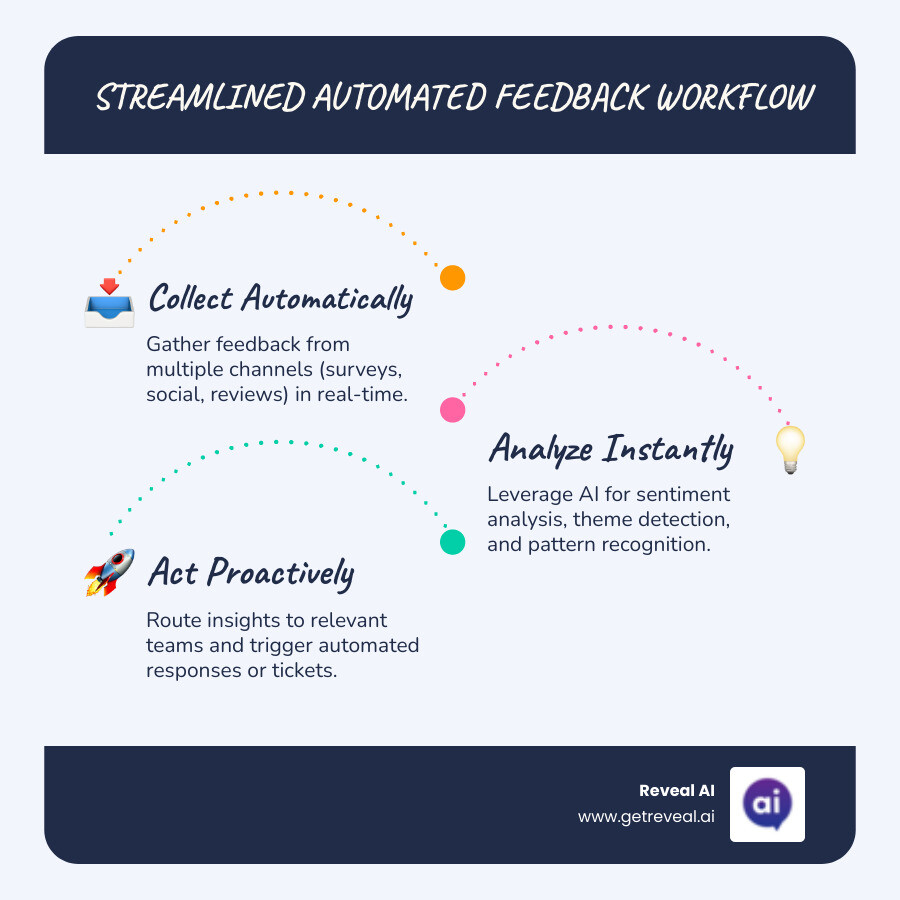
Imagine a world where customer insights flow freely, where every comment, every star rating, and every suggestion is instantly heard, understood, and acted upon. That's the promise of customer feedback automation. It's about moving from reactive to proactive, from guesswork to data-driven confidence.
When we talk about automation, we're not just replacing a human task with a robot. We're fundamentally changing how we interact with our customers and how we learn from their experiences. Unlike manual methods, which are often expensive, time-consuming, and prone to inaccuracies, automated systems are efficient, consistent, and always on duty. They ensure faster insights and better decision-making for customer experience improvement. This means our teams can stop sifting through endless data and start focusing on what truly matters: building stronger customer relationships and innovating.

One of the most compelling reasons to accept customer feedback automation is its direct impact on our bottom line and our customers' happiness.
First, let's talk about churn. In the U.S. alone, businesses lose an astonishing $136.8 billion each year because customers switch brands. This isn't just a number; it's a testament to the fact that managing churn is paramount. By automating feedback collection and analysis, we can quickly spot the main problems our customers face. When we act on this feedback, not just collect it, we significantly move the needle on customer satisfaction, retention, and ultimately, our ROI. Automated follow-up questions and recovery workflows for "Detractors" (those unhappy customers) are crucial strategies to improve retention.
Then there's the power of positive reviews and conversions. Marketing automation, which includes feedback automation, helps 80% of companies increase leads and 77% increase conversions. Think about it: around 92% of B2B buyers are more likely to purchase after reading a positive, trusted review. And it's not just B2B; product reviews are among the top three sources of information in the U.S. If our business has great reviews, people might even be willing to spend 31% more on our products or services. By collecting and leveraging positive feedback, we can turn satisfied customers into powerful advocates, fueling our growth and strengthening our brand reputation. This is a core tenet of The Power of Customer-Centric Branding.
Beyond boosting growth, customer feedback automation is a game-changer for operational efficiency and consistency.
Manual feedback processes are notorious for human error and subjective interpretation. We've all been there: a hurried glance over a survey, a miscategorized comment, or simply missing a critical piece of feedback. Automation, especially when powered by AI, eliminates much of this. AI-based feedback categorization provides consistent and 90%+ accurate insights, ensuring every piece of data is handled objectively and reliably.
Furthermore, automated systems work 24/7. This means we can collect feedback at any time, from any customer, across any touchpoint, without needing a human to be physically present. This continuous collection ensures we never miss a beat and always have fresh insights.
The real magic happens when automation frees up our most valuable asset: our team. Automated customer service can offload simpler, lower-effort issues, preventing agent burnout and lowering customer wait times. This allows our human agents to focus on more complex, strategic work—the kind of work that truly requires empathy, problem-solving, and relationship building. Instead of spending hours manually sifting through data, our teams can focus on interpreting insights, designing solutions, and making strategic decisions. This shift empowers our employees and helps us deliver a consistently high-quality customer experience.
Building an automated feedback engine is like setting up a continuous learning system for our business. It's a structured approach that ensures we're always listening, always learning, and always improving. At its heart is the customer feedback loop—a circular process of gathering feedback, acting upon what we've learned, and then asking for feedback again. This iterative process drives continuous improvement and helps us maintain a pulse on customer sentiment.
This journey involves defining our goals, selecting the right channels, setting up smart triggers, leveraging the power of AI, and closing the loop with automated actions. Let's explore the steps.

Before we automate anything, we need to understand why we're collecting feedback. Are we aiming to improve a specific product feature? Reduce churn in a particular segment? Improve our customer support experience? Clearly defined goals will guide our entire automation strategy.
Once our goals are clear, we select the right channels to gather feedback, ensuring we listen to our customers at every stage of their journey. Different types of feedback serve different purposes:
We can collect these insights through various automated channels:
The beauty of customer feedback automation lies in its ability to collect feedback precisely when and where it matters most. This is achieved through behavioral triggers and a centralized data strategy.
Behavioral triggers are rules that automatically initiate a feedback request based on a customer's action or stage in their journey. This ensures contextuality and relevance, leading to higher response rates and more meaningful data. Examples include:
Once collected, all this valuable feedback needs a home. A critical step is to centralize this data into a unified platform or data warehouse. Integrating our customer experience management software with platforms like Airtable, Firebase, MySQL, or MongoDB allows us to sync customer feedback data seamlessly. This centralization ensures that all feedback, regardless of its source, is accessible in one place. Furthermore, integrating with our CRM ensures that customer profiles are enriched with their feedback history, providing a holistic view. A centralized dashboard that aggregates tagged feedback allows us to monitor trends and act quickly, changing raw data into actionable insights.
This is where things get really exciting! AI and machine learning are no longer futuristic concepts; they are the backbone of modern customer feedback automation. They transform mountains of raw, often unstructured, data into clear, actionable insights.
Our research highlights that AI-based feedback categorization provides consistent and 90%+ accurate insights. This means we can rely on the system to understand and sort feedback much faster and more reliably than manual human effort.
Here's how AI plays a pivotal role:
At Reveal AI, we provide an AI-powered platform for conversational surveys, changing customer voices into business decisions rapidly. We operate at the forefront of the market and customer research industry, uniquely offering deeper insights and faster decisions through automated qualitative analysis. Our AI helps us not just listen, but truly understand.
Collecting and analyzing feedback is only half the battle; the real impact comes from acting on it. Customer feedback automation extends to automating the actions triggered by feedback, effectively closing the loop with our customers.
By automating these actions, we ensure that feedback isn't just collected and analyzed; it's actively used to drive improvements, resolve issues, and improve the customer experience in a timely and consistent manner.
Implementing customer feedback automation is a significant investment, and like any investment, we need to measure its return. This final stage is all about changing those rich insights into tangible business growth and continuously refining our approach. Our goal is to move from simply collecting data to making confident, data-driven decisions that impact product development, service delivery, and overall customer loyalty. This entire process is a prime Use Case: Customer Research.
To truly leverage our automated feedback program, we need to focus on specific metrics that reflect its effectiveness:
To keep track of all these necessary KPIs and share results across the team as they happen, tools like Databox are incredibly useful. They pull all our data into one place, shifting our focus from calculating spreadsheets to interpreting insights and acting. This real-time visibility helps us make informed product decisions and demonstrate the ROI of our feedback efforts.
Even with the power of automation, we might encounter some bumps along the road. But with foresight and strategy, we can overcome them.
We've explored the transformative power of customer feedback automation, moving beyond the days of manual, slow, and often inaccurate feedback collection. We've seen how automation can significantly boost business growth and customer loyalty by reducing churn and increasing conversions, all while improving our customer experience. We've also highlighted its incredible ability to improve efficiency and consistency, freeing up our teams for more strategic, impactful work.
The journey to building an automated feedback engine involves clear goals, strategic channel selection, smart trigger setup, and, crucially, leveraging the power of AI for deep analysis. By automating actions and consistently closing the feedback loop, we ensure that every piece of customer insight leads to tangible improvements. And by measuring key metrics and proactively addressing challenges, we can continuously refine our approach, ensuring a robust and responsive system.
The future of customer research is undeniably AI-driven and "always-on." This means feedback flows continuously, and AI handles the heavy lifting of analysis, allowing us to blend human empathy with machine-level speed to get to real insights faster. At Reveal AI, our platform is built precisely for this future, changing customer voices into business decisions rapidly and uniquely offering deeper insights and faster decisions through automated qualitative analysis.
Embracing customer feedback automation isn't just about adopting new technology; it's about adopting a mindset of continuous improvement, customer-centricity, and proactive growth. It's about setting it and forgetting it, so we can focus on what truly matters: our customers.
Ready to open up smarter, faster customer insights? Explore our Product and see how Reveal AI can transform your customer feedback process.