No items found.

Blog
How to choose the right HR analytics solutions for your team

Rhythm Dahiya


HR analytics solutions are software platforms that collect, integrate, and analyze workforce data to help research leaders and analysts make faster, smarter people decisions.
Here are the most widely used types at a glance:
TypeWhat It DoesExample ToolsAI Research PlatformsAutomated qualitative analysis and conversational interviewsReveal AIPeople Analytics PlatformsUnified workforce insights and benchmarkingEnterprise Analytics ToolsCore HR Systems (HRIS)Centralized employee data and reportingEnterprise HRIS PlatformsBI & Visualization ToolsCustom dashboards and data storytellingTableau, Power BI
Tracking workforce data used to mean spreadsheets and annual reviews. That era is over.
Today, nearly 80% of organizations rate people analytics as essential to business success. Research teams and analysts have ranked HR technology as their top investment priority for three consecutive years, according to Gartner surveys. And the stakes are real — replacing a single employee can cost 1.5 to 2 times their annual salary.
The pressure is clear: research teams need tools that go beyond basic reporting. The best platforms don't just show you what happened — they help you understand why, predict what comes next, and recommend what to do about it. At Reveal AI, we believe in a "Trust first, not novelty first" approach to these insights.
But with dozens of platforms competing for attention, choosing the right one is harder than it looks. Different tools serve very different needs — some are built for recruiting, others for culture, retention, or executive reporting.
This guide breaks down the key features, metrics, and evaluation criteria to help you find the right fit for your team.
When we evaluate the landscape of HR analytics solutions for 2025, it is clear that the "standard" reporting of five years ago no longer cuts it. For UX and product research teams, modern platforms must act as a GPS for workforce decisions, helping leaders navigate shifting skills, rising labor costs, and evolving team structures.
The most effective tools today share several core characteristics:
According to people and analytics strategies research by McKinsey, public companies with highly effective talent management are significantly more likely to outperform their peers, often reporting up to six times higher total returns to shareholders.
For research-driven organizations, these tools are not just administrative helpers; they are engines for business success. When 80% of organizations rate people analytics as essential to business success, it indicates a shift from "gut-feeling" management to evidence-based leadership.
By unifying people data, research teams can identify patterns that lead to higher performance. For example, linking performance analytics to development and compensation ensures that top talent is rewarded fairly, reducing the risk of "flight" among high-performers. This strategic alignment turns HR from a cost center into a value driver that directly impacts the bottom line.
To get the most out of your HR analytics solutions, you must track the right Key Performance Indicators (KPIs). Focusing on these areas allows you to diagnose trends before they become crises:
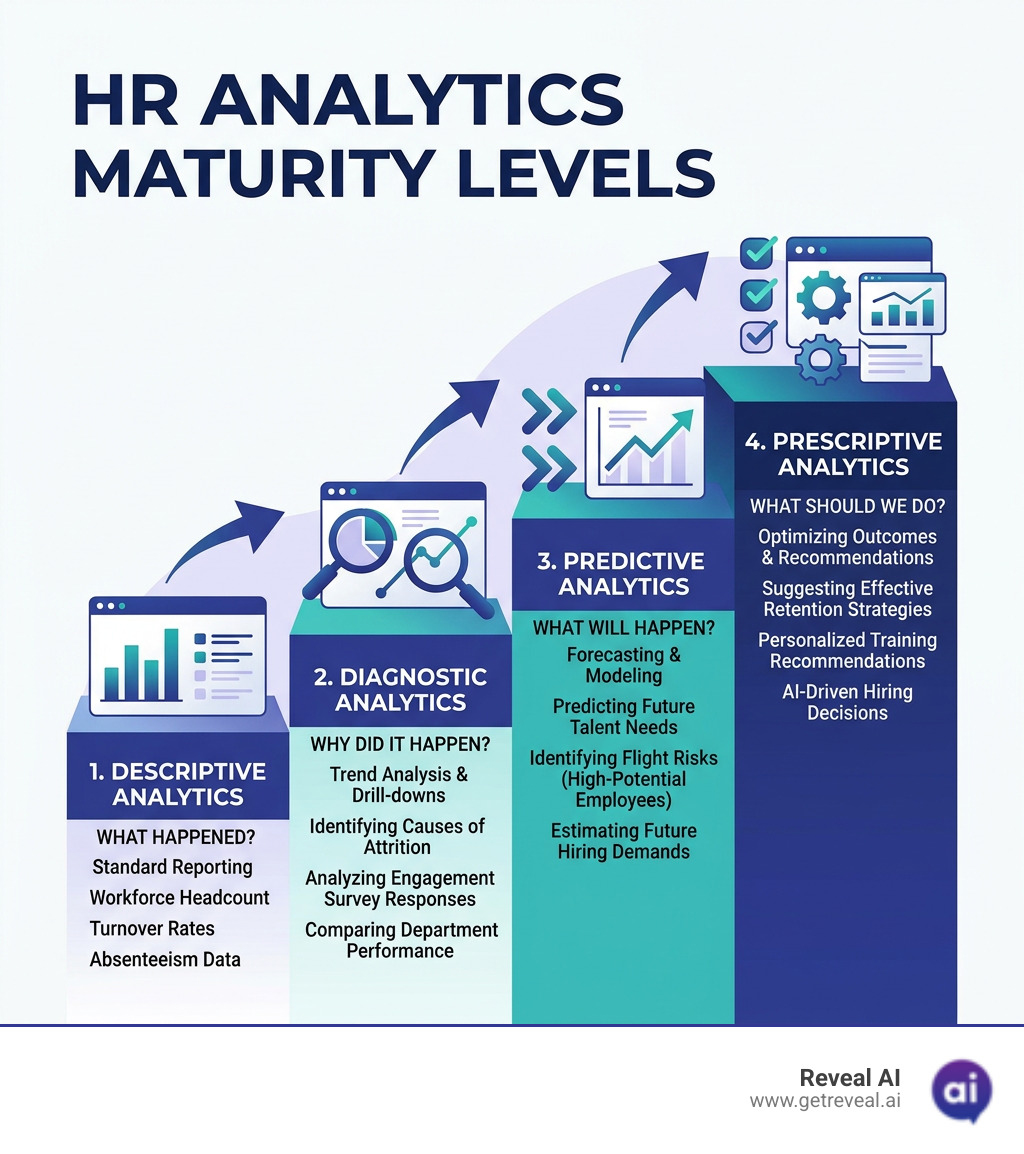
The evolution of analytics has moved from looking in the rearview mirror (descriptive) to looking through the windshield (predictive) and eventually having a co-pilot (prescriptive).
FeaturePredictive AnalyticsPrescriptive AnalyticsPrimary QuestionWhat is likely to happen?What action should we take?OutputForecasts, Risk Scores, TrendsRecommended Interventions, Action PlansValue AddEarly warning of skill gaps or attritionAccelerated decision-making and strategy
Choosing between different HR analytics solutions requires more than a feature checklist. For research teams, it requires a framework that prioritizes data integrity and actionable insights.
When we look at the selection process, we recommend focusing on these three pillars:
Understanding How Real-Time Employee Feedback Enhances HR Practices is a great starting point for teams looking to move away from static, annual data collection.
The "Holy Grail" of HR analytics is a unified data model. This means your HR technology as their top investment priority should involve systems that talk to each other.
Without API connectivity and unified data, your team will spend more time cleaning data in Excel than actually driving strategy.
One of the greatest risks in modern HR analytics solutions is the potential for AI hallucinations or embedded bias. If an AI tool is trained on biased historical data, it may inadvertently recommend biased hiring or promotion paths.
To Foster a Thriving Organizational Culture, organizations must insist on research-grade guardrails. This includes:
The ultimate goal of any analytics platform is to connect insight to action. Data for the sake of data is a distraction; data that reveals friction points in your culture is a strategic asset.
This is where Reveal AI enters the conversation. As an AI-powered qualitative research platform, we help UX and product research teams go beyond the "what" of quantitative metrics to the "why" of human experience. While traditional HR analytics solutions focus on numbers, Reveal AI enables qualitative analysis at scale.
Our platform allows you to conduct short, conversational AI interviews that feel natural to participants but provide researchers with structured, verifiable data. By operating within a "Walled Garden" integrity model, we ensure that your workforce insights are secure, attributed, and free from the risks of generic AI tools. Whether you are looking to understand the nuances of workforce sentiment or trying to diagnose why top talent is leaving, the key is to use tools that prioritize trust over novelty.
Selecting the right HR analytics solutions is a journey from being reactive to being proactive. By focusing on integrated data, predictive modeling, and—most importantly—verifiable qualitative insights, your team can move from simply "tracking" the workforce to actively "shaping" it.
The best technology doesn't just provide a dashboard; it provides a roadmap. It helps you identify high-performers, eliminate compensation bias, and build a culture where every decision is backed by evidence. At Reveal AI, we believe in "Trust first, not novelty first." As you evaluate your options for 2025, prioritize platforms that offer research-grade integrity and the ability to turn complex voices into clear business decisions.