Blog
What Your Team Really Thinks: Mastering Employee Engagement Verbatims Analysis

Rhythm Dahiya

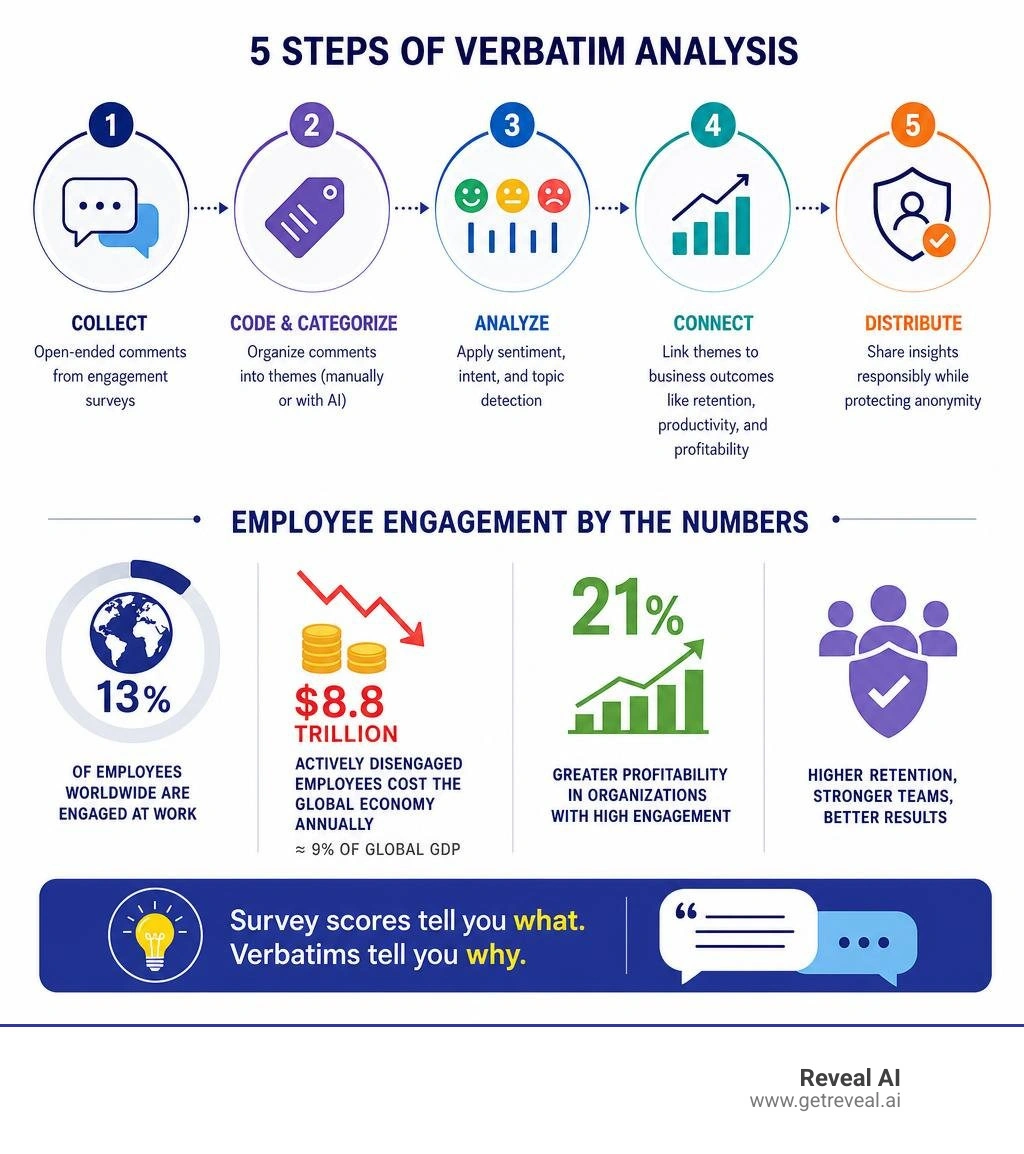
Employee engagement verbatims analysis is the process of systematically reading, coding, and interpreting the open-ended text comments employees leave in engagement surveys — then turning those qualitative responses into structured, actionable insights.
Here's a quick breakdown of what it involves:
Most organizations already collect this data. The problem is what happens next.
Survey scores tell you that something is wrong. Verbatim comments tell you why. And that distinction is enormous. Research suggests that 70% of engagement issues stem from themes that quantitative scores simply never surface on their own.
Yet too many HR teams treat open-ended comments like a footnote — skimmed quickly, filed away, or summarized into a word cloud that nobody acts on. One common observation in the field puts it plainly: too many teams collect verbatim feedback, then treat it like anecdotes.
The stakes are real. Only 13% of employees worldwide are engaged at work, and actively disengaged employees cost the global economy $8.8 trillion annually — roughly 9% of global GDP. Meanwhile, organizations with high engagement see 21% greater profitability and significantly better retention.
Closing that gap starts with understanding what employees are actually saying.
When we look at traditional survey metrics, we often see clean numbers. A score of 7.2 out of 10 on "Professional Growth" looks respectable on a spreadsheet. But that number doesn't tell you if employees are leaving because they feel there is no clear path upward, or if they simply want better training workshops.
This is where employee engagement verbatims analysis shines. By analyzing written comments, we uncover the exact context behind the scores. This deep contextual insight transforms flat data into a roadmap for leadership. To build a thriving culture, organizations must shift toward Real-Time Employee Feedback systems that capture the unfiltered voice of the workforce continuously, rather than waiting for annual post-mortems.
Standard Likert-scale questions suffer from semantic overlap and confirmation bias. The way questions are structured often leads employees down a predefined path, confirming leadership's existing assumptions rather than uncovering new realities.
According to research on employee self-narratives, traditional quantitative instruments are no longer adequate on their own to measure the nuances of the modern workplace. You can read more about this in the study What is work engagement? A text mining approach using employees' self‐narratives .
The study highlights that text mining psychological and linguistic markers can classify employee engagement with roughly 60% accuracy. For example, highly engaged employees use first-person plural pronouns ("we") far more frequently, while disengaged employees focus heavily on power dynamics and make frequent, often negative, references to their direct managers.
Unstructured comments aren't just HR metrics; they are leading indicators of business health. By identifying themes in employee feedback, we can map qualitative sentiments directly to quantitative outcomes.
A spike in negative comments regarding "workload balance" or "unclear goals" is a precursor to employee burnout and turnover. In fact, companies in the top quartile for employee engagement outperform those in the bottom quartile by 59% in terms of employee retention.
By analyzing these comments, organizations can proactively address churn risk, boost productivity, and improve internal Net Promoter Scores (eNPS). If you want to see how these principles apply to broader feedback ecosystems, check out our AI Driven Customer Insights Complete Guide.
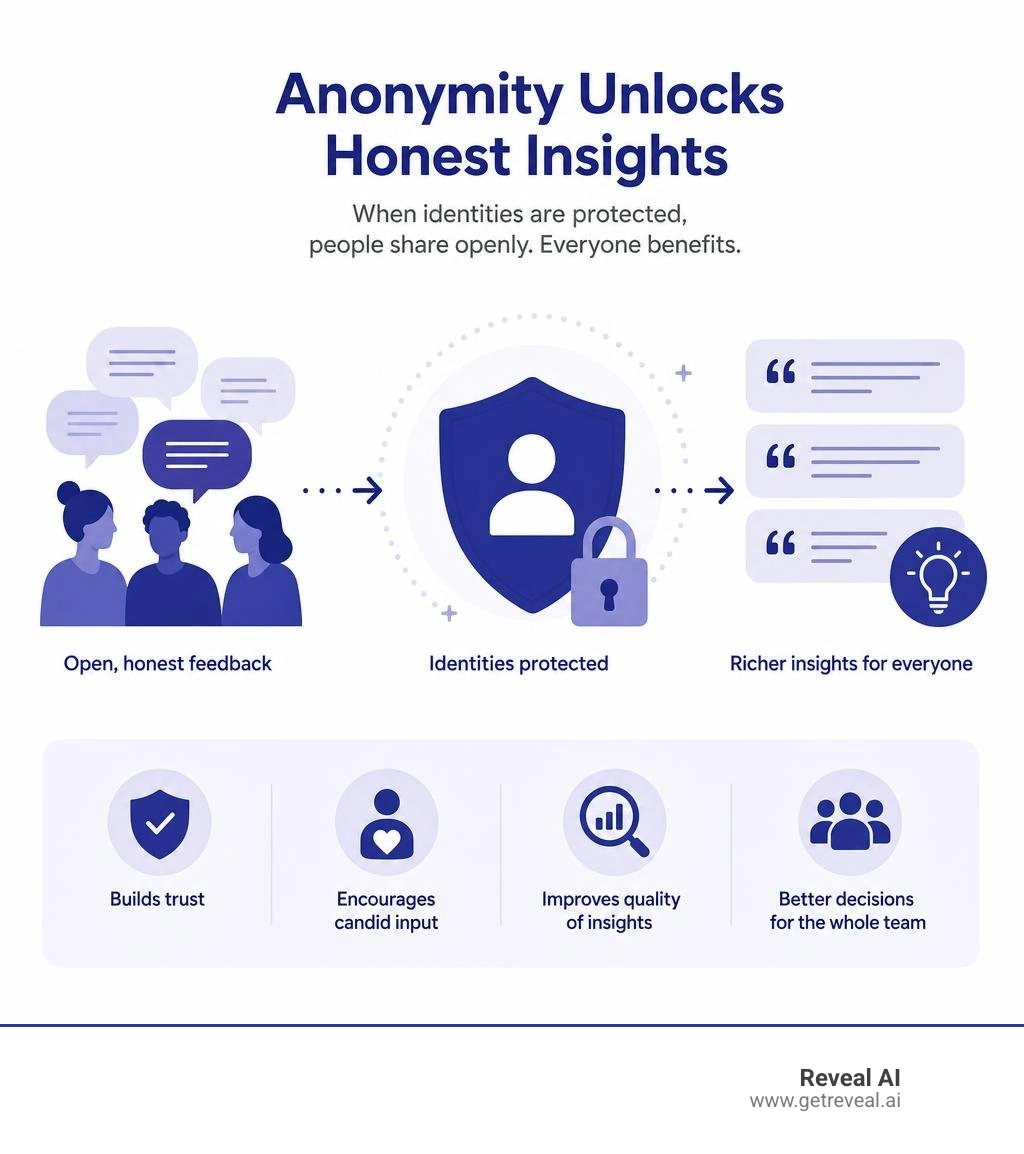
Collecting honest feedback requires absolute trust. If employees fear that their comments will be traced back to them, they will either write generic, safe responses or stay silent. This makes anonymity protection the most critical element of any feedback strategy.
When distributing verbatim comments, organizations must walk a tightrope between sharing actionable insights and protecting employee privacy to prevent trust erosion or manager retaliation. Utilizing the right Employee Survey Software is essential to managing this risk effectively.
To protect respondent confidentiality, we must establish strict data thresholds. A general rule of thumb: distributing raw verbatim comments from groups smaller than 100 employees risks privacy breaches. In small teams, unique vocabulary, writing styles, and specific complaints make it incredibly easy to identify the author.
To safely share feedback, organizations should employ:
Leveraging modern AI-Driven Surveys helps automate these safeguards, ensuring that manager dashboards only display compliant, risk-free feedback.
It is human nature for managers to try and guess who wrote a specific comment—especially critical ones. However, studies show that managers guess the author of verbatim comments incorrectly more than 50% of the time.
When a manager guesses wrong, the consequences are disastrous. They may retaliate against an innocent employee, creating a toxic work environment and completely destroying trust within the team. This is why we must actively train managers to focus on systemic themes rather than trying to play detective.
Reading and coding thousands of survey comments manually is a monumental task. Fortunately, advancements in Natural Language Processing (NLP) allow us to process massive text datasets in minutes. By using sentiment analysis, theme detection, and intent classification, AI converts qualitative text into structured, quantitative data. To understand the broader implications of these technologies, you can read about The Role of AI in HR.
Manual coding is slow, expensive, and highly subjective. Two human analysts might read the exact same comment and categorize it entirely differently based on their personal biases. AI, on the other hand, applies the same objective rules across every single comment.
Speed
- Weeks or months vs. Minutes
Objectivity
- Low (prone to human bias) vs. High (consistent rules applied)
Scalability
- Poor (breaks down at scale) vs. Excellent (processes millions of words)
Actionability
- Often delayed and outdated vs. Real-time
Cost
- High manual labor costs vs. Highly cost-efficient
Using AI Powered Feedback Analysis allows organizations to achieve up to a 94% reduction in manual labor while increasing the validity of sentiment analysis by over 20%.
Modern AI doesn't just look for simple keywords or basic "positive/negative" labels. Advanced NLP uses encoder-based transformer models to perform aspect-based sentiment analysis. This means the AI can look at a sentence like, "I love my team, but our scheduling tool is incredibly frustrating," and split it into two distinct data points:
These models are fine-tuned on domain-specific employee language, recognizing subtle emotional markers and implicit feedback that general-purpose AI models often miss.
To maximize the value of your qualitative data without risking employee trust, we recommend adopting the Informed Approach Model. This model focuses on ranking themes by prevalence, applying demographic filters safely, and turning insights into structured action plans. Utilizing modern HR Analytics Solutions is a great way to put this model into practice.
An effective feedback loop requires a clear structure. Instead of dumping raw comments into a document, organizations should establish:
By closing the loop, employees see that their feedback directly influences company decisions, which in turn drives up engagement and participation. Discover how Real time Employee Feedback enhances HR practices to create a more responsive corporate culture.
With the volume of feedback collected across multiple channels, manual coding is simply too slow. By the time a human team reads, categorizes, and reports on thousands of comments, the insights are weeks or months out of date. Modern organizations require real-time data to make agile decisions, making AI Survey Analysis Tools a necessity.
You should never share raw, un-redacted comments from small teams directly with their line managers. Instead, aggregate the comments into high-level thematic summaries. Only provide raw verbatims when the respondent pool is large enough (typically 100+ employees) to guarantee that individual writing styles cannot be identified.
While you can paste comments into a general-purpose LLM, it is not recommended for enterprise feedback. Raw LLMs lack data security guardrails, risk hallucinating themes, and cannot easily map feedback back to persistent employee records over time. For secure and reliable insights, organizations need specialized tools built for AI Interview Analysis and qualitative feedback protection.
Unlocking the true voice of your workforce requires moving past simple numbers and embracing the depth of qualitative feedback. By mastering employee engagement verbatims analysis, your organization can turn unstructured comments into decision-grade insights while maintaining the absolute trust of your employees.
At Reveal AI, we help organizations bridge the gap between human feedback and actionable, evidence-backed insights. Our platform combines conversational surveys, multi-level clustering, and secure respondent-level audit trails to help you move faster from open-ended responses to defensible business strategies.
Learn more about optimizing your employee experience strategy and discover how Reveal AI can transform your approach to employee feedback today.