Blog
The Art of Employee Experience Survey Design

Rhythm Dahiya

Employee experience survey design is the process of building structured listening tools that capture how employees perceive their workplace — across their physical environment, culture, and day-to-day work life — at every stage of their journey with an organization.
Here is a quick overview of what effective EX survey design involves:
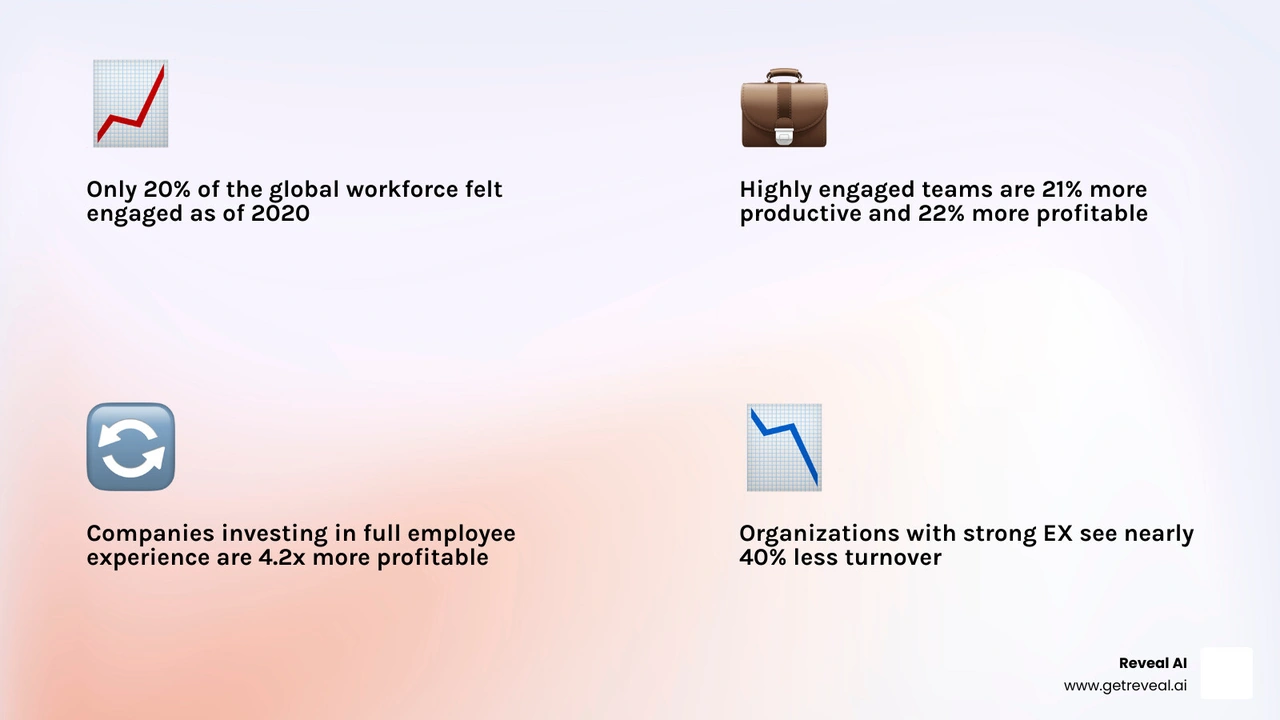
The stakes are real. Only 20% of the global workforce felt engaged as recently as 2020, according to Gallup. Yet companies with highly engaged teams are 21% more productive, 22% more profitable, and score 10% higher on customer ratings. Organizations that invest in the full employee experience — not just engagement — are 4.2x more profitable and see nearly 40% less turnover.
The gap between those numbers is largely a design problem. Most organizations survey their employees. Far fewer design surveys that produce insights leaders can actually act on.
How you ask matters as much as what you ask. A poorly designed survey generates noise. A well-designed one becomes a genuine conversation between employees and the organization — one that builds trust every time visible action follows.
This guide walks through every layer of that design process, from strategic alignment and question construction to culture measurement, change management, and qualitative depth.

To build an effective listening program, we must first clear up a common point of confusion: the difference between employee satisfaction, employee engagement, and employee experience.
While they are closely related, they measure fundamentally different things:
When we focus solely on engagement, we are measuring the symptoms rather than the causes. If engagement scores drop, we cannot fix them without understanding the underlying conditions. Designing an effective program requires a deeper look into the entire journey, which you can explore in our Employee Experience Insights Guide.
Metric Focus with Example Question
Satisfaction
- Basic needs and comfort
- "Are you satisfied with your current benefits package?"
Engagement
- Motivation and effort
- "Are you proud to tell others where you work?"
Experience
- Environmental conditions
- "Do you have the right software tools to do your job efficiently?"
According to industry frameworks, the employee experience is shaped by three distinct environments. To understand the "why" behind your engagement scores, your employee experience survey design must address all three:
If your team is struggling with slow, outdated software, their engagement will suffer no matter how many culture initiatives you launch. By structured grouping, you can ask targeted questions across these three environments to ensure you cover all aspects of the employee experience.
A common mistake in survey design is "designing by committee." When every department adds their own "nice-to-have" questions, surveys become long, bloated, and disconnected from organizational goals.
Instead, survey design must align directly with your overall business strategy and talent strategy. We recommend starting with stakeholder interviews. Ask your executives: What are our primary business goals this year? What talent challenges (e.g., retention, rapid scaling, restructuring) are we facing?
If your strategy relies on high innovation, your survey should focus heavily on psychological safety and collaboration. If you are focused on operational efficiency, the questions should target resources, tools, and process bottlenecks. Using professional Employee Survey Software allows you to customize and adapt these templates to reflect your organization's specific terminology. This ensures that you are deploying targeted Employee Feedback Solutions rather than generic, off-the-shelf questionnaires.
Employees experience your organization as a journey, not a static event. Therefore, a single annual survey is rarely enough. Organizations should map shorter, event-triggered surveys to key lifecycle milestones:
By integrating lifecycle feedback into your overall HR Analytics Solutions, you can spot leading indicators of turnover before they impact productivity and build a continuous listening strategy across these phases.

While the drivers of experience vary by company, the core outcomes of employee engagement are universal. Every comprehensive survey should include the four core measures of engagement:
These four metrics serve as your core outcome indicators. However, measuring outcomes alone isn't enough to drive change. You must pair them with actionable drivers to understand why these scores are where they are. You can learn more about balancing these elements in our guide on Employee Feedback Solutions.
To make your survey results useful for managers, you must measure the specific drivers that influence engagement. These include:
When analyzing these drivers, it is critical to prioritize. We recommend using an Impact vs. Feasibility Matrix to identify quick wins—such as fixing a slow IT process—while building long-term action plans for complex issues like career progression. Actively Listening to Employee Suggestions and prioritizing these drivers shows your workforce that their input directly shapes company policy.
Managers have a massive impact on the employee experience. When designing questions about management effectiveness and leadership perceptions, focus on behaviors rather than personal traits.
Instead of asking, "Do you like your manager?", ask behavior-based questions:
To foster a healthy workplace, organizations must design surveys that measure leadership trust and psychological safety. You can read more about building these trust networks in our guide on how to Foster a Thriving Organizational Culture.
To capture a complete picture of your organizational culture, your employee experience survey design should incorporate a mix of these four question types:
Organizational change, such as restructuring, mergers, or leadership transitions, is a critical time to survey your workforce. However, it is also when employees are most vulnerable to survey fatigue.
During periods of change, surveys should focus on tracking morale, trust, and productivity. This helps leaders identify friction points and address anxieties before they lead to disengagement or turnover. Using a dedicated Pulse Survey App can help you run short, lightweight checks during these transitions without overwhelming your teams.
When surveying during major transitions, keep these three best practices in mind:
Deploying Real-Time Employee Feedback systems allows HR teams to respond quickly to shifting sentiments. For a deeper look at how this works in practice, explore How Real-Time Employee Feedback Enhances HR Practices.
To prevent survey fatigue, we recommend balancing your survey cadence. A good approach is to run one comprehensive annual survey (40-60 questions) to establish a baseline, supplemented by short quarterly or monthly pulse surveys (5-10 questions) to track progress.
Always protect employee anonymity. If employees fear retaliation, they will either skip the survey or give dishonest answers. A response rate of 70% or higher is considered excellent, while dropping below 50% is a warning sign that employees may feel their feedback doesn't lead to real change. Balancing the art and science of survey design ensures you gather high-quality data while maintaining high participation rates.
Quantitative metrics (like 1-5 Likert scales) show you what is happening, but qualitative open-ended questions explain why. Combining both gives you a complete picture of the employee experience. For example, a low rating on "tools and resources" doesn't tell you which software is failing; an open-ended follow-up question does.
To learn how advanced tools help parse these responses, read Enhancing Employee Engagement with AI: A Guide for HR Professionals. You can also explore practical question-framing tips in How to Design an Effective EX Survey: A Practical Guide.
For mid-to-large organizations, a response rate of 70% or higher is excellent. Rates between 60-69% are good, and 50-59% are acceptable. If your response rate drops below 50%, it is a red flag indicating potential disengagement or a lack of trust in the survey process. For frontline or high-turnover industries, 30-40% is common but still leaves room for improvement through better communication.
The primary cause of survey fatigue is not the frequency of surveys, but the lack of action taken on the results. If employees see that their feedback leads to concrete improvements, they are usually happy to participate. To prevent fatigue, limit the length of your surveys, communicate your findings quickly, and share an action plan with 1-3 clear goals. For more expert tips, check out What are the best practices for designing an employee experience survey?
Effective employee experience survey design is a powerful tool for building a transparent, high-performing organization. However, traditional surveys often force researchers to choose between the scale of quantitative metrics and the depth of qualitative feedback. Analyzing thousands of open-ended text fields manually is slow, while relying only on multiple-choice questions misses the human context behind the scores.
This is where Reveal AI can help. Reveal AI is an AI-powered market research platform designed for professional researchers and insights leaders. It helps you collect richer open-ended responses through conversational surveys and real-time, AI-moderated probing.
Instead of static text boxes, Reveal AI asks intelligent, context-aware follow-up questions to understand the "why" behind employee feedback. It then uses automated transcription, multi-level clustering, and respondent-level audit trails to help you turn qualitative data into clear, evidence-backed insights—while keeping you in complete control of the final analysis.
Ready to elevate your continuous listening strategy? Explore how Reveal AI can help your team turn open-ended feedback into actionable insights at our Employee Insights Resource Hub.