Blog
Stop the Spin with Better 360 Performance Review Software

Rhythm Dahiya


At RevealAI, we view 360 employee review software not merely as an HR administrative tool, but as a critical data collection mechanism for researchers and analysts. It is a system that gathers performance feedback from a full circle of sources—including managers, peers, direct reports, and external stakeholders—to provide a research-grade, well-rounded view of performance.
For the modern analyst, this software:
Traditional reviews are often limited by recency bias and a single point of failure: the manager's perspective. 360-degree reviews flip that model. They allow researchers to analyze the whole person—behaviors, competencies, and impact—from every angle.
This depth is critical for success. Gallup research shows employee engagement has sunk to a near decade-low of just 30%. For analysts tasked with reversing this trend, the right 360 software turns qualitative signals into actionable intelligence at scale.
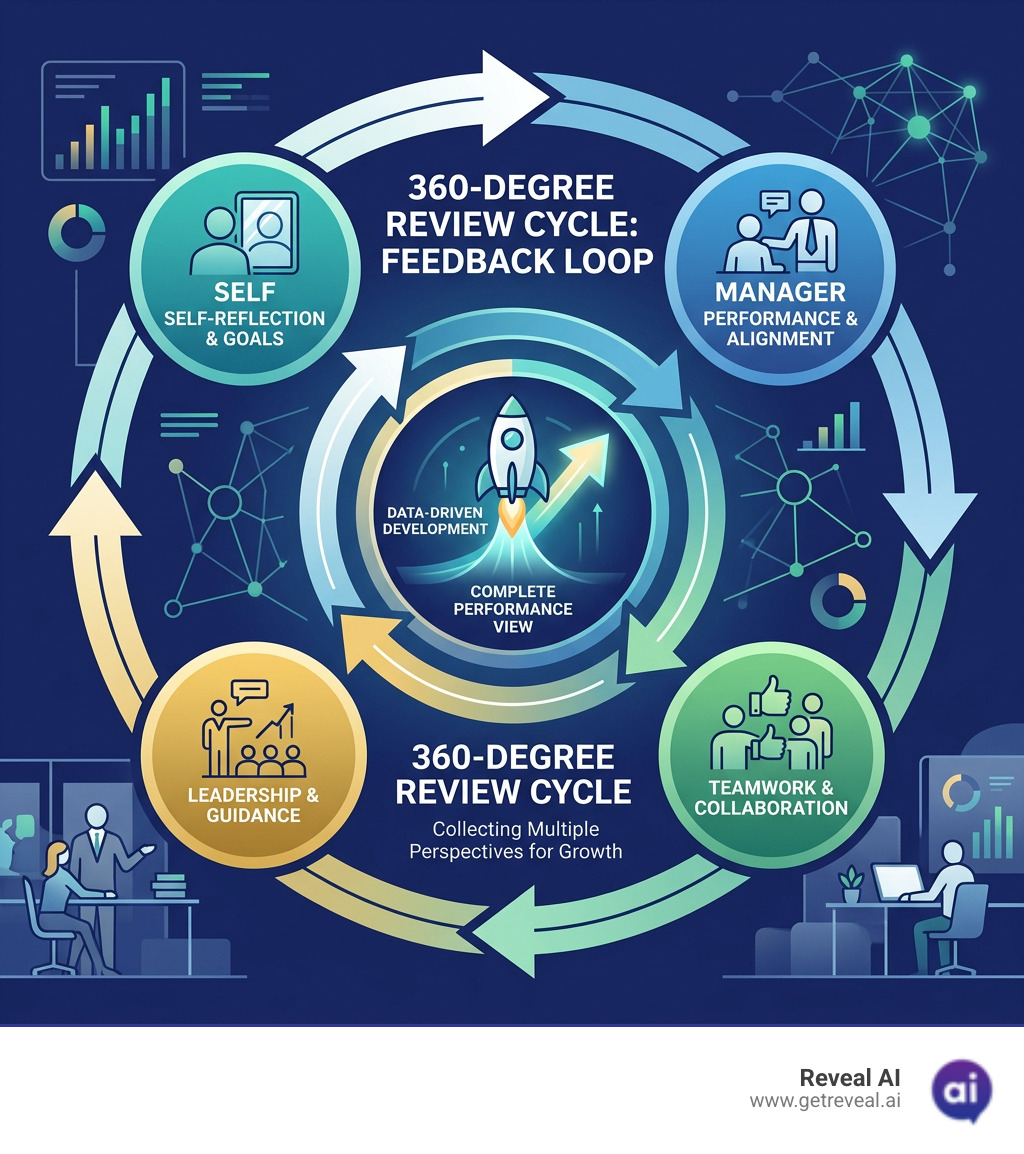
In the modern workplace, a single perspective is insufficient for rigorous performance analysis. Today, employees collaborate across matrixed teams and support various internal departments. To capture this complexity, research teams are turning to 360 employee review software to provide a holistic assessment of talent.
From RevealAI’s perspective, this is also a useful analogy for market and product research: multi-source inputs create a more complete picture—but only if the data is trustworthy, attributable, and captured with the right guardrails.
360 employee review software collects structured performance feedback from multiple rater groups to create a “full-circle” view of an employee.
Typical rater inputs include:
A 360-degree model is designed to reduce single-rater bias and surface blind spots. But the software category is crowded, and many platforms prioritize scale over research-grade integrity.
For example, platforms like Qualtrics or CultureAmp offer broad quantitative surveying, and tools like SurveyMonkey can handle basic forms—yet they often struggle to preserve nuance, ensure consistent attribution, and maintain high-confidence outputs when open-ended feedback is involved.
That distinction is central to RevealAI’s philosophy: Trust first, not novelty first.
RevealAI is an AI-powered qualitative research platform for market researchers and product teams. We help teams run short, conversational AI interviews at scale (text-based—RevealAI does not use voice input) and analyze qualitative feedback with speed, structure, and verifiable trust.
Where generic AI tools introduce risk—hallucinations, weak sourcing, loss of nuance, and declining client trust—RevealAI is designed with built-in guardrails:
When research teams evaluate 360 employee review software, they typically prioritize:
Those evaluation criteria map closely to how serious research teams should evaluate AI for qualitative work: speed matters, but trust and verifiability are what protect decisions—and credibility.
For context on why engagement and feedback quality matter, see: Gallup research and scientific research on feedback and turnover.
Source note: The engagement statistic referenced above comes directly from Gallup’s reporting at the linked URL.
Rolling out a 360-degree program is a strategic shift in how you analyze talent. If you treat it like a one-time survey, you get brittle data and low adoption. If you treat it like an ongoing measurement system, you get trendable insight.
From RevealAI’s perspective, that same principle applies to qualitative research: long-term value comes from repeatable workflows, consistent structure, and outputs your stakeholders can trust.
When evaluating the market, contrast generic survey tools with platforms built specifically for performance workflows. While SurveyMonkey might handle basic forms, it lacks the specialized guardrails needed for robust anonymity rules, rater thresholds, and role-based reporting.
Use these practical evaluation pillars:
A research-grade rollout typically follows this sequence:
The next step beyond “more feedback” is higher-integrity feedback. Many teams feel pressure to use AI for speed and cost savings—but generic AI introduces hard-to-detect risks: hallucinations, missing attribution, and loss of nuance that erodes stakeholder and client confidence.
RevealAI addresses that gap. RevealAI is an AI research platform for market research firms, UX teams, product research teams, and analysts—built to run short, conversational AI interviews at scale (text-based only) and produce analysis that remains provable.
RevealAI’s differentiators are built for trust:
RevealAI is an AI-powered qualitative research platform built for researchers who need faster insight without sacrificing rigor. Our philosophy is Trust first, not novelty first. We deliver research-grade guardrails through a Walled Garden model (no web data), direct quotes for attribution, transparent outputs, and human source verification—reducing the risk of hallucinations, loss of nuance, and declining client trust.
Final thought: the best teams don’t choose between speed and integrity. They choose systems—whether for 360 reviews or qualitative research—that make outputs defensible, repeatable, and easy to verify.