No items found.

Blog
Get Actionable AI Employee Listening Insights Today

Rhythm Dahiya


AI employee listening insights are what you get when AI-moderated conversations replace static surveys — capturing not just what employees think, but why they feel that way, in their own words.
If you're evaluating tools right now, here's a quick overview:
What AI employee listening insights give you:
The pressure on people researchers and insights leaders is real. Employee engagement hit a 10-year low of 21% globally in 2026 according to Gallup. Annual survey response rates in large organizations have fallen from 64% in 2018 to 38% in 2025. And only 14% of HR leaders say their annual engagement insights are actionable in the same quarter they were captured.
The problem isn't that organizations aren't listening. It's that the tools they're using were built for a different era.
Standard surveys — even well-designed pulse surveys — capture a single point in time. They produce scores, not stories. They tell you that something is wrong, rarely why, and almost never with enough depth to act on confidently.
That's the gap AI employee listening is designed to close: moving from static snapshots to continuous, conversational feedback that surfaces the qualitative context researchers actually need.
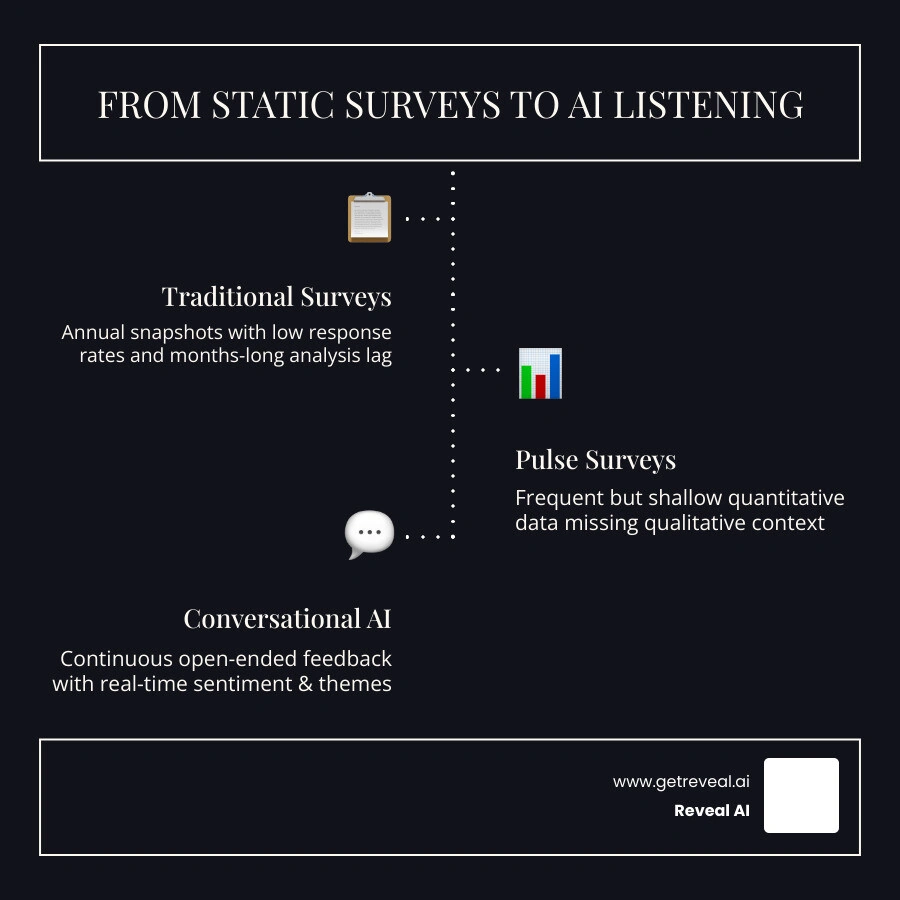
Historically, gathering feedback meant launching a massive annual survey, waiting weeks for responses to trickle in, and spending months analyzing the quantitative data. By the time HR teams presented the findings, the organizational climate had already shifted. This lag is a major reason why 42% of C-suite executives don’t see HR as an equal partner in 2026—a sharp drop from 57% in 2021.
To bridge this gap, organizations are shifting how they understand The Role of AI in HR. Instead of relying on rigid, backward-looking questionnaires, modern teams are leveraging AI-driven Employee Feedback Solutions that turn open-ended text into clear, structured themes. This evolution moves the needle from passive observation to active, conversational understanding.
FeatureTraditional SurveysAI-Driven Conversational ListeningPrimary FormatClosed-ended Likert scales (1-5 ratings)Adaptive, open-ended conversational dialoguesInsight Latency8 to 14 weeks24 to 72 hoursResponse Rates30% – 42% (declining due to fatigue)64% – 78% (due to interactive engagement)Diagnostic DepthTells you what the score isTells you why the sentiment existsActionable Follow-upManual, retrospective planningReal-time, evidence-backed recommendations
Traditional Employee Survey Software is structurally limited. It relies heavily on multiple-choice questions that force employees to fit their complex workplace experiences into a pre-defined box. If an employee rates their alignment with company goals as a "3 out of 5," the survey software records the number but misses the context.
Even deploying a standard Pulse Survey App only solves the frequency problem, not the depth problem. Running the same closed-ended questions on a weekly cadence does not reduce feedback fatigue; in fact, it often accelerates it. Without the ability to ask follow-up questions or probe for details, organizations miss the critical "why" behind the numbers.
In 2026, we have reached a clear inflection point. For the first time, continuous AI-driven employee conversations have surpassed traditional annual survey programs in adoption among forward-thinking enterprises. This paradigm shift occurs because leaders realize that AI Will Rewrite Employee Experience, And Deep Listening Shows How by analyzing unstructured digital interactions and conversational surveys in a privacy-safe manner.
By treating feedback as an ongoing, natural dialogue rather than an administrative chore, organizations see response engagement rates jump significantly. Employees are far more willing to share candid feedback when the interface responds to their input dynamically, validating their experiences in real time.
Modern AI-driven systems do not just scan for keywords; they evaluate sentiment through advanced, emotion-aware natural language processing (NLP). This allows organizations to collect Real-Time Employee Feedback that differentiates between nuance and noise. For example, emotion-aware models can distinguish between constructive frustration regarding a slow software tool and deep-seated burnout caused by systemic workload imbalances.
By combining behavioral science with advanced language models, researchers can maintain psychological safety while mapping the emotional health of the organization. Because the AI adapts to the tone and substance of the employee's input, the interaction feels less like an interrogation and more like a supportive, professional check-in.
When employees are given the freedom to write or speak naturally, they use rich, descriptive language that a numerical scale could never capture. An AI-moderated survey platform dynamically generates follow-up questions based on the respondent’s initial answers. If an employee mentions feeling unsupported during a recent transition, the AI might ask, "Can you share a specific example of what support would have looked like in that moment?"
This process of Listening to Employee Suggestions ensures that the raw verbatims are preserved, while multi-level clustering algorithms group similar concepts together. Researchers can then review high-level themes without losing the authentic, individual voices that back them up.
Detecting early warning signs of disengagement is critical for maintaining organizational stability. Utilizing How Real-Time Employee Feedback Enhances HR Practices allows insights teams to identify friction points—such as confusion over a structural reorganization or anxiety about new technology—long before they manifest as attrition.
For instance, if multiple team members in a specific department express frustration about unclear project ownership, the system flags this pattern. Leaders can intervene with targeted support within days, rather than discovering the issue during exit interviews months down the road.
The ultimate value of gathering AI employee listening insights lies in translating qualitative feedback into hard business results. Organizations that actively listen and respond to their workforces experience:
Furthermore, when organizations implement feedback-driven improvements, they can achieve a 9% reduction in overall turnover and a 40% cut in top-talent turnover through predictive analytics.
Investing in these insights is a direct pathway to Enhancing Employee Engagement with AI: A Guide for HR Professionals. When employees see that their feedback leads to actual changes, their motivation to do their best work increases by 69%, and they are likely to stay with the company for an average of three additional years.

Selecting the right platform requires looking beyond basic survey-building features. When evaluating modern solutions, check our Employee Experience Insights Guide and consider the following criteria:
No employee listening program can succeed without absolute trust. Employees must feel entirely confident that their candid feedback will not be used against them. To Foster a Thriving Organizational Culture, organizations must establish rigorous ethical guardrails.
This includes implementing strict data privacy standards, such as robust anonymization protocols and differential privacy. The AI should analyze trends, themes, and collective sentiments without ever exposing individual identities or creating tracking profiles that could lead to retaliation. Transparency about how the data is collected, processed, and acted upon is non-negotiable.
A standard pulse survey sends out a fixed set of quantitative questions on a regular schedule. While it measures frequency, it lacks depth. Conversational AI, on the other hand, moves away from a traditional Employee Survey App by using adaptive questioning. It conducts a real-time, qualitative dialogue, probing for details when an employee shares an open-ended response, helping researchers understand the underlying reasons behind the sentiment.
Top-tier conversational platforms prioritize data security, compliance, and strict anonymization. As detailed in our Employee Experience Insights Guide, identifying details are stripped during the preprocessing phase. The AI clusters data based on aggregate themes rather than individual tracking, ensuring that employees can share honest, constructive feedback safely.
AI does not replace the human researcher; it acts as an advanced research partner. While the AI handles the heavy lifting of automated transcription, real-time probing, and multi-level clustering, the researcher remains in control of the analysis. Human researchers review the clustered themes, verify the traceability of the verbatims, and apply their contextual understanding to make the final, defensible strategic decisions. This collaborative workflow is at the heart of modern AI Interview Analysis.
The era of relying solely on static, annual surveys to understand your workforce is over. To build a highly engaged, resilient, and productive organization, insights leaders need deeper qualitative context. Conversational surveys powered by AI-moderated probing allow you to capture richer respondent language, trace insights back to real verbatims, and make defensible, evidence-backed decisions in days instead of months.
Ready to see how conversational AI can transform your qualitative research workflow? Explore RevealAI's Employee Insights Resource Hub and discover how to collect deeper, action-ready insights today.