No items found.

Blog
Find Your Perfect Match: Top Employee Experience and Engagement Survey Tools

Rhythm Dahiya



For market research firms, UX and product research teams, and analysts, the voice of the employee has become a critical external signal. Employee sentiment analysis tools are no longer just operational HR utilities; they are now valuable inputs to research workflows that validate hypotheses, pressure-test market narratives, and understand organizational change.
From a RevealAI perspective, employee sentiment is one more qualitative dataset that researchers can analyze with research-grade standards applied to customer interviews or expert calls. Our AI-powered qualitative research platform enables teams to run short, conversational AI interviews at scale and apply the same guardrailed, verifiable analysis pipeline to internal workforce feedback or publicly available data provided by the user.
Quick Answer: Types of Employee Sentiment Analysis Tools
Tool CategoryBest ForKey DifferentiatorAI-Powered Qualitative PlatformsMarket research and product teams needing verifiable insightsSource attribution, quote-level evidence, research-grade guardrailsTraditional Survey PlatformsHigh-level quantitative pulse checksLarge sample sizes, simple benchmarkingAnalytics SuitesEnterprise-wide dashboardsIntegration with existing HRIS and BI systemsSpecialized NLP ToolsText analysis at scaleAutomated theme detection and basic sentiment scores
A recent industry analysis found that 67% of market research professionals report AI helps them identify insights they would have otherwise missed. Yet this speed comes with risk: many generic AI tools hallucinate findings, blend in uncontrolled web data, or strip away the nuance that makes qualitative research credible.
For serious researchers, employee sentiment data complements core customer or market studies. It can:
The problem? Most employee-focused tools fall into two camps:
A research-grade employee sentiment analysis tool must deliver both speed and trust. It should automate thematic analysis while maintaining clear attribution to source data, operate only on datasets you provide, and surface nuanced patterns you can defend.
RevealAI was built for this standard. Our AI-powered qualitative research platform turns unstructured feedback into strategic intelligence that is fast, traceable, and aligned with a "Trust first, not novelty first" philosophy.
This guide examines the modern employee sentiment analysis tool landscape through a researcher's lens, focusing on what separates research-grade platforms from purely HR-focused tools.
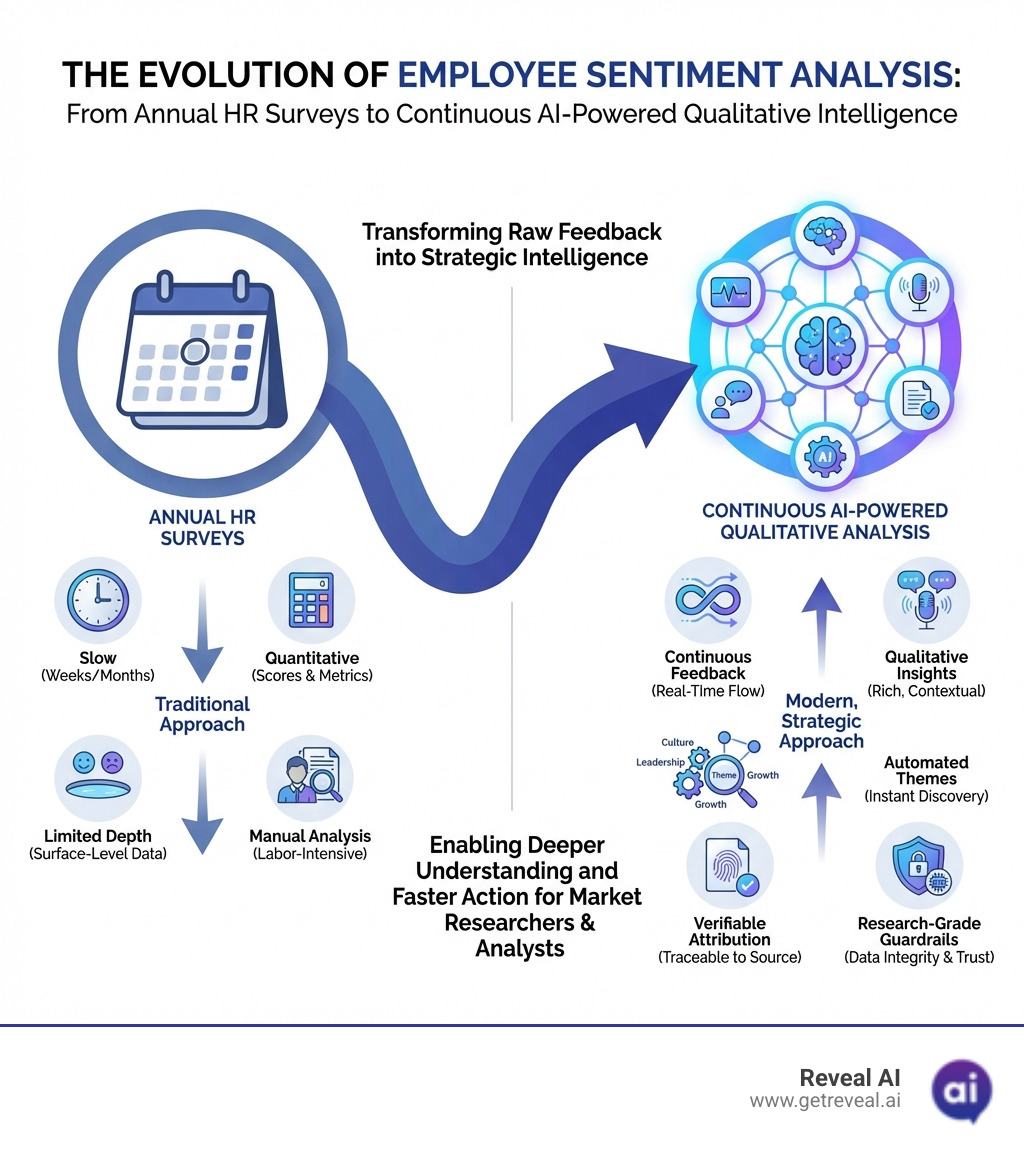
For researchers, employee sentiment analysis is analyzing workforce opinions as input into broader market, product, or investment analysis. It moves beyond internal HR metrics to uncover signals about operational efficiency, leadership quality, and resilience.
In practice, it means treating internal comments, reviews, and interview transcripts as unstructured qualitative data that can be coded, themed, and triangulated like any research corpus. By analyzing this feedback, researchers discern not just what employees feel, but why—and how that context should influence product roadmaps, market theses, or investment memos.
For example, widespread disengagement, with 51% of employees feeling disengaged, can signal underlying operational issues. A market research firm might use that insight to:
Our AI-powered qualitative research platform applies research-grade guardrails to employee data as it does to customer or professional interviews. RevealAI never pulls in web data, operates within a strict Walled Garden model, and backs each theme with direct quotes. Learn more about RevealAI's approach to happiness analysis.
Traditional survey data presents significant limitations for market researchers requiring deep, verifiable insights:
These limitations drive research teams toward advanced, AI-driven solutions built for qualitative rigor. As a 2024 study notes, AI's predictive power is reshaping analysis and expectations, signaling a move toward trusted, guardrailed AI supporting high-stakes decisions.
RevealAI is designed for this reality. Our AI-powered qualitative research platform helps teams compress analysis timelines, preserve nuance, and maintain full attribution—without sacrificing scientific standards underpinning client trust.
The modern employee sentiment analysis tool has undergone a seismic shift, driven largely by advancements in Artificial Intelligence. For market research firms, UX and product research teams, and analysts, this shift is less about HR operations and more about accessing another high-signal qualitative dataset that can be analyzed with research-grade rigor.
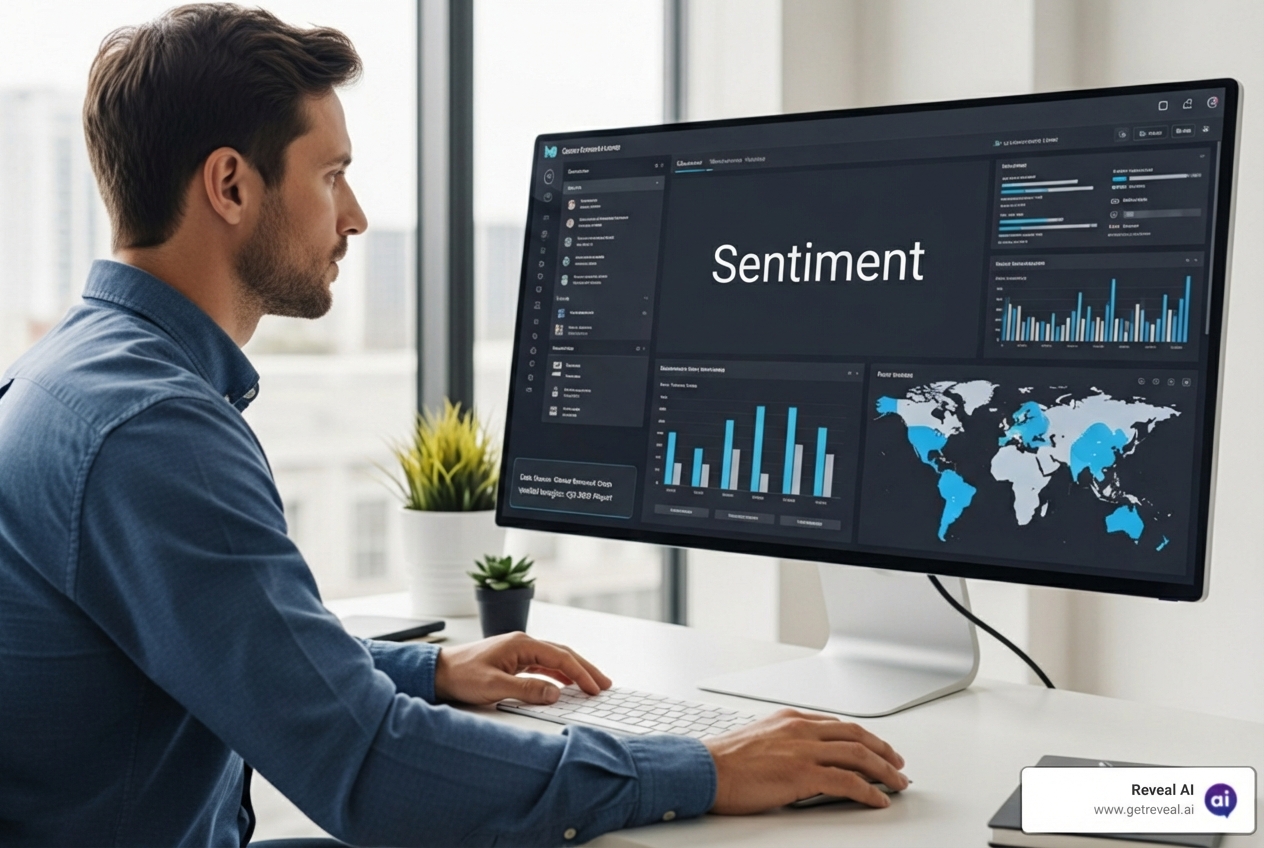
At RevealAI, we build for researchers who cannot compromise on trust. Our AI-powered qualitative research platform combines Natural Language Processing (NLP), Machine Learning, and stringent AI guardrails to ensure data integrity and deliver truly verifiable insights across use cases—including employee sentiment when it is relevant to a market, product, or investment thesis.
RevealAI does not use voice input; instead, it conducts short, conversational AI interviews and analyzes text-based feedback at scale. Every theme links back to direct quotes, preserving the evidence base you need for client-ready outputs.
AI addresses the core challenges of traditional qualitative analysis, offering researchers unprecedented speed, scale, and depth—without defaulting to the opaque behavior of generic AI tools.
AI in research is not about chasing novelty; it is about open uping defensible insight at a pace that matches commercial pressure. For a deeper dive into how AI is changing research practice, read about The Role of AI in Research.
When framed correctly, employee sentiment becomes a powerful complementary signal for core research questions. RevealAI helps teams treat it as just one of several qualitative inputs they can interrogate with the same standards as customer or expert interviews.
Our AI-powered qualitative research platform is built to help research teams integrate these signals into structured, verifiable insight—always with direct quotes and transparent reasoning paths.
Not all AI is created for research. Market researchers, UX and product teams, and analysts need research-grade AI that can withstand scrutiny from clients, leadership, and regulators.
Here is what to look for in an employee sentiment analysis tool when you plan to use it as part of a broader research stack:
When you compare providers—from legacy survey tools to generic AI assistants—use these criteria to evaluate how each one supports or undermines your ability to deliver trusted, high-impact research. Choosing a research-grade tool like RevealAI means prioritizing scientific rigor and data integrity over novelty, and building a stack that helps you foster a thriving organizational culture within your own research practice.
The future of employee sentiment analysis, particularly for market research firms, UX and product research teams, and analysts, is inextricably linked to verifiability and trust. As AI becomes more pervasive in research workflows, the core challenge is not just processing more data faster; it is ensuring that every insight you present to stakeholders is robust, attributable, and ethically sound.
RevealAI is built around a "Trust first, not novelty first" philosophy. Our AI-powered qualitative research platform operates within a strict Walled Garden data integrity model, never training on or blending in uncontrolled web data. Every theme is backed by direct quotes and transparent reasoning, so you can defend your findings in any forum—whether they concern customers, professionals, or employees.

Analyzing sensitive employee data carries significant ethical responsibilities. For research teams whose credibility is their currency, maintaining trust is critical.
Ethical data handling is not an optional extra for RevealAI; it is the foundation of trustworthy insights and is essential for maintaining long-term client relationships.
The landscape of market and product intelligence is evolving quickly. While traditional survey data is slow and superficial, and generic AI lacks reliability, research-grade AI offers a new path for market research, UX, and product teams.
The future belongs to platforms that prioritize:
This is the core of our "Trust first" philosophy at RevealAI. We believe AI's true power lies in delivering deeper, reliable insights that drive confident decisions—not in generating flashy but unverifiable outputs.
By using a research-grade employee sentiment analysis tool within a broader qualitative research strategy, teams can:
Ready to build a research stack that treats trust as a feature, not an afterthought? Explore how RevealAI helps you foster thriving culture within your research practice and use employee sentiment as a complementary signal in your next market, product, or investment study.