Blog
Stop Guessing and Start Asking with These HR Survey Tools

Rhythm Dahiya

Employee survey software is a digital tool that lets research teams and analysts collect, analyze, and act on feedback from their workforce - covering everything from day-to-day engagement to culture, leadership, and retention risk.
For market researchers, UX and product research teams, and analysts, the real issue is rarely survey distribution. The hard part is converting what people say into defensible insights you can present to stakeholders without losing nuance or trust.
Many employee survey platforms on the market - from broad enterprise tools to lightweight pulse survey apps - are strong at structured measurement (scales, benchmarks, dashboards). But when your key questions are qualitative ("Why did sentiment shift?" "What is driving friction?"), generic AI summaries can create risk: unclear attribution, loss of context, and the "black box" problem that undermines client confidence.
Reveal AI is an AI-powered qualitative research platform built for trust-first research. We help research teams run short, conversational AI interviews at scale and turn open-ended feedback into decision-ready themes with human source verification (direct, attributable quotes) inside a Walled Garden environment (no web data).
For readers who want a neutral overview of how modern organizational measurement evolved, see the background on Employee engagement.
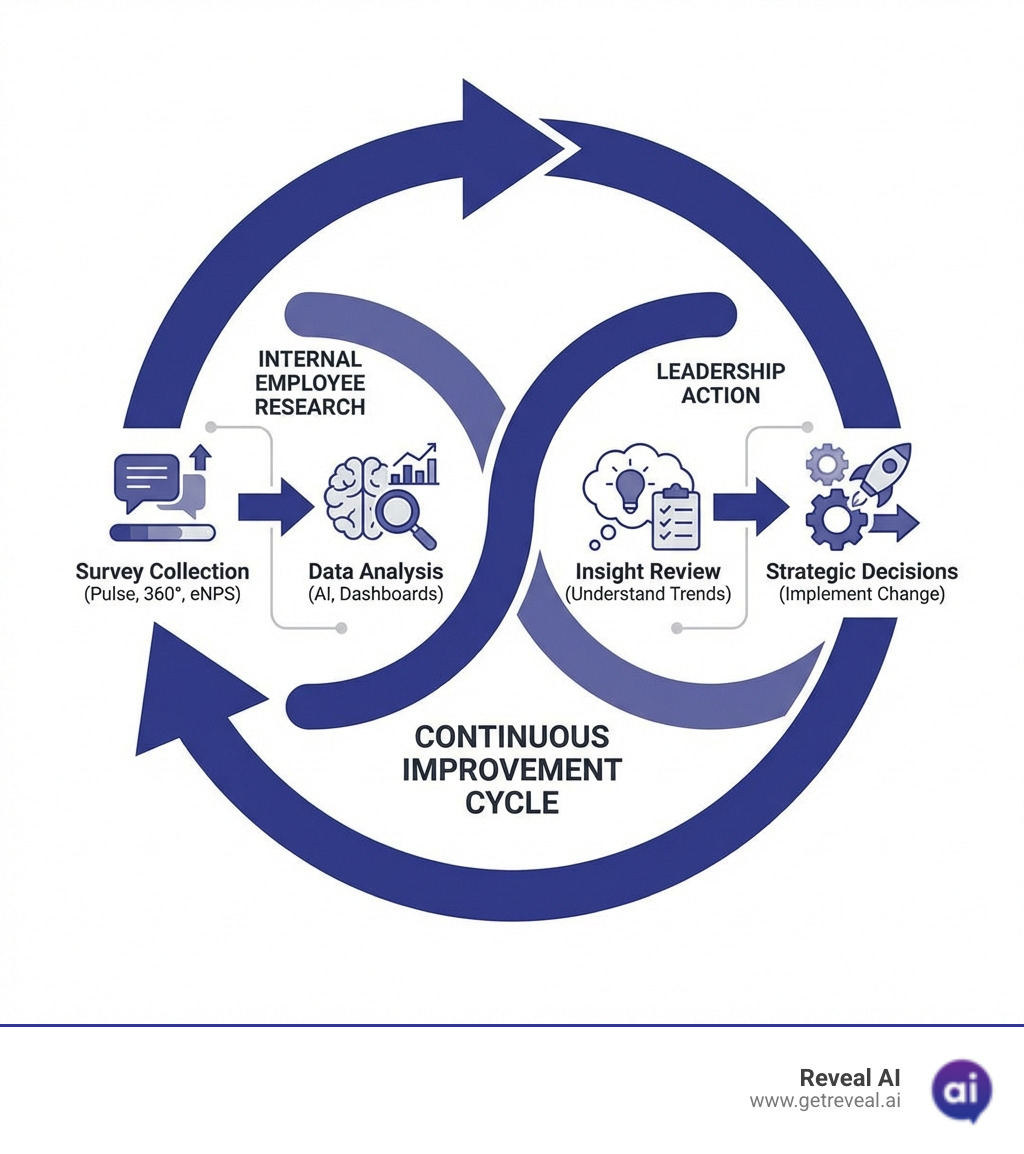
When evaluating employee survey software, it's easy to get distracted by flashy interfaces. For research teams (market research firms, UX and product research teams, and analysts) who are accountable for credible insights, certain capabilities are non-negotiable.
Below, we contrast what classic survey platforms do well with what research teams often need once open-ended feedback becomes the core dataset.
Anonymity is the bedrock of honest feedback in workforce research. If participants believe responses can be traced back to them, you get "safe" answers instead of useful signals.
Look for:
Modern platforms reduce the lag between collecting and acting. Real-time dashboards help stakeholders see sentiment shifts during reorganizations, policy changes, or leadership transitions.
For context on how speed changes HR decision-making, see how real-time employee feedback enhances HR practices.
High response rates and clean data depend on survey design.
Prioritize tools that support:
Mobile-friendly delivery is critical in hybrid organizations and distributed teams. If the survey experience is clunky on mobile, participation quality and completion rates drop.
Survey TypeBest ForFrequencyKey MetricPulse SurveysTracking short-term sentiment shiftsMonthly/QuarterlyEngagement Score360-Degree FeedbackIndividual professional developmentAnnuallyCompetency GapseNPSHigh-level loyalty and advocacyMonthly/QuarterlyNet Promoter Score
From Reveal AI's perspective, the right choice depends on whether your program is primarily measurement (dashboards and benchmarks) or understanding (defensible qualitative insight). When teams rely heavily on open-ended feedback, the analysis workflow matters as much as distribution.
Many traditional platforms - including broad enterprise suites and lightweight pulse tools - focus on structured data collection and scoring. Where they often fall short is in producing qualitative analysis that research teams can defend under scrutiny. This is the gap Reveal AI is designed to close.
Evaluate:
If your goal is research-grade understanding (not just scores), our use case: Employee listening explains how to structure collection and analysis so the findings are defensible.
AI is now standard in analysis, but not all AI is safe for high-stakes research.
Many tools offer "AI summaries" that are fast but difficult to verify. For research teams under pressure to cut turnaround time without risking stakeholder trust, the key requirement is verifiability:
Reveal AI is an AI research platform built on a trust-first philosophy. Our approach uses NLP to cluster themes while preserving traceability to the original comments for human source verification, inside a Walled Garden model that avoids pulling in unverified web data.
Related reading: The role of AI in HR.
Metrics help you track change, but they rarely explain the "why" without qualitative evidence.
Common metrics to support a research program:
For market research firms, UX and product research teams, and analysts supporting internal organizational research, the standard is higher than running a questionnaire. You need an AI research platform that turns open-ended feedback into insights you can defend to stakeholders.
This is where many employee survey tools fall short: they capture comments, then produce summaries that are difficult to audit. Reveal AI is built to close that gap with trust-first, research-grade guardrails.
When working with sensitive internal sentiment, data integrity is a requirement for credibility.
Reveal AI uses a Walled Garden approach:
This is designed to reduce the risk of untraceable outputs and protect stakeholder trust. Compliance expectations such as GDPR readiness and SOC 2-aligned controls are standard requirements to evaluate during vendor review.
In professional research, every conclusion must be verifiable.
Research-grade AI should support:
If an analysis claims "leadership feels disconnected," a researcher should be able to inspect the anonymized comments that drove that theme. Our happiness analysis methodology explains how verification improves accuracy and reduces overconfident interpretation.
Maintaining confidentiality while still producing useful cuts of the data is a technical and procedural challenge.
Operational requirements we recommend:
Likert scales tell you "what" changed. Open-ended feedback tells you "why." The bottleneck is analysis: hundreds or thousands of comments quickly overwhelm manual workflows.
Reveal AI is an AI-powered qualitative research platform that helps teams move past static forms by conducting short, conversational AI interviews (text-based, not voice) and then clustering themes with verifiable trust.
What "trust-first" qualitative analysis looks like in practice:
The future of employee survey software is not just about collecting more data. It's about producing insights that stakeholders can trust and act on.
From Reveal AI's perspective, the market is splitting into two categories:
Reveal AI is an AI-powered qualitative research platform designed for market researchers, UX and product research teams, and analysts who need speed without sacrificing rigor. We help teams run short, conversational AI interviews at scale and turn open-ended responses into structured themes backed by direct quotes, inside a Walled Garden environment that avoids unverified web data.
Key takeaways to use when selecting tooling:
If you want to operationalize a trust-first employee research program, explore our more info about AI-driven internal research and learn how to foster a thriving culture using verifiable, qualitative insight.
Stop guessing. Start asking - and make sure every insight can be proven back to the human voice that created it.