Understanding the Shift to AI-Driven Research
The landscape of qualitative research is undergoing a seismic shift. For decades, researchers relied on a process that was as rewarding as it was exhausting: reading every single line of text, manually assigning codes, and physically grouping those codes into themes. This traditional breakdown of content analysis was the gold standard for rigor, but it simply wasn't built for the "Big Data" era.
Enter Natural Language Processing (NLP) and Machine Learning (ML). These aren't just buzzwords; they are the engines behind automated qualitative analysis. NLP allows computers to "read" and understand the nuances of human language—including context and sentiment—while machine learning allows the software to get smarter the more data it processes.
Historically, researchers used Legacy CAQDAS (Computer-Assisted Qualitative Data Analysis Software). While these tools were widely used in the early 2000s for organizing multimedia data, they were primarily digital filing cabinets. You still had to do the heavy lifting of coding. The Evolution of Market Research has moved us toward "augmented intelligence," where the software doesn't just store your data—it helps you interpret it in real-time.
Key Features of Automated Qualitative Analysis Software
When evaluating modern tools, it’s important to look beyond basic keyword searching. True automated qualitative analysis offers a suite of sophisticated features:
- Theme Extraction: Instead of you hunting for patterns, the AI identifies recurring topics and concepts across thousands of responses.
- Sentiment Analysis: The software categorizes text as positive, negative, or neutral, often detecting the emotional "intensity" behind a customer's words.
- AI Transcription: Modern automated tools can process an hour of audio in as little as 12 to 30 minutes with up to 90% accuracy.
- Coding Suggestions: Based on your initial manual coding, the AI suggests "child codes" or labels for the rest of your dataset, acting like a tireless research assistant.
- Pattern Detection: AI can find "unknown unknowns"—insights or trends you weren't even looking for because they weren't part of your original hypothesis.
- Word Clouds and Lemmatization: Advanced word clouds use lemmatization to group word variations (like "run," "running," and "ran") into a single "base" form, giving you a more accurate frequency count.
The Core Benefits of Automated Qualitative Analysis
The primary reason teams are flocking to automated qualitative analysis is simple: manual methods don't scale. If you have 50 survey responses, you can handle them in an afternoon. If you have 5,000, you're looking at weeks of work.
By leveraging AI in market research, we unlock several transformative benefits:
- Speed: What used to take months now takes hours. This is critical in industries like tech or retail, where a delay of six weeks in reporting means the "insight" is already obsolete.
- Scalability: AI doesn't get tired. Whether you have 100 interviews or 1 million social media comments, the processing time scales linearly rather than exponentially.
- Consistency: Human researchers are prone to "coder drift." We might code the first 10 responses strictly, but by response number 400, our criteria might have shifted due to boredom or fatigue. AI applies the exact same rules to the first response as it does to the last.
- Reduced Bias: While AI can inherit biases from its training data, it lacks the personal cognitive biases (like confirmation bias) that a human researcher might bring to a project.
- Combating Researcher Fatigue: Qualitative work is mentally taxing. By automating the "grunt work" of initial coding, researchers can save their energy for high-level synthesis and storytelling.
Accuracy and Reliability in Automated Qualitative Analysis
A common question we hear is: "Can I actually trust a machine to understand my customers?" The short answer is yes, provided there is human oversight.
Research shows that Thematic analysis with open-source generative AI can achieve 85-90% agreement with human coders. In research, this is often measured by "Intercoder Agreement" or Kappa scores. A Kappa score helps determine if the agreement between two coders (or a human and an AI) is due to actual shared understanding or just random chance.
While traditional software has faced criticism for inaccuracies in "auto-coding" features in the past, modern LLM-based (Large Language Model) approaches are much more nuanced. They don't just look for keywords; they look for meaning. However, the gold standard remains a "Human-in-the-loop" approach, where the AI suggests the themes and the researcher validates or refines them.
A Step-by-Step Guide to the AI Research Workflow
Implementing automated qualitative analysis isn't about pushing a button and walking away. It’s a systematic process that blends technology with human expertise.
PhaseAction StepAI's RoleHuman's Role1. GatheringCollect surveys, interviews, or reviews.Real-time probing & transcription.Setting research objectives.2. OrganizingClean and centralize data.Deduplicating and formatting.Defining segments (e.g., by age/region).3. CodingLabeling segments of text.Suggesting codes and labels.Reviewing and "blessing" the codebook.4. AnalyzingFinding themes and patterns.Multi-Level AI Clustering.Interpreting the "So What?"5. ReportingCreating the final story.Generating charts and summaries.Presenting actionable recommendations.
The Workflow in Practice:
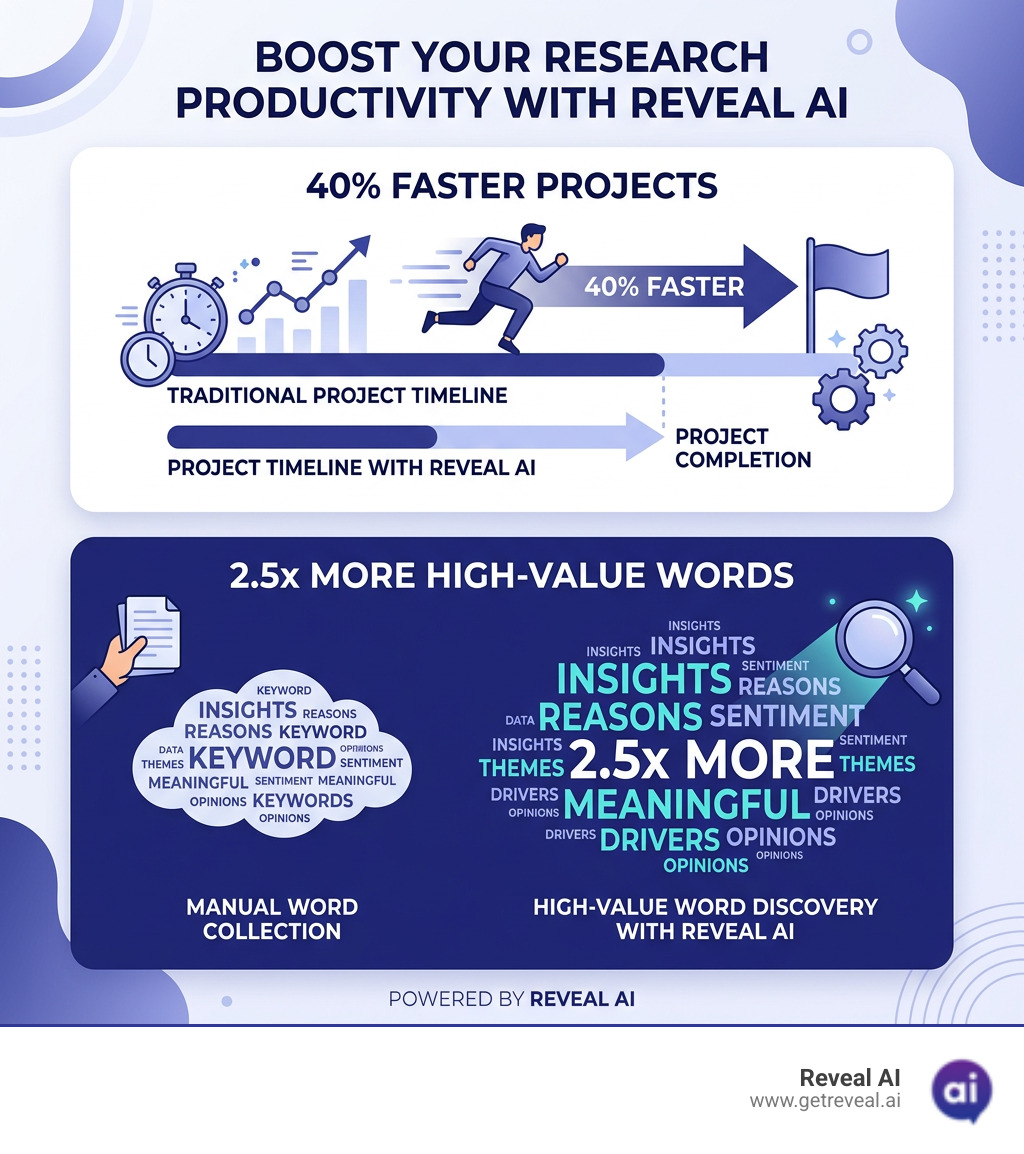
- Data Gathering: Use tools that allow for real-time interaction. For example, our conversational AI surveys can probe deeper into a participant's answer immediately, capturing 2.5x more high-value words than a static form.
- Organization: Centralize your data. Having a "single source of truth" for your research is vital.
- Inductive vs. Deductive Coding: You can start with a pre-set list of codes (deductive) or let the AI discover them from the ground up (inductive). Most successful projects use a hybrid approach.
- Reporting: Use visualizations like word clouds or sentiment maps to make the data digestible for stakeholders.
Integrating Qualitative Insights with Quantitative Data
The true power of automated qualitative analysis is realized when it’s paired with quantitative metrics. This is known as mixed-methods research.
Imagine you have a Net Promoter Score (NPS) of 7. The "7" tells you what happened, but the qualitative feedback tells you why. AI can perform "Impact Analysis," calculating exactly how much a specific theme (like "long wait times") is dragging down your overall NPS. By Leveraging AI in Market Research, you can correlate customer segments with specific qualitative complaints, allowing for hyper-targeted fixes.
Overcoming Challenges with Human-in-the-loop Oversight
Despite the power of AI, it isn't perfect. It can struggle with:
- Sarcasm: "Oh great, another update" might be flagged as positive by a basic sentiment tool.
- Contextual Nuance: Industry-specific jargon can sometimes confuse general AI models.
- Cultural Sensitivity: Slang or regional dialects require a nuanced understanding.
This is why we advocate for Agentic AI—AI that acts as an assistant rather than a replacement. By maintaining a clear audit trail, researchers can click on any AI-generated theme and see the original raw data it came from. This transparency builds trust and ensures that the final insights are grounded in reality.
Data security is also paramount. When using automated tools, ensure they offer enterprise-grade encryption and comply with privacy standards like GDPR or SOC2. Some advanced tools even offer offline transcription options for highly sensitive data.
Frequently Asked Questions about Automated Qualitative Analysis
How does AI handle researcher bias in qualitative data?
AI provides a layer of "algorithmic consistency." While a human might subconsciously ignore data that contradicts their hypothesis, an AI will flag a pattern regardless of whether it "fits" the expected narrative. By reducing cognitive fatigue, AI also prevents the "shortcuts" our brains take when we're tired, leading to more objective pattern recognition.
Is automated coding as accurate as manual coding?
In many experiments, AI-powered thematic analysis has shown 85-90% agreement with expert human coders. In fact, some studies suggest that for very large datasets, AI is more accurate because it doesn't suffer from the inconsistencies that arise when multiple human coders (who may have different interpretations) work on the same project.
What are the cost implications of switching to AI?
The ROI is usually found in labor savings. Manual coding for a large project can cost tens of thousands of dollars in researcher hours. Automated tools can reduce these costs by 60% or more. For example, automated transcription is roughly 20 times cheaper than some traditional transcription services, costing as little as $0.24 per hour.
Conclusion
The future of research is not "Human vs. Machine"—it's "Human + Machine." As we look toward future trends, we see a move toward even more "agentic" research assistants that can handle real-time probing during interviews and provide instant summaries.
At Reveal AI, we’ve seen how this technology transforms outcomes. By using conversational AI for surveys, our partners see 41% higher response rates and 40% faster project completion times. We don't just help you collect data; we help you find the "Why" behind the "What" without the manual grind.
Ready to see how automated qualitative analysis can supercharge your next project? Market Research Without Doubt, Powered by AI is just a click away. You can also Master your research with automated social listening to stay ahead of the curve.