No items found.

Blog
Qualitative Research: Diving Deep into Real-World Problems

Riddhi Patel


Qual research is the practice of gathering non-numerical data—text, images, and observations—to understand the why and how behind human behavior. Unlike quantitative methods that measure "how many," qualitative research explores motivations and perceptions by asking open-ended questions. It uses smaller, focused samples to generate rich insights and uncover patterns in human behavior.
For market and product teams, this is critical. It answers the questions that numbers alone cannot: Why did users abandon the checkout process? How do customers *really perceive your brand? What unmet needs are driving purchase decisions?* These insights fuel better product decisions and strategies grounded in real customer language—not assumptions.
Qualitative vs. Quantitative Research:
DimensionQualitative ResearchQuantitative ResearchGoalExplore the "why" and "how"Measure the "what" and "how many"Sample SizeSmaller, focused groupsLarge, statistically significant samplesData TypeNon-numerical (text, quotes, observations)Numerical (metrics, percentages, counts)Questions AskedOpen-ended, exploratoryClosed-ended, structuredOutputThemes, narratives, contextStatistics, trends, correlations
The challenge? Traditional qualitative research is slow and manual. Analyzing interview text and coding responses can delay insights for weeks, forcing a painful trade-off between depth and speed.
This is where research-grade AI platforms like RevealAI change the game. By enabling short, conversational AI interviews at scale and analyzing qualitative feedback with structure and verifiable trust, RevealAI helps market researchers and product teams capture the depth they need—without sacrificing speed or credibility.
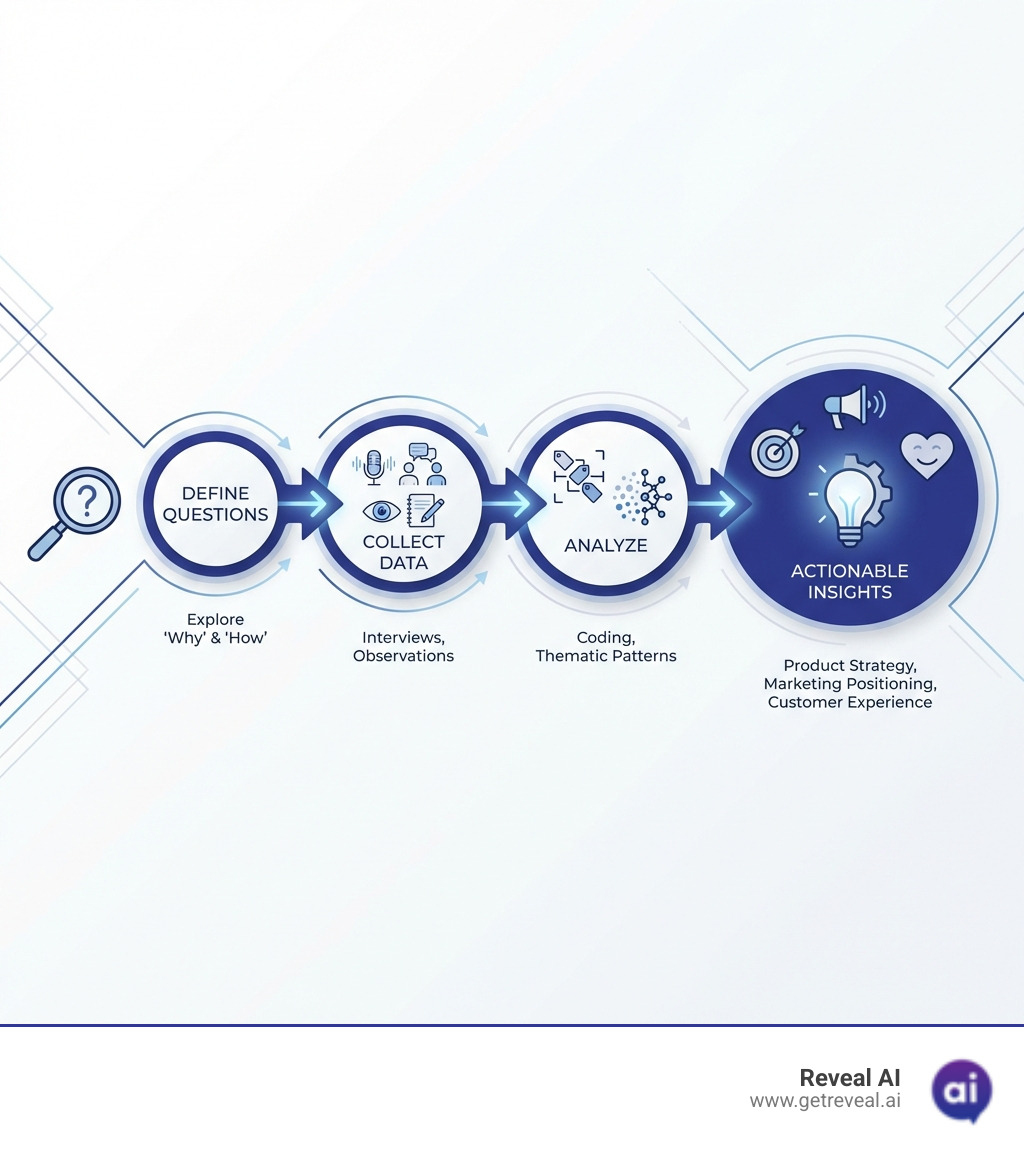
Effective qual research starts with choosing the right methodology to explore the 'why' and 'how' behind customer actions. It's about delving deep to provide the context that numbers often miss.
Several powerful methodologies allow us to explore the "why" and "how":
Choosing the right approach depends on your research questions. Our RevealAI platform complements these methods by enabling efficient collection and analysis of rich textual data, helping build a comprehensive understanding of your target audience. Learn more about how we apply this in practice with Use Case: Audience Intelligence with RevealAI's AI-powered qualitative research platform.
The heart of qual research is collecting rich, non-numerical information. Common methods include:
Qualitative sampling focuses on purposeful selection for deep insights, not statistical representation. Common strategies include purposive sampling (selecting based on specific traits), criterion sampling (meeting predefined criteria), snowball sampling (referrals), and convenience sampling (using accessible participants). The goal is to reach data saturation, the point where no new themes or insights emerge from the data.
When selecting a sampling method, you should:
Once data is collected, the next step is analysis. Traditionally, this is a labor-intensive process of manually coding interview text line-by-line and grouping codes to identify overarching themes. This can take hundreds of person-hours for a single study.
Computer-Assisted Qualitative Data Analysis Software (CAQDAS) emerged to help organize and code data, but it still relies heavily on the researcher's manual interpretation.
The landscape is now evolving with research-grade AI platforms like RevealAI. We recognize the pressure on researchers to deliver insights faster. While generic AI tools are tempting, they carry risks like hallucinations, lack of attribution, and loss of nuance.
At RevealAI, our philosophy is "Trust first, not novelty first." Our platform is designed with guardrails to address these challenges, automating analysis with full transparency and verifiability. We differentiate ourselves through:
By leveraging RevealAI, researchers can transform raw qualitative data into structured, actionable insights with speed and accuracy. This allows you to focus on strategy, not manual coding. To dive deeper, explore Leveraging RevealAI for Market Research.

In qual research, trustworthiness is the equivalent of validity and reliability. It assures stakeholders that findings are credible, applicable, consistent, and neutral. Key criteria include:
Ethical conduct is paramount. Core principles include respect for persons (informed consent), beneficence (minimizing harm), and justice (fair participant selection). Researchers must maintain participant anonymity and confidentiality and be mindful of their own researcher positionality—how their background might influence interpretation. A recent scientific article highlights the importance of "participant orientations and ethical contracts in interviews" for sensitive topics Scientific research on ethical contracts in interviews.
RevealAI is built to uphold these standards:
The final stage of any qual research endeavor is changing rich data into compelling narratives that drive real-world impact.
Reporting qual research is about telling a compelling story with your data.
When traditional methods fall short, RevealAI redefines qual research reporting. Our platform’s ability to swiftly analyze text and present structured insights with direct quotes streamlines the process, ensuring your findings are timely and relevant. Find how this change happens at When Traditional Research Methods Fall Short: How RevealAI Redefines Qualitative Research.

Qual research is indispensable for understanding the 'why' behind human behavior. It’s the key to opening up customer motivations, refining products, and crafting marketing that resonates. However, traditional methods have struggled to deliver these deep insights with the speed and scale today's world demands.
The challenge has been scaling this nuance without losing its essence. This is where research-grade AI platforms like RevealAI step in—not to replace the human researcher, but to empower them. We believe the future of qual research is a synergy between human expertise and trusted AI.
RevealAI's "Trust first" approach ensures that while we leverage AI for speed, we never compromise on integrity. Our "Walled Garden" data integrity and commitment to direct attribution mean every insight is traceable to its human source. This provides the guardrails necessary for responsible AI in research.
By turning conversational AI interviews into structured, verifiable insights, RevealAI empowers market and product researchers to:
RevealAI is designed to make qual research more accessible, efficient, and impactful than ever before. We are committed to providing the tools that help teams build genuinely customer-centric products and strategies.
Ready to transform your qualitative research? Explore how RevealAI can revolutionize your approach to Market Research with RevealAI.