No items found.

Blog
Beyond the Questionnaire: Understanding Survey Research Methods

Riddhi Patel



Survey research methods are the systematic approaches used to collect, analyze, and interpret data from a defined group of people to answer specific questions about attitudes, behaviors, or characteristics. Whether you're gathering customer feedback, testing a new product concept, or measuring brand awareness, the method you choose directly impacts the quality and usefulness of your insights.
Key Survey Research Methods at a Glance:
Many a market researcher has a story about making a common mistake early in their career: chasing sample size over substance. Mountains of survey data couldn't answer the most important question: why are users disengaging? Five simple interviews changed everything. The problem became crystal clear.
This shift from surface-level measurement to deep understanding represents the evolution of survey research. Modern businesses need more than just numbers—they need the why behind customer behavior. Yet many teams struggle with slow, manual analysis that delays decisions and keeps insights locked away in spreadsheets.
The good news? Survey research has evolved dramatically. Online surveys are now one of the most widely used methods, reaching thousands of people for a fraction of traditional costs. New technologies like AI-powered analysis can reduce coding time from weeks to hours, while conversational survey approaches blend qualitative depth with quantitative scale.
But technology alone isn't the answer. The foundation remains unchanged: clear objectives, well-designed questions, appropriate sampling, and rigorous analysis. This guide walks you through the complete survey research process—from defining your goals to turning raw data into business decisions.
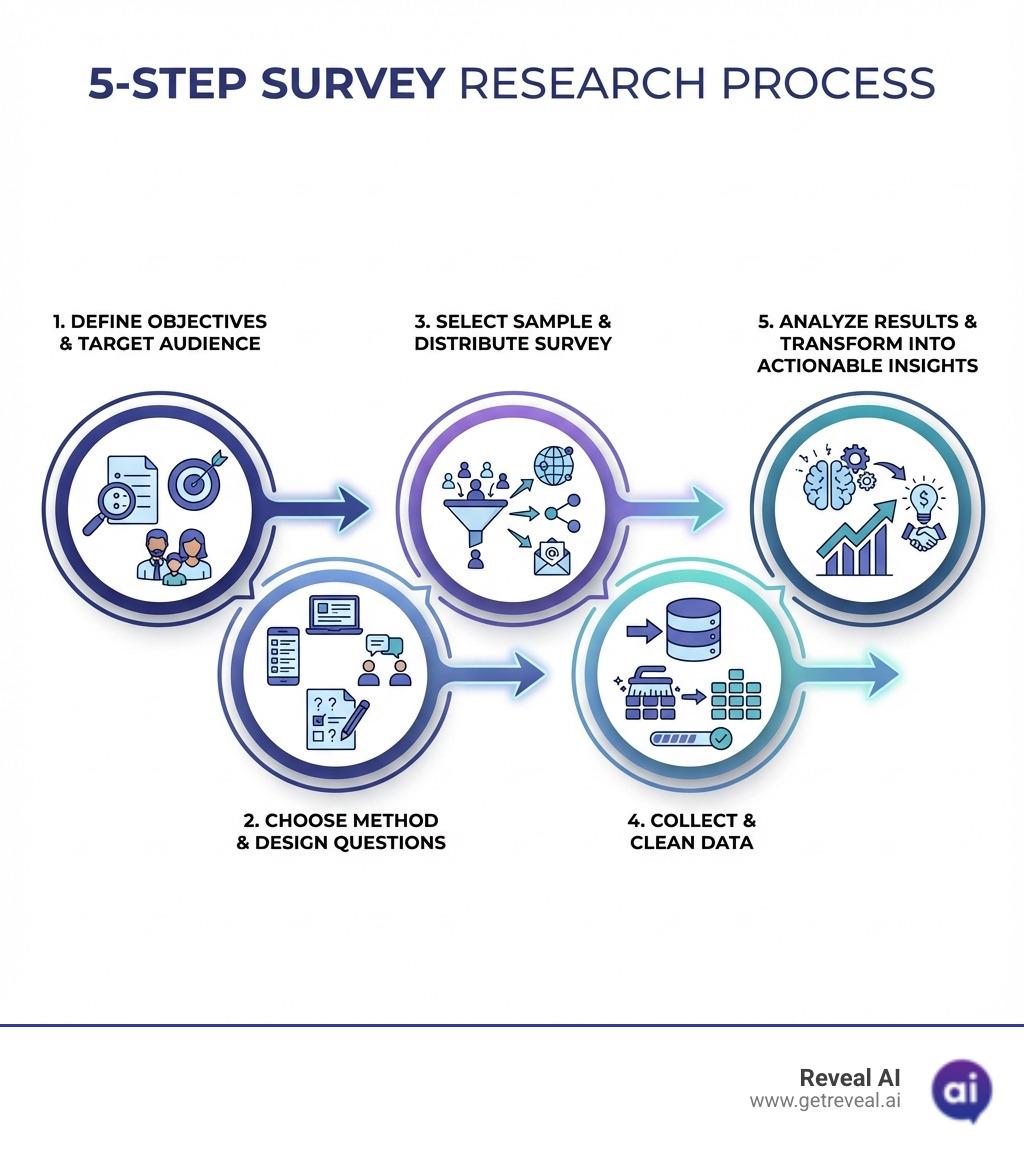
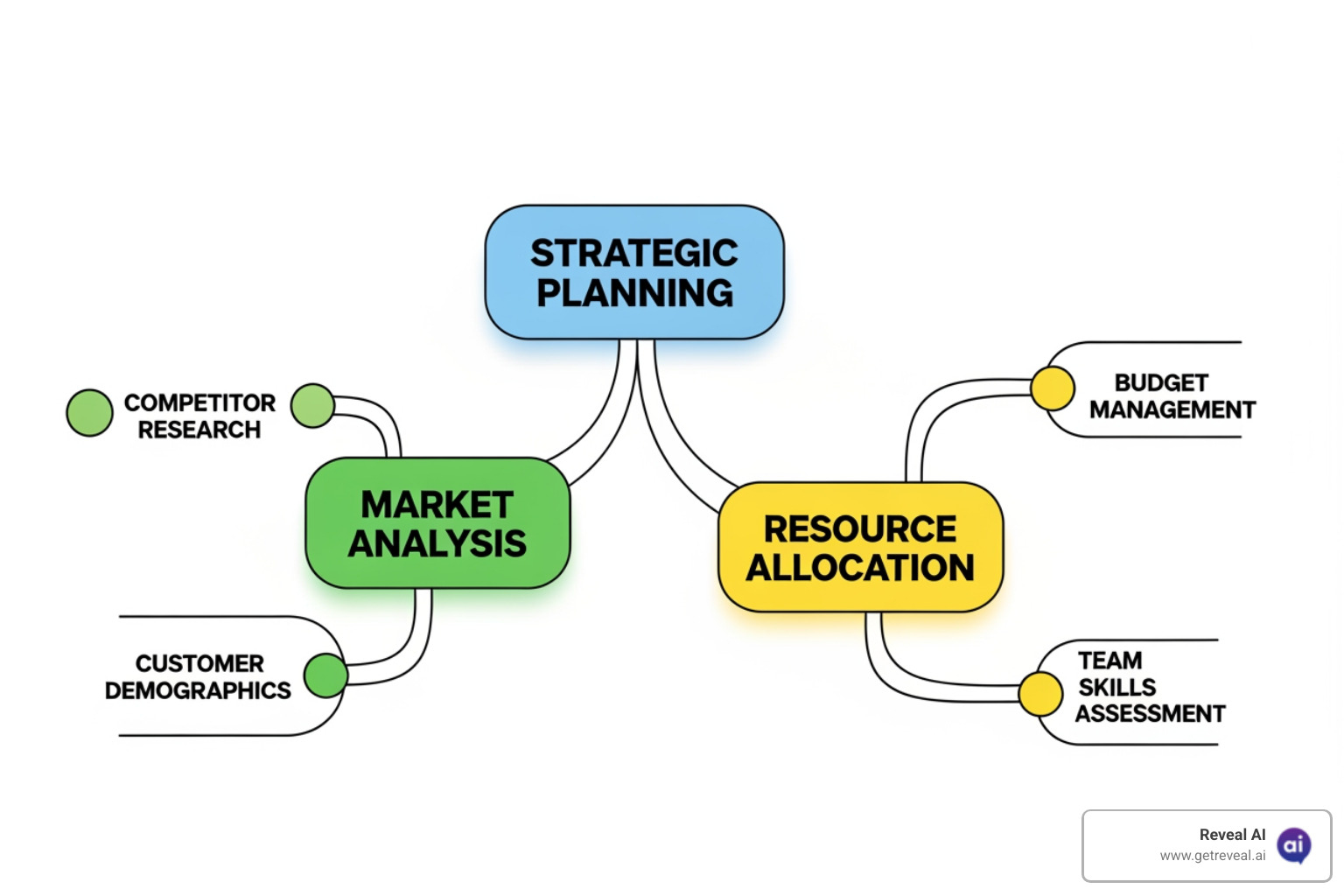
Before we even think about drafting questions, we need a clear roadmap. The success of any survey research methods hinges on meticulous planning. Just as a chef needs a recipe before cooking, we need a blueprint for our survey.
Our journey begins by defining our research goals. Are we exploring new ideas, describing market trends, or solving specific business problems with evidence? Surveys can serve various primary purposes:
Next, we pinpoint our target population. This isn't just about who might take our survey, but who should. We define this group as narrowly as possible, whether it's all US adults, small business owners in Europe, or existing customers in California. The clearer our target, the more relevant our insights. For more on understanding who you're trying to reach, explore our insights on Audience Intelligence.
Once we know who we want to hear from, we face the crucial task of sampling. Since surveying an entire population is rarely feasible, we select a representative subset. The goal is to obtain a sample large enough and diverse enough to reflect the broader population, allowing us to generalize our findings.
There are two main categories of sampling:
Determining the right sample size is a balancing act. It depends on factors like the desired degree of precision (how close we want our sample results to be to the true population value), the statistical power required (the probability of detecting a real effect if one exists), and practical considerations like our budget and access to subjects. Generally, as sample size increases, our confidence in the results grows.
The quality of our survey insights is directly tied to the quality of the questions we ask. Crafting effective survey questions is an art and a science.
First and foremost, questions must be clear and direct. We avoid jargon, acronyms, and overly complex sentence structures. Imagine explaining it to a friend – if they wouldn't understand it, neither will our respondents. A common pitfall is the "double-barreled question," which asks about two different things at once (e.g., "Are you satisfied with our product and customer service?"). Respondents won't know how to answer if they like one but not the other.
We primarily use two types of questions:
Within closed-ended questions, we often use various scales:
The choice of scale depends on the type of data we need. We always ensure response options are mutually exclusive (no overlap) and exhaustive (cover all possibilities). Maintaining consistent orientation in response scales (e.g., always positive to negative) throughout a survey is crucial to avoid confusing respondents and distorting results.
Here's a quick list of best practices for question design:
For a deeper dive into crafting impactful questions, explore our guide to question design best practices.
With our objectives clear and questions drafted, we then select the most appropriate survey method. This decision isn't one-size-fits-all; it depends on several factors:
For innovative projects requiring rapid feedback, Agile Research for Innovation can guide our method selection, emphasizing speed and adaptability.
The way we collect data profoundly impacts its quality and the insights we can derive. Let's explore the common survey research methods and their respective strengths and weaknesses.

Surveys can also be classified by their time dimension:
Here’s a comparison of common data collection modes:
MethodCostSpeedData QualityReach/StrengthsOnline/Web SurveysLowHighGenerally High (if well-designed)Widely accessible, cost-effective, real-time data, large reach.Telephone SurveysMediumMediumHigh (trained interviewers)Can reach diverse demographics, clarify questions, higher response rates than mail. Declining response rates.Face-to-Face InterviewsHighLowVery High (deep insights)Builds rapport, observes non-verbal cues, clarifies complex questions, suited for sensitive topics. Very expensive and time-consuming.Mail SurveysLow-MediumLowMedium (self-administered)Good for sensitive topics (anonymity), reaches populations without internet/phone. Low response rates, slow.
Online surveys have revolutionized survey research methods. They are incredibly popular, and for good reason: they are fast, cost-effective, scalable, and highly accessible. We can reach thousands of people across the United States and Europe for a fraction of the cost of traditional methods. This efficiency allows us to gather data quickly and analyze it in real-time, making them invaluable for agile decision-making.
However, online surveys aren't without their drawbacks. They can suffer from coverage bias, as not everyone has consistent internet access or digital literacy, which can skew results in certain demographics. For example, some studies have highlighted internet coverage bias in web surveys, particularly in Europe. Despite this, for many research purposes, especially with tech-savvy audiences, online surveys remain our go-to choice. For more on this methodology, you can review resources on Web Survey Methodology.
Before the digital age, telephone and face-to-face interviews were often considered the gold standard for survey research due to their ability to yield high-quality data.
Telephone surveys allow interviewers to clarify questions and probe for more detailed answers, leading to richer insights than purely self-administered questionnaires. However, their effectiveness has waned. Response rates for telephone surveys have been declining steadily since the 1990s. We've seen that these methods can be time-consuming, involve extensive cold-calling, and respondents may not always provide complete or entirely candid answers. You can explore more about these trends in Trends in survey response rates.
Face-to-face interviews offer the deepest insights. They allow for observation of non-verbal cues, building rapport, and the ability to handle long or complex questionnaires effectively. They are particularly useful when the true population is unknown or when respondents are unlikely to respond to other methods. The trade-off, however, is significant: they are often the most expensive and time-consuming method, and interviewer bias can subtly influence responses.
To overcome the limitations of any single method, we often employ mixed-mode surveys. This approach combines two or more data collection methods (e.g., an online survey followed by telephone interviews) to maximize reach, improve response rates, and reduce nonresponse error. For instance, we might start with an online questionnaire and follow up with telephone interviews to clarify unclear responses or reach those without internet access.
While mixed-mode surveys offer significant advantages, we must be mindful of "mode effects." These occur when the survey mode itself influences how respondents answer, potentially affecting the comparability of data collected through different channels. Careful design and analysis are needed to mitigate these effects. This strategy is particularly effective in Customer Research, where reaching diverse customer segments is key.
Even with the best intentions, errors can creep into any research endeavor. In survey research methods, minimizing these errors is paramount to ensuring our findings are trustworthy and actionable.
We approach survey design and implementation with a "total survey error" framework in mind, aiming to minimize various sources of error that can compromise our results. You can dig deeper into this concept via the total survey error resource. The main types of error we watch out for include:
To reduce these errors, we employ several strategies: designing clear and unbiased questions, using a combination of survey administration methods, improving the visual appeal of electronic questionnaires, and conducting pilot surveys to test our instruments and procedures before full deployment.
At the heart of quality survey research are two critical concepts: validity and reliability.
To ensure both validity and reliability, we diligently pre-test our questionnaires. This involves small-scale pilot studies and cognitive interviews, where respondents "think aloud" as they answer questions, helping us identify ambiguities, confusing phrasing, or unintended interpretations. Scientific research continually explores these aspects, including the validity of survey scales.
Conducting ethical survey research methods is non-negotiable. Our responsibility extends beyond just collecting data; it involves protecting our participants and upholding the integrity of the research process. Key ethical considerations include:
These principles guide all our research efforts. For more general resources, visit our Resources page.
Once we've carefully designed our survey, collected the data, and ensured its quality, the real magic begins: changing raw numbers and words into meaningful insights. This phase of survey research methods involves careful data preparation, robust analysis, and thoughtful interpretation.
Data preparation is the unsung hero of analysis. It involves cleaning the data (removing inconsistencies, errors, or incomplete responses) and coding open-ended answers into manageable categories.
Our analysis then typically branches into two main avenues:
The challenge with qualitative data has traditionally been the time and effort required for manual analysis. However, as we'll see, technology is rapidly changing this landscape. For a deeper look at how we're evolving this, explore Leveraging AI in Market Research.
Analyzing data is one thing; interpreting it to draw meaningful conclusions is another. We identify trends and patterns, often segmenting responses by different demographic or behavioral groups to uncover deeper insights. For instance, while 76% of consumers might rate their experiences highly, our research found that fewer actually go on to trust (73%), recommend (70%), or repurchase (69%). This highlights the need to look beyond surface-level satisfaction.
It's crucial to avoid overgeneralization, especially if our sample wasn't perfectly representative. We always connect our findings back to our initial research objectives, ensuring that our conclusions directly answer the questions we set out to explore. The ultimate goal is to translate these insights into actionable recommendations that drive business decisions. This process is key to Navigating Growth and Innovation in Market Research.
The landscape of survey research methods is constantly evolving, largely driven by technological advancements. What was once a slow, labor-intensive process is now becoming faster, smarter, and more insightful.
The proliferation of mobile devices has made mobile surveys ubiquitous, allowing us to reach respondents wherever they are, often leading to higher engagement and more in-the-moment feedback. But the most transformative trend is the rise of Artificial Intelligence (AI).
AI is revolutionizing how we conduct and analyze surveys. We're seeing the emergence of conversational surveys, where an automated moderator engages respondents in thoughtful, adaptive dialogue. This newer approach blends the depth of qualitative interviews with the scale and efficiency of quantitative methods. Imagine a survey that can dynamically adjust its questions based on previous answers, probing for clarification just like a human interviewer.
Perhaps even more impactful is the role of AI in qualitative analysis. Traditionally, analyzing open-ended survey responses was a time sink, requiring researchers to manually read, interpret, and code thousands of comments. Now, AI tools can automate transcription, identify key themes and patterns, and even generate summaries. This significantly reduces analysis time; some researchers report cutting transcript coding from weeks to mere hours. This means we can get deeper and faster insights, converting customer voices into actionable business decisions at an unprecedented pace.
At Reveal AI, we're at the forefront of this change, providing an AI-powered platform for conversational surveys that automates qualitative analysis, empowering businesses across the United States and Europe to make faster, more informed decisions. The future of survey research methods is here, offering us the ability to move beyond basic questionnaires to truly understand the why behind human behavior. For more on how this field is changing, check out The Future of Survey Methodology.
While often used interchangeably, a questionnaire is simply the tool containing the questions that respondents answer. A survey, on the other hand, refers to the entire systematic process of collecting, analyzing, and interpreting data using that questionnaire (or other data collection instruments) from a sample of individuals. The questionnaire is a component of the broader survey research method.
Determining the ideal sample size is crucial and depends on several factors: the size of your target population, the desired margin of error (how much you want your sample results to deviate from the true population value), and the confidence level (how sure you want to be that your results fall within that margin of error). Other considerations include the variability of the population, the statistical power needed to detect an effect, and practical constraints like budget and time. There's no single magic number, but statistical formulas can help calculate an appropriate size for your specific research goals.
Boosting response rates is a common challenge in survey research methods. Strategies we've found effective include:
From understanding complex consumer behaviors to gauging market sentiment, survey research methods remain an indispensable tool for businesses and researchers across the United States and Europe. We've journeyed from defining our research objectives and crafting precise questions to navigating diverse data collection modes and carefully analyzing our findings.
The core principles of proper design, robust sampling, and rigorous analysis are timeless. Yet, the field is anything but static. The advent of AI-powered platforms and conversational surveys is ushering in a new era, allowing us to move beyond the limitations of traditional questionnaires. We can now dig deeper into the why behind the data, uncover nuanced insights, and transform raw information into actionable business decisions with unprecedented speed and efficiency.
In this dynamic environment, embracing innovative survey research methods is not just an advantage—it's a necessity for staying ahead. Ready to open up deeper insights and drive faster decisions? Start your Market Research journey with us.