

No items found.
Qualitative Research Has a Speed Problem — AI Tools Are Solving It
The best ai tools for qualitative research available in 2026 include:
- Legacy CAQDAS Platforms — established software suites that have integrated AI coding, transcription, and automated assistance
- AI-Native Research Platforms — modern platforms designed from the ground up for rapid interview analysis, theme generation, and sentiment detection
- Local-First & Open-Source Tools — privacy-respecting applications that run models locally to keep sensitive data entirely on your machine
- General-Purpose LLMs (e.g., ChatGPT, Claude) — flexible but require careful prompt design and privacy handling
Qualitative research has always been some of the most valuable work a researcher can do. It captures why people think and feel the way they do — in their own words.
But the analysis? That part has always been slow.
Coding hundreds of interview transcripts. Identifying themes across thousands of open-ended survey responses. Building a defensible audit trail that holds up to scrutiny. These tasks have traditionally taken weeks of focused human effort.
That's changing fast.
Since ChatGPT launched in 2022, a wave of AI tools has reshaped what's possible in qualitative analysis. What once took weeks can now be done in hours. AI can transcribe, suggest initial codes, surface hidden patterns, and flag inconsistencies — consistently, across large datasets, without analyst fatigue.
But speed isn't the whole story. The tools vary enormously in how they handle your data, how much control they give you as a researcher, and whether the outputs are actually trustworthy.
This guide breaks down the landscape clearly — so you can choose tools that fit your workflow, protect your participants, and produce insights you can stand behind.
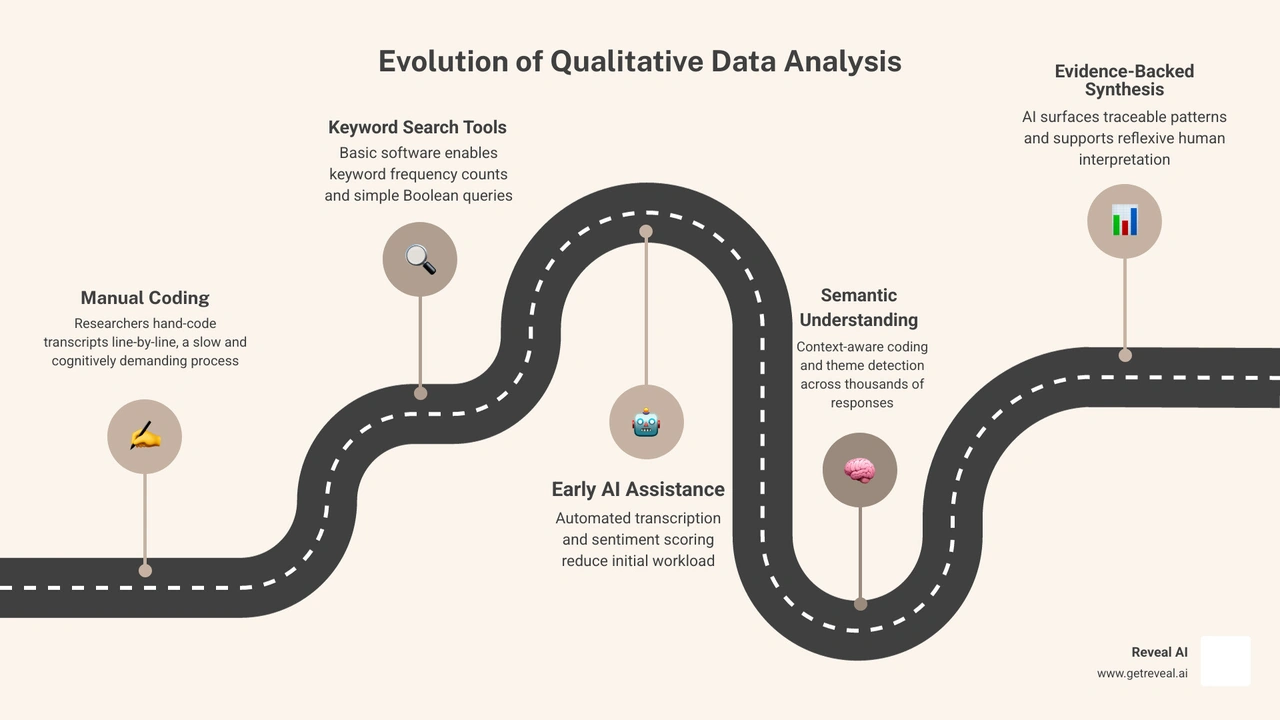
The Landscape of AI Tools for Qualitative Research in 2026
The market for qualitative analysis software has experienced a massive shift. In 2026, new AI tools to analyze qualitative data have transformed the research landscape, moving from simple keyword searches to complex semantic understanding.
We no longer have to choose between rigid, old-school software and unstructured, public chatbots. The modern toolkit is highly specialized, offering varied approaches to Data Analysis Qualitative workflows.
Today, the ecosystem is divided into four main categories:
- Legacy CAQDAS (Computer-Assisted Qualitative Data Analysis Software) Integration: Traditional giants that have bolted on powerful AI extensions.
- AI-Native Research Platforms: Tools designed from the ground up to leverage large language models (LLMs) for thematic synthesis and user feedback.
- General-Purpose LLMs: Powerhouses like GPT-5 or Claude utilized via custom prompt engineering frameworks.
- Local and Open-Source Tools: Privacy-first applications that run entirely on a researcher’s local hardware.
Traditional CAQDAS vs. Specialized AI Tools for Qualitative Research
For decades, academic and professional research relied on heavy-duty desktop software. Traditional desktop platforms have adapted by integrating smart AI coding modules. These features allow researchers to automatically generate codebooks, summarize documents, and auto-tag text segments.
The primary benefit of legacy CAQDAS is structural rigor. They allow you to run complex queries, manage massive multi-method databases, and maintain deep control over your coding hierarchy. However, their learning curves remain steep.
In contrast, specialized, AI-native tools focus on speed and intuitive interfaces. They excel at AI Interview Analysis by instantly linking generated insights back to the original respondent verbatims. Instead of spending days setting up a database, researchers can upload audio or text files and receive report-ready summaries, thematic heatmaps, and sentiment trends in minutes.
Local and Open-Source AI Tools for Qualitative Research
For academic researchers, medical institutions, and corporate teams handling highly sensitive personal identifiable information (PII), sending data to cloud-based AI models is a non-starter. This constraint has fueled the rapid rise of local-first, open-source ai tools for qualitative research.
Local-first tools allow researchers to run advanced LLMs locally using frameworks like Ollama. By running models like Llama 3 or Qwen 3.5 directly on your own computer, your research data never leaves your machine. This setup completely bypasses cloud subscription costs and ensures absolute data privacy.
Similarly, open-source toolkits provide computational triangulation, combining textual and numeric data into a single corpus for mixed-methods analysis. For researchers looking to build an interactive, conversational relationship with their data, the linxule/interpretive-orchestration repository provides an epistemic partnership framework. It treats qualitative analysis not as a task to automate, but as a collaborative, reflective dialogue between the human analyst and local AI agents.
How AI Transforms the Qualitative Research Workflow
Integrating AI into your research doesn't mean letting a machine write your final report. Instead, it means redesigning your workflow to eliminate administrative bottlenecks while keeping your analytical mind focused on what matters.

Implementing Automated Qualitative Analysis generally follows a structured, seven-step process:
- Transcribe: Convert raw audio and video into clean text.
- Prepare: Clean, structure, and strip sensitive PII from your transcripts.
- Generate Preliminary Codes: Let AI run an initial pass to suggest open codes.
- Refine Codes Manually: Review, merge, split, and validate the AI's suggestions.
- Create Themes: Cluster verified codes into broader conceptual categories.
- Synthesize & Interpret: Interrogate the themes, cross-reference with theory, and extract deep insights.
- Report: Build a transparent, auditable report with direct links back to source quotes.
Accelerating Transcription and Initial Coding
The most immediate, measurable impact of AI is the reduction of cognitive load during the early stages of analysis. Manual transcription used to consume hours of tedious labor; today, whisper-based speech-to-text models handle multi-language transcription and translation in minutes.
When it comes to coding, AI tools can apply codes inductively (identifying emergent concepts directly from the text) or deductively (applying an existing, structured codebook). This is particularly useful when dealing with a large volume of data. AI can code consistently across massive datasets without the risk of "coder drift"—where a human researcher's application of a code subtly changes over hours of reading.
Theme Identification and Synthesis
Once initial coding is complete, the challenge is finding the forest among the trees. AI excels at multi-level clustering and pattern detection. It can analyze thousands of open-ended survey responses or hours of interview text to identify subtle relationships that a tired human analyst might overlook.
By leveraging Conversational Data Analysis, researchers can ask direct questions of their dataset (e.g., "What are the primary frustrations expressed by participants over the age of 45 regarding our new interface?"). The AI searches the semantic space, groups relevant segments, and synthesizes the findings. Crucially, professional-grade tools will always provide direct citations back to the source text, ensuring you can verify every claim.
Methodological Rigor, Ethics, and the Human-in-the-Loop
As exciting as these efficiency gains are, qualitative research is fundamentally an interpretive act. A machine can identify patterns, but it cannot understand human experience, cultural subtext, or emotional nuance. Maintaining methodological rigor requires a strict "human-in-the-loop" approach.
To help you decide which deployment style fits your project's ethical and technical requirements, we have compared cloud-based and local AI systems below:
| Feature | Cloud-Based AI Tools | Local-First AI Tools |
|---|---|---|
| Data Privacy | Data is processed on external servers; requires strict vendor data-processing agreements. | Absolute privacy; data remains entirely on your local hardware. |
| Processing Power | High; utilizes enterprise-grade cloud GPUs for fast analysis. | Dependent on your local computer's hardware specs. |
| Cost | Usually subscription-based (SaaS models). | Free and open-source, with no recurring subscription fees. |
| Setup Complexity | Low; plug-and-play web interfaces. | Medium to high; requires basic command-line or local model installation. |
| Internet Dependency | Required. | Completely offline. |
The MERIT Framework and Reporting Standards
To maintain academic and professional credibility, researchers must be entirely transparent about how AI was used. We cannot simply state that "themes were analyzed using AI."
To solve this, methodologists Professor Jessica Lester and Professor Trena Paulus developed the MERIT framework (Methodological Evaluation and Relation of Information Technologies). This framework provides a structured pathway for researchers to evaluate, justify, and report the use of generative AI in their qualitative workflows. It ensures that when you publish your findings, your readers can clearly audit how much of the work was automated, how the prompts were structured, and how human oversight was maintained at every stage.
Maintaining Reflexivity and Preventing Over-Reliance on Automation
A key risk of using ai tools for qualitative research is the loss of researcher reflexivity—the active awareness of how your own biases, background, and theoretical assumptions shape your interpretation. If we let an LLM run wild on our data without critical intervention, we risk accepting generic, superficial themes.
To prevent this, we recommend adopting a "sandwich" methodology:
- The Bottom Bread (Human Foundation): The researcher conducts the first 10 to 15 analyses manually. This builds "theoretical sensitivity" and deep familiarity with the data.
- The Filling (AI Collaboration): The researcher uses AI to scale this initial understanding across the remaining hundreds of documents, generating suggestions, clustering codes, and checking for consistency.
- The Top Bread (Human Interpretation): The researcher steps back in to make final interpretive judgments, refine the thematic structure, and write the narrative.
Taking intentional "interpretive pauses" during the analysis ensures you remain the primary author of the research, rather than a passive editor of AI-generated text. For a deeper look at how this balance reshapes modern research, explore When Traditional Research Methods Fall Short: How Conversational AI Redefines Qualitative Research.
Frequently Asked Questions about AI in Qualitative Research
How do AI tools handle context, nuance, and cultural meaning?
Currently, LLMs are incredibly sophisticated at pattern recognition, but they lack genuine cultural lived experience. They can struggle with deep sarcasm, localized slang, or highly subtle emotional cues.
To mitigate this, researchers should use AI tools as a sounding board rather than an absolute authority. When extracting AI Conversational Insights, always cross-check the AI's thematic summaries against the raw transcripts to ensure the original emotional context hasn't been lost in translation.
What are the data privacy risks of using cloud-based AI tools?
If you upload non-public qualitative data to public, free AI tools, your data may be sent over the internet and used to train future models. This violates basic research ethics and institutional compliance.
To protect participant privacy, professional researchers should only use enterprise tools that offer strict SOC 2 and GDPR compliance, guarantee that data is never used for model training, and employ automatic PII masking to strip out names, locations, and contact details before processing.
Can AI tools completely automate the qualitative coding process?
Technically, yes—but methodologically, they shouldn't. Fully automated coding without human oversight leads to superficial, "hallucinated," or generic insights.
The gold standard is a hybrid workflow where AI Survey Analysis Tools do the heavy lifting of sorting, grouping, and initial tagging, while the researcher retains final veto power over every single code and thematic connection.
Conclusion
The rise of AI has not made the qualitative researcher obsolete. Instead, it has stripped away the administrative drag, allowing us to spend less time shuffling paper and more time doing what we do best: thinking deeply about human experiences.
If you are looking to run faster, deeper qualitative projects without losing your methodological rigor, we designed RevealAI for exactly this balance.
RevealAI is an AI-powered research platform built specifically for professional insights teams, market research agencies, and CX researchers. Instead of relying on static forms, RevealAI helps you conduct conversational surveys with real-time, AI-moderated probing. It captures incredibly rich respondent language, automatically transcribes and clusters open-ended responses, and preserves a clear, traceable audit trail from every high-level insight straight back to the original respondent verbatims.
Ready to see how conversational AI can transform your research speed and depth while keeping you firmly in control? Discover how our Qualitative Research Solutions can elevate your next project.