Blog
How to Turn Employee Listening Surveys into Real Action

Rhythm Dahiya

Listening to employee suggestions is one of the highest-leverage actions a product or research leader can take — yet most organizations struggle to extract actionable intelligence from this internal data.
For UX and product teams, turning internal input into real action requires a structured research approach:
The data highlights a significant opportunity. More than 34% of employees worldwide feel their ideas for improvement are ignored. When internal experts — those closest to the product and the organization — are unheard, organizations lose out on critical innovation.
The irony? 82% of employees have ideas for improving their company's offerings. The problem isn't a lack of ideas; it's the absence of a research-grade system for capturing and analyzing them without the risk of bias or loss of nuance.
Companies that build genuine listening cultures into their research strategy outperform competitors by four times. The gap isn't about intent; it's about the speed and accuracy of execution. Most leaders collect feedback but lack the tools to transform raw input into structured business decisions fast enough to matter.
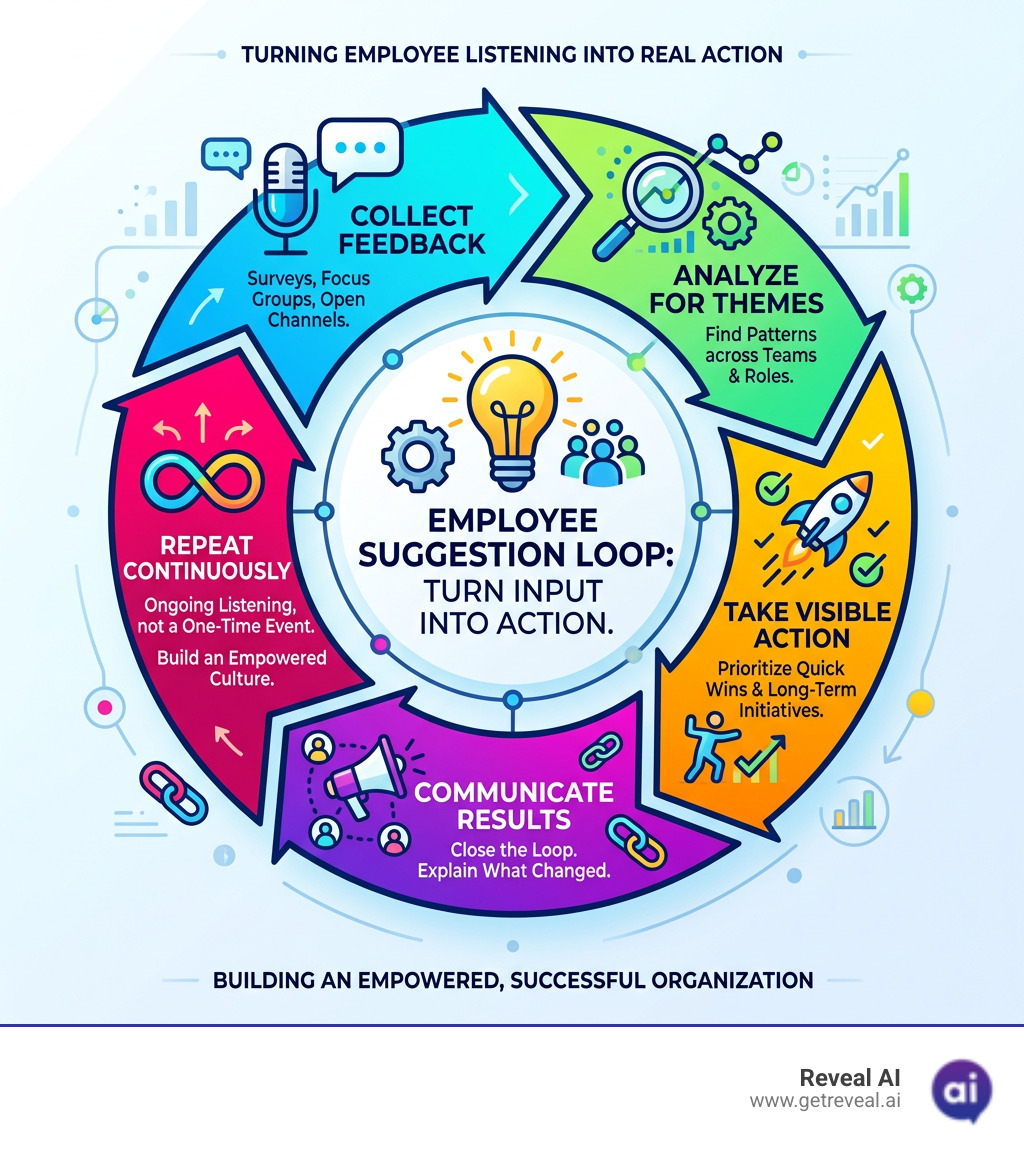
Terms related to listening to employee suggestions:

To move beyond a static suggestion box, research teams need a cohesive strategy. A true strategy for listening to employee suggestions involves treating internal stakeholders as expert users whose feedback can drive the product mission forward.
At Reveal AI, we advocate for continuous listening. This means gathering qualitative data at every stage of the product development lifecycle. Research from Penn State University indicates that active listening from leadership can significantly reduce organizational friction. To help your team bridge the gap between hearing and acting, you can explore how to accelerate leader success through better communication frameworks.
Many organizations fall into the trap of passive listening — they collect data but don't process the intent. Active research requires a formal, continuous process.
FeaturePassive ListeningActive Research (Reveal AI)ApproachCasual, accidental absorptionFormal, structured, and continuousToolsOpen-door policy (rarely used)AI-powered qualitative research platformFollow-up"Thanks for the input""You Said, We Did" communication cyclesOutcomeLost innovation and disengagementHigh trust and 4x market performanceFrequencyAnnual or crisis-drivenReal-time, conversational AI interviews
The business case for listening to employee suggestions is centered on intelligence. Employees on the front lines see the friction in software, the gaps in internal workflows, and the inefficiencies in the supply chain that executives might miss.
However, failing to follow through after promising to implement suggestions can be harmful. A study from Frontiers in Psychology found that ignoring feedback after soliciting it damages trust. To prevent this, researchers must foster a thriving culture built on authentic dialogue.
Capturing these insights requires a multi-channel approach that caters to different roles:
Traditional surveys often fail because they rely on Likert scales (1-5). To truly understand listening to employee suggestions, researchers need qualitative depth. This is where an AI-powered qualitative research platform becomes essential.
At Reveal AI, we take a "Trust First" approach. Our AI research platform is designed with specific guardrails for research-grade insights:
By leveraging AI in HR and product research, teams can move past manual spreadsheet work and focus on strategy.
The most dangerous part of any research program is the "Action Gap" — the space between hearing a suggestion and doing something about it. If internal stakeholders feel their feedback is going into a "black hole," they will stop providing the insights that drive innovation.
To bridge this gap, we must treat employee suggestions with the same rigor as any critical business data. This requires:
Implementing real-time employee feedback practices ensures that researchers aren't acting on stale data. In a rapidly changing market, speed is a form of respect.
The "You Said, We Did" framework is a powerful tool for researchers. It links organizational change back to the feedback that inspired it, building a thriving organizational culture by proving the company is a partnership.
Even with the best intentions, listening programs can fail. Researchers should avoid:
For those in research leadership, understanding these nuances is critical for new leader success.
For market research firms, UX teams, and product analysts, the challenge is scaling listening without losing nuance. Reveal AI provides the middle ground: Verifiable Trust.
Our AI-powered qualitative research platform enables you to conduct short, conversational AI interviews at scale. Whether you are researching internal tool adoption or gathering suggestions for a new product roadmap, we provide:
By focusing on research-grade qualitative data, we help organizations turn suggestions into a competitive advantage.
Listening to employee suggestions is no longer just an internal initiative; it is a fundamental business strategy for innovation. The companies that win will be those that treat their internal stakeholders as partners in the research and development process.
By moving from passive absorption to active, AI-enhanced listening, we can bridge the gap between hearing and doing. We can replace the cost of missed opportunities with a culture of creativity, productivity, and trust.
The suggestions are already there, held by the people who know your product best. Your job is to give them a voice — and then have the courage to act on the insights.
Summary Takeaways: