No items found.

Blog
AI-Powered Employee Engagement Surveys: From Silent Treatment to Real-Time Insights

Rhythm Dahiya


employee engagement survey AI is reshaping how organizations listen to their people — moving from static, once-a-year checkboxes to continuous, conversational feedback that captures the why behind how employees feel.
When evaluating AI-powered engagement survey tools, research and insights teams typically look for platforms that can scale qualitative depth. Rather than relying on rigid, pre-defined question paths, modern AI-driven platforms use conversational listening, real-time probing, and multi-level clustering to turn open-ended feedback into evidence-backed reporting.
The numbers paint a stark picture. Traditional employee engagement surveys see 60–80% initial compliance — but near-zero engagement between survey cycles. The average engagement platform retains just 25% of employees as consistent users. Static forms average a 30% response rate.
Meanwhile, conversational AI surveys are achieving 85–90% completion rates, and employees who receive AI-driven follow-up nudges are 32% less likely to leave.
The problem isn't that employees don't have opinions. It's that standard surveys don't give them a real chance to express them.
Annual or quarterly pulse surveys create dangerous gaps — problems emerge, escalate, and drive people out the door long before the next survey lands in their inbox. And when responses do come in, HR teams face mountains of open-text feedback with no efficient way to analyze it.
AI changes this in two important ways:
For research and insights teams specifically, the shift matters beyond HR dashboards. The real value lies in moving from scores to stories — capturing the actual language employees use, and building defensible insights that trace directly back to respondent responses.
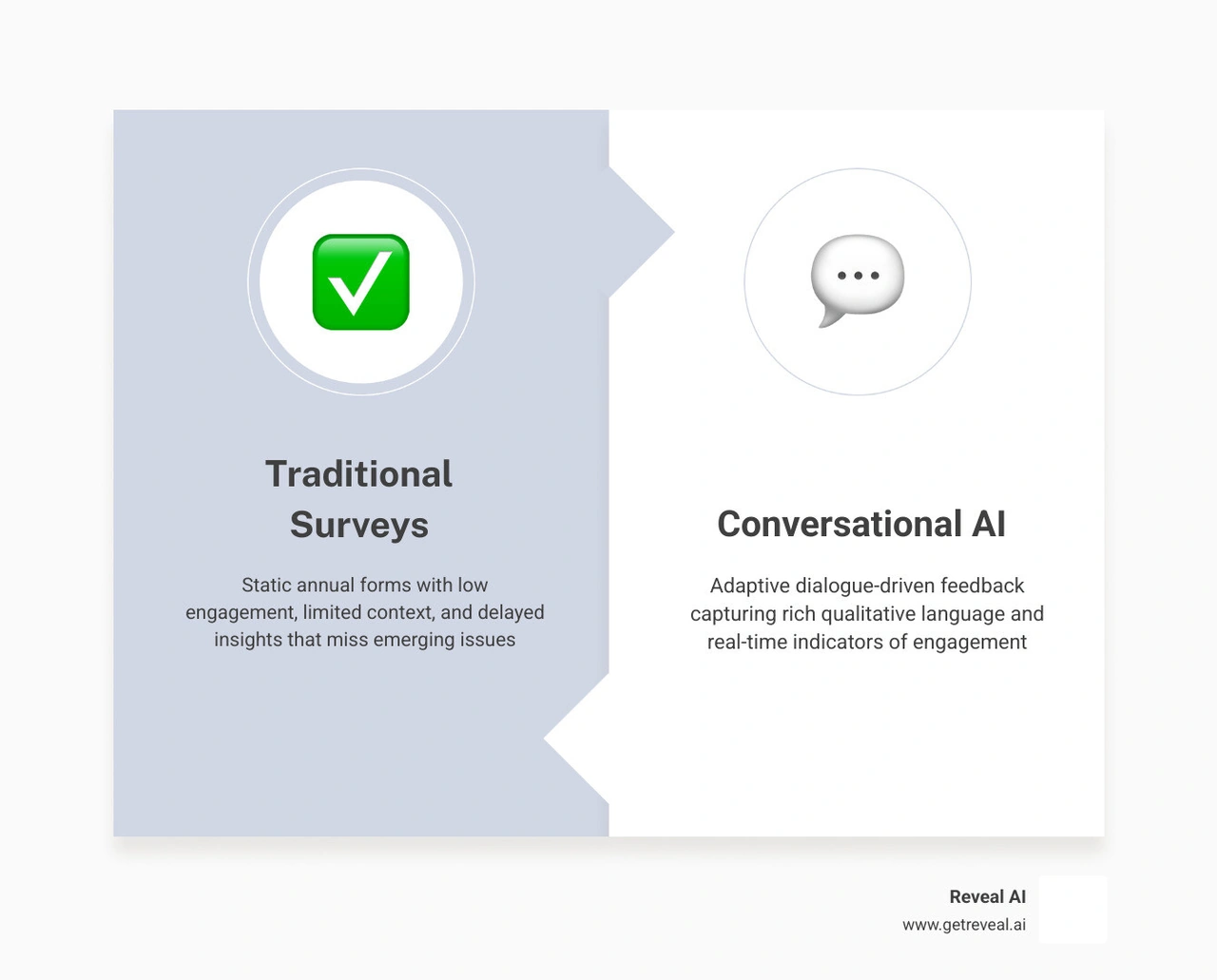
At its core, an employee engagement survey AI is a feedback system that uses artificial intelligence to conduct, moderate, and analyze employee surveys. Unlike traditional tools that rely on static, multiple-choice questions, an AI-driven platform acts more like an active listener.
We can better understand this shift by looking at how we approach Enhancing Employee Engagement with AI: A Guide for HR Professionals. Traditional surveys treat feedback as a transactional, point-in-time metric. AI-driven conversational listening, on the other hand, treats feedback as a continuous, qualitative dialogue.
FeatureTraditional Static SurveysAI-Driven Qualitative SurveysQuestion FormatMultiple-choice, rigid Likert scalesOpen-ended, conversational dialogueFollow-Up AbilityNone (static pathing)Real-time, AI-moderated probing based on responsesAnalysis MethodManual coding, basic word cloudsMulti-level clustering, automatic theme detectionTime to InsightWeeks or monthsNear real-timeEmployee ExperienceTransactional complianceCollaborative, interactive listening
When organizations transition from static forms to conversational surveys, the impact on data quality is immediate. According to our Employee Survey App Complete Guide, traditional forms often fail because they force complex employee experiences into rigid dropdown menus.
Conversational AI surveys achieve higher response engagement because they feel like a natural check-in rather than corporate paperwork. Instead of checking a box that says "Discontent with management," an employee can explain why they feel unsupported. The AI then asks relevant, non-intrusive follow-up questions to capture the nuance. This interactive approach reduces survey fatigue by up to 90%, transforming a cold questionnaire into a meaningful dialogue that captures richer respondent language.
A common pitfall of standard employee listening is the "one-size-fits-all" approach. A software engineer, a retail associate, and a regional manager have vastly different workplace experiences.
Using advanced Employee Survey Software, we can tailor conversational flows dynamically. Instead of serving the exact same script to everyone, the AI adapts its questions based on the respondent’s role, tenure, or previous answers. If a new hire mentions onboarding struggles, the AI focuses on training clarity. If a senior manager hints at resource constraints, the AI probes into budget and staffing bottlenecks. This real-time, AI-moderated probing ensures we dig deeper into role-specific experiences without requiring researchers to manually build hundreds of complex branching paths.
When evaluating platforms for your organization, it is easy to get lost in feature lists. However, professional researchers need to look beyond flashy dashboards and focus on features that support rigorous, defensible qualitative research.
When configuring a Pulse Survey App or exploring broader Employee Feedback Solutions, look for these key capabilities:
The true bottleneck of qualitative research has never been collecting data—it is analyzing it. Reading and manual coding of thousands of open-text responses can take weeks, often leading to delayed decision-making.
Through advanced AI Interview Analysis, platforms can now automatically transcribe, clean, and categorize unstructured open-text feedback.

Using multi-level clustering, the AI groups similar responses into hierarchical themes while preserving the exact respondent verbatims. This ensures that when you present findings to leadership, you do not just deliver abstract percentages. You deliver a clear, traceable audit trail that links every high-level theme directly back to the actual, unaltered words of your employees.
Quantitative scores can tell you that engagement is dropping, but they rarely tell you why. Relying solely on numerical averages often obscures the leading indicators of turnover, such as burnout, lack of career growth, or localized team friction.
By leveraging HR Analytics Solutions, organizations can systematically analyze qualitative depth. For example, an AI agent might identify that while overall team satisfaction scores look healthy, a cluster of senior engineers is expressing quiet frustration about legacy tech debt and unclear promotion pathways. Catching these nuanced patterns early allows leadership to intervene proactively, rather than finding out during exit interviews.
Investing in an employee engagement survey AI is not just about keeping employees happy; it is a critical strategy for protecting the bottom line. Replacing a single employee can cost anywhere from 50% to 200% of their annual salary.
As detailed in our guide on How Real-Time Employee Feedback Enhances HR Practices, organizations using high-adoption, continuous feedback platforms report a 40% reduction in turnover. For a 200-person company, detecting and resolving cultural misalignments early translates to an average of $480,000 in annual savings.
By establishing systems for Real-Time Employee Feedback, insights teams can move at the speed of business, equipping executives with the qualitative proof they need to make high-impact organizational decisions.
Insights leaders are often tasked with presenting uncomfortable truths to senior management. To drive actual change, those findings must be undeniable.
When you share reports generated through AI-driven qualitative platforms, you are not just presenting a subjective summary. You are presenting evidence-backed insights backed by a clear audit trail. Because the platform preserves the connection between high-level themes and original verbatims, managers can drill down to see the real context. This transparency builds trust, reduces skepticism, and guides leaders to take precise, meaningful action.
While the benefits of AI-driven listening are clear, organizations must navigate significant ethical considerations. The moment employees suspect that AI is being used to monitor them individually or grade their performance, trust evaporates, and response quality plummets.
According to our Employee Experience Insights Guide, maintaining trust requires unwavering commitment to data privacy and transparency. Organizations should:
Traditional surveys suffer from low participation because they feel like tedious administrative tasks. By Listening to Employee Suggestions through conversational check-ins, the experience becomes collaborative. Employees respond to dynamic, conversational prompts that value their input, leading to completion rates of up to 90% while reducing survey fatigue.
Modern AI survey platforms do not require you to abandon your current toolstack. They are designed to fit seamlessly into a researcher's toolkit, offering robust data export capabilities, API access, and integrations with collaboration tools like Slack or Microsoft Teams. This allows teams to Foster a Thriving Organizational Culture by keeping feedback loops integrated with the systems employees use daily.
Reputable AI engagement platforms prioritize data security by adhering to strict GDPR compliance and SOC2 standards. When designing a Performance Feedback Questionnaire, the AI can be configured to aggregate feedback into high-level themes, automatically stripping out personally identifiable information (PII) to protect individual employee identities.
The era of relying on silent, static checkboxes to measure company health is over. To build resilient organizations, insights leaders and researchers need to understand the human stories behind the numbers.
By understanding The Role of AI in HR, research teams can leverage advanced technology to collect richer open-ended responses, automate complex thematic analysis, and deliver truly evidence-backed insights.
Ready to transform how your organization gathers and analyzes qualitative employee feedback? Explore our Reveal AI Employee Insights Hub to learn how we help research teams turn open-ended feedback into clear, defensible strategies.