

No items found.
Why Coding and Thematic Analysis Is the Foundation of Great Qualitative Research
Coding and thematic analysis is the process of systematically labeling segments of qualitative data — such as interview transcripts or survey responses — and organizing those labels into meaningful patterns called themes.
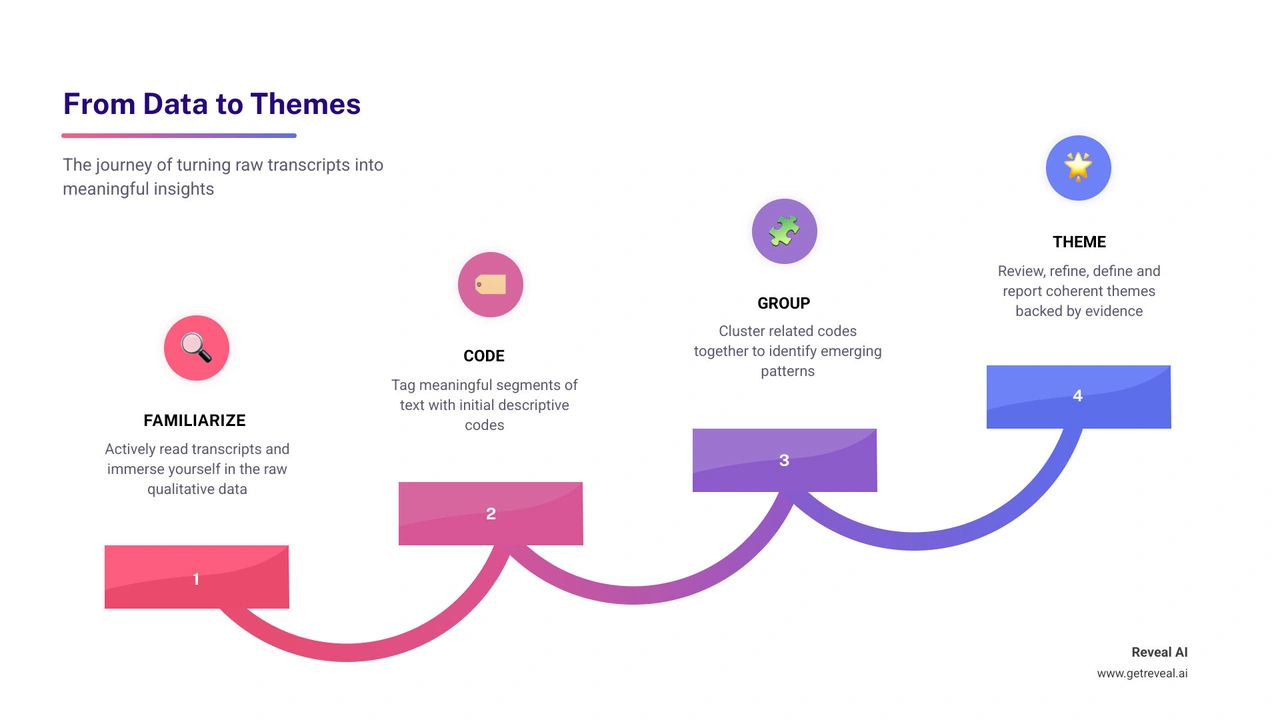
Here's a quick overview of how it works:
- Familiarize yourself with your raw data (transcripts, responses, notes)
- Generate initial codes by tagging meaningful segments of text
- Search for themes by grouping related codes together
- Review themes to check they accurately reflect the data
- Define and name each theme clearly
- Report your findings with evidence and transparency
If you've ever stared at a stack of interview transcripts and wondered how to turn hundreds of pages of raw responses into a clear, defensible insight — you're not alone.
Qualitative data is rich. It's also messy. Participants go off-script. Responses overlap. Meaning hides inside casual phrases and throwaway remarks. Without a structured process, it's easy to either miss important patterns or over-interpret limited evidence.
That's exactly why coding and thematic analysis has become the most widely used approach for analyzing qualitative data. According to research published in health and social sciences journals, it appears in approximately 30% of qualitative studies — and over 75% of qualitative researchers use it as their primary method for analyzing interviews and focus groups.
The appeal is straightforward: thematic analysis is structured enough to produce rigorous, transparent findings, yet flexible enough to work across different research questions, data types, and theoretical perspectives.
But flexibility can be a double-edged sword. Without clear guidance on how to code, how to move from codes to themes, and how to build findings that hold up to scrutiny, the process can feel overwhelming — or worse, produce results that lack credibility.
This guide walks you through the full process, from your first read of raw data to a finished set of themes you can defend.
Understanding Thematic Analysis and How It Differs from Other Methods
When we dive into qualitative research, we are faced with several analytical pathways. Choosing the right one depends entirely on our research questions and the depth of insight we need to uncover.
Thematic analysis is highly flexible, but it is important to understand where it sits in relation to other common data analysis qualitative methods:
- Content Analysis: Often confused with thematic analysis, content analysis focuses on quantifying qualitative data. It involves counting the frequency of specific words, phrases, or predefined concepts. While thematic analysis seeks to interpret the underlying meaning of patterns, content analysis tends to stay closer to the descriptive, surface-level frequency.
- Narrative Analysis: This method treats the participant's story as a cohesive whole. Instead of breaking transcripts apart into fragmented codes, narrative analysis looks at the structure, sequence, and storytelling devices an individual uses to make sense of their experiences.
- Discourse Analysis: This approach studies language in use, looking at how social context, power dynamics, and cultural norms shape the way people speak and write. It is less about what people say and more about how they say it and what those choices reveal about social structures.
- Grounded Theory: Unlike thematic analysis, which can be applied to almost any theoretical framework, grounded theory is a highly structured, inductive methodology aimed at building a brand-new theory from the ground up. It requires continuous, simultaneous data collection and analysis until "theoretical saturation" is reached.
| Qualitative Method | Primary Focus | Best Used For | Flexibility Level |
|---|---|---|---|
| Thematic Analysis | Identifying patterns of meaning across a dataset | Explaining shared experiences, perceptions, or behaviors | Extremely High |
| Content Analysis | Quantifying the presence of specific words or concepts | Measuring frequency and surface-level trends | Medium |
| Narrative Analysis | Analyzing individual stories as complete units | Understanding personal journeys and identity construction | Low (highly specific) |
| Discourse Analysis | Examining language structures and power dynamics | Uncovering societal beliefs and ideological framing | Low (highly specific) |
| Grounded Theory | Developing a new theory grounded in systematic data | Explaining social processes without existing theories | Low (highly prescriptive) |
The Role of Philosophical Perspectives in Shaping Your Analysis
No qualitative analysis happens in a vacuum. Your philosophical starting point directly shapes how you interpret your data.
For instance, a constructivist perspective assumes that meaning is subjective, fluid, and co-created between the participant and the researcher. In constructivist thematic analysis, your coding will focus heavily on how participants make sense of their world, acknowledging that your own background and biases actively shape the themes you develop.
Conversely, a critical realist perspective assumes that an objective reality exists, but our understanding of it is always filtered through human perception and social structures. A critical realist analysis might look at how systemic barriers influence a participant's lived experience, aiming to identify the underlying mechanisms driving their observed behaviors.
Regardless of your paradigm, practicing reflexivity — actively reflecting on your own role, assumptions, and potential biases as a researcher — is essential. In qualitative research, subjectivity is not a bug; it is the analytical lens that makes deep insight possible.
The Six Phases of Coding and Thematic Analysis
To ensure rigor and trustworthiness, we recommend following the widely respected six-phase thematic analysis framework originally developed by Virginia Braun and Victoria Clarke. This is not a rigid, linear march, but an iterative, recursive process where you will constantly move back and forth between phases.
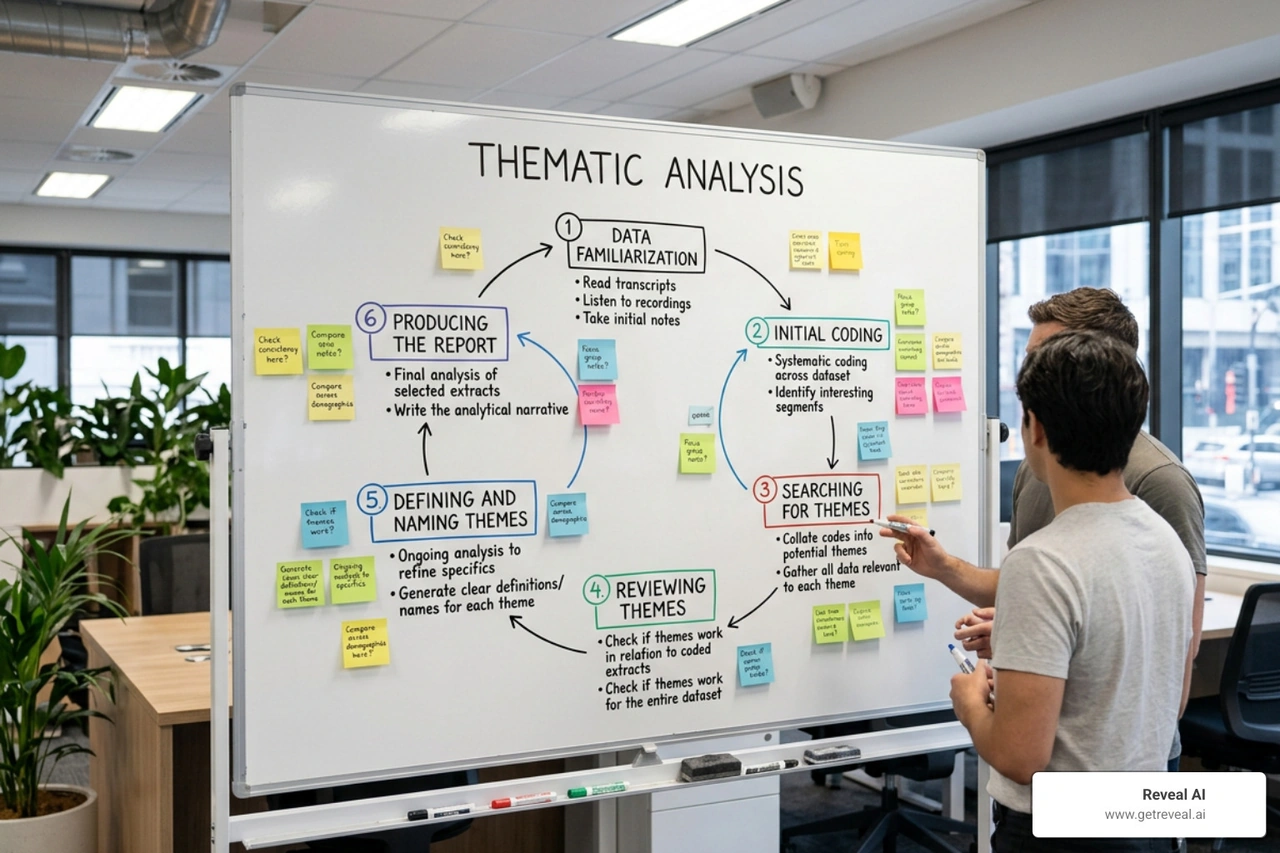
In modern research workflows, managing this process manually can become incredibly time-consuming, which is why teams frequently turn to specialized AI interview analysis platforms to help organize transcripts and track developing patterns without losing the researcher's vital interpretive oversight.
Phase 1 to 3: From Familiarization to Initial Coding and Thematic Analysis
The first half of the process is all about getting close to your data and beginning to break it down systematically.
- Phase 1: Familiarization. This begins with transcription. Active, close reading of your transcripts is non-negotiable. Read through your datasets multiple times without coding, noting down casual thoughts, early impressions, and interesting patterns in the margins.
- Phase 2: Generating Initial Codes. Here, you begin labeling meaningful segments of text. A code is a descriptive or interpretive tag applied to a specific excerpt. As you work line-by-line, you will build a preliminary codebook to ensure you define and apply your codes consistently across the entire dataset.
- Phase 3: Searching for Themes. Once your dataset is coded, you shift your focus from individual codes to broader patterns. You start clustering related codes together. For example, if you have codes like "bus schedules," "lack of parking," and "long walking distances," you might group them under a candidate theme called "Physical barriers to access."
Using automated qualitative analysis tools during these early phases can help you instantly group similar concepts and cluster massive amounts of conversational data, giving you a structured head start on finding potential themes.
Phase 4 to 6: Developing, Reviewing, and Naming Themes
The second half of the process is where your analytical narrative comes to life.
- Phase 4: Reviewing Themes. In this phase, you check your candidate themes against two levels of data. First, read all the coded extracts for each theme to ensure they form a coherent pattern. Second, review your themes against the entire dataset to make sure they accurately represent the overall narrative and that you haven't missed major nuances.
- Phase 5: Defining and Naming Themes. Here, you write a detailed analysis for each theme, identifying its "essence." What is the story this theme tells? How does it relate to your research question? Give each theme a clear, punchy, and conceptual name that immediately communicates its core meaning.
- Phase 6: Producing the Report. The final phase is writing up your findings. This is your chance to tell a compelling story, weaving together your analytical narrative with vivid, representative participant quotes that serve as empirical evidence.
Designing Your Coding Strategy: Inductive vs. Deductive Approaches
Before you begin tagging your transcripts, you must decide on your coding structure.
Some researchers prefer a flat coding frame, where all codes sit at the same level of importance. Others use a hierarchical coding frame, organizing codes into parent categories and child sub-codes (e.g., Parent: "Customer Experience" -> Sub-codes: "Ease of Use," "Friction Points," "Surprise and Delight").
For insights teams processing thousands of customer touchpoints, utilizing AI powered feedback analysis helps automatically organize these complex hierarchies, allowing you to instantly visualize high-level trends alongside granular details.
Choosing Between Inductive and Deductive Coding and Thematic Analysis
Your overall research goals will dictate whether you take a bottom-up or top-down approach:
- Inductive Coding (Bottom-Up): You start coding from scratch without a predefined codebook. Your codes emerge directly from the raw data. This approach is ideal for exploratory research where you want to remain entirely open to unexpected insights.
- Deductive Coding (Top-Down): You start with a pre-established codebook based on existing theoretical frameworks, literature, or your specific research questions. You then search your data for instances of these predefined categories.
- Hybrid Coding (Combined): In practice, many market and UX researchers use a hybrid approach. They begin with a basic deductive framework to address core business questions, but leave plenty of room to inductively create new codes as unexpected patterns emerge in the participant verbatims.
Moving from Descriptive Codes to Analytical Themes
A common pitfall in thematic analysis is staying too descriptive. For example, if you are analyzing interviews with working parents, a descriptive code might be "Precipitation" or "Rain."
To move to an analytical level, you must "chunk up" your concepts. How do these descriptive elements connect?
Through a process of continuous comparison, you might group codes like "Rain," "Bus Delays," and "Childcare drop-off" into a deeper, more abstract analytical theme: "Systemic scheduling vulnerability."
To do this effectively, we can use specialized coding techniques:
- In Vivo Coding: Using the participant’s exact, poignant words as the code label to preserve their precise meaning.
- Process Coding: Using gerunds (words ending in "-ing") to capture action, transition, and ongoing processes in the data (e.g., "Adapting to hybrid routines").
Ensuring Rigor, Trustworthiness, and Transparency in Qualitative Research
Unlike quantitative research, which relies on statistical metrics, qualitative research establishes quality through trustworthiness. This is typically evaluated using four key criteria:
- Credibility: Do the findings accurately represent the participants' reality? (Enhanced by peer debriefing and persistent observation).
- Transferability: Can these findings be applied to other contexts? (Enhanced by providing "thick description" of the research context).
- Dependability: Is the research process logical, traceable, and clearly documented?
- Confirmability: Would other researchers reach similar conclusions based on the same data? (Requires a clear audit trail).
Applying the 6Rs Framework for Keyword and Code Selection
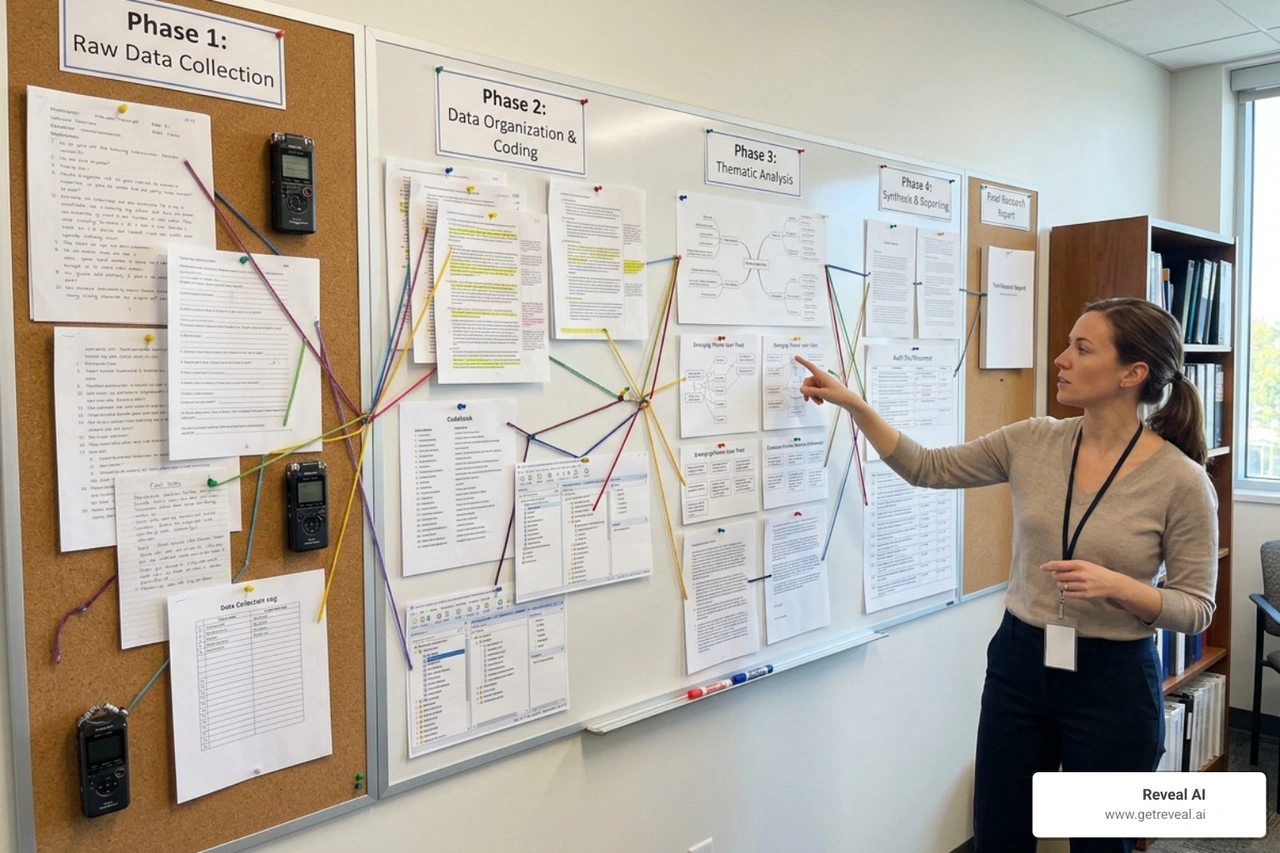
To bring structured rigor to the early stages of transcription and keyword selection, researchers can utilize the 6Rs framework proposed by Naeem, Ozuem, Howell, and Ranfagni (2023).
When reviewing your raw data to select the most significant keywords and quotations, evaluate them against these six criteria:
- Realness: Does the quote reflect genuine, lived experiences rather than superficial answers?
- Richness: Is the language detailed, expressive, and full of context?
- Repetition: Does this concept recur frequently across different participants?
- Rationale: Is the keyword grounded in, or relevant to, your study's theoretical foundations?
- Repartee: Does the segment capture witty, highly emotional, or poignant moments that reveal deeper truths?
- Regal: Is the quote or keyword absolutely crucial to answering your primary research question?
By systematically applying this framework, you ensure that your initial codebook is built on the most robust, meaningful parts of your qualitative dataset. For a deeper dive into this methodology, you can read the full study: A Step-by-Step Process of Thematic Analysis to Develop a Conceptual Model in Qualitative Research.
Building a Conceptual Model from Qualitative Themes
The ultimate goal of advanced thematic analysis is often to move beyond a simple list of themes and build a cohesive conceptual model.
By mapping out how your themes interact, you can create a visual framework that explains a phenomenon. For example, you might map out how Theme A ("Perceived Risk") mediates the relationship between Theme B ("Information Overload") and Theme C ("Decision Paralysis").
Using modern qualitative research solutions helps researchers map these conceptual relationships visually, ensuring that every link in your final theoretical model remains directly traceable back to the raw verbatims.
Overcoming Common Challenges in Thematic Analysis
Thematic analysis is incredibly rewarding, but it comes with distinct practical hurdles:
- Coding Inconsistencies: When multiple researchers are working on the same dataset, they may interpret segments differently. To combat this, establish a detailed codebook with clear definitions and examples of what to include and exclude for each code.
- Cognitive Fatigue: Coding line-by-line is mentally exhausting. After hours of reading, your focus slips, and you may begin missing critical patterns. Pace yourself, set clear daily limits, and use digital tools to help organize your progress.
- Handling Large Datasets: If you are dealing with hundreds of open-ended survey responses or dozens of long interview transcripts, the sheer volume of text can feel paralyzing.
To scale your analysis without losing your sanity, leveraging modern ai survey analysis tools can dramatically speed up the initial clustering and sorting phases, allowing you to focus your energy on deep interpretation rather than manual organization.
Adapting Thematic Analysis for Diverse Data Types
Thematic analysis can be easily adapted to suit different data sources:
- Interviews: Ideal for deep, individual reflections. Coding focuses on personal narratives and nuanced emotional shifts.
- Focus Groups: Analysis must account for group dynamics, consensus-building, and disagreements between participants.
- Open-Ended Survey Responses: Often shorter and more direct. Thematic analysis here requires a balance of speed and depth, making ai customer feedback tools incredibly valuable for parsing thousands of brief responses quickly.
- Visual Data: When analyzing photos or videos, coding can apply to both the literal visual elements and the underlying emotional messages conveyed.
Best Practices for Reporting and Presenting Your Findings
When writing up your final report or academic publication, keep these best practices in mind:
- Balance Narrative and Quotes: Never just list quotes. Your analytical narrative must do the heavy lifting, explaining why the quotes are significant.
- Preserve Context: When presenting a participant verbatim, provide enough surrounding context so the reader understands the true intent behind the words.
- Maintain Traceability: Ensure that every major claim you make in your report can be directly traced back to a specific code, sub-code, and original transcript excerpt.
Frequently Asked Questions about Coding and Thematic Analysis
What is the difference between a code and a theme?
A code is a specific, granular label applied to a single segment of text (e.g., "complaining about price"). A theme is a broader, more abstract concept that captures an overarching pattern of meaning across the entire dataset (e.g., "The perceived mismatch between cost and product durability"). Codes are the building blocks; themes are the houses you build with them.
How do you calculate inter-coder reliability in thematic analysis?
In postpositivist thematic analysis, researchers often calculate Cohen's kappa or percent agreement to measure how consistently two coders apply the same codes. However, in purely reflexive thematic analysis (like Braun & Clarke's approach), coding is viewed as an inherently subjective process, meaning that collaborative discussion and conceptual alignment are valued far more than a mathematical reliability score.
Can AI and Large Language Models be used for thematic coding?
Yes. Modern generative AI and machine learning models can assist in summarizing, clustering, and coding qualitative data. Workflows like GATOS demonstrate that open-source models can accurately identify and recover underlying themes in large text datasets.
The key is keeping a human-in-the-loop approach, using conversational data analysis platforms to automate the heavy lifting of sorting and clustering, while leaving the final, critical interpretation of themes to the human researcher.
Conclusion
Coding and thematic analysis is the golden key that unlocks the deep, rich insights buried inside messy qualitative data. Whether you are conducting academic research or running market insights, having a structured, transparent process is what separates a superficial summary from a brilliant, evidence-backed narrative.
At RevealAI, we believe that AI should not replace the researcher's analytical mind—it should empower it. Our platform helps insights teams run conversational surveys with AI-moderated probing, automatically transcribing and clustering open-ended responses in real-time.
By taking care of the tedious, manual sorting while maintaining a clear, respondent-level audit trail, we help you move from raw verbatims to defensible, brilliant themes faster than ever before.
Ready to see how AI can streamline your qualitative workflows while keeping you in total control? Explore our comprehensive Automated Qualitative Data Analysis Guide or reach out to our team today.